
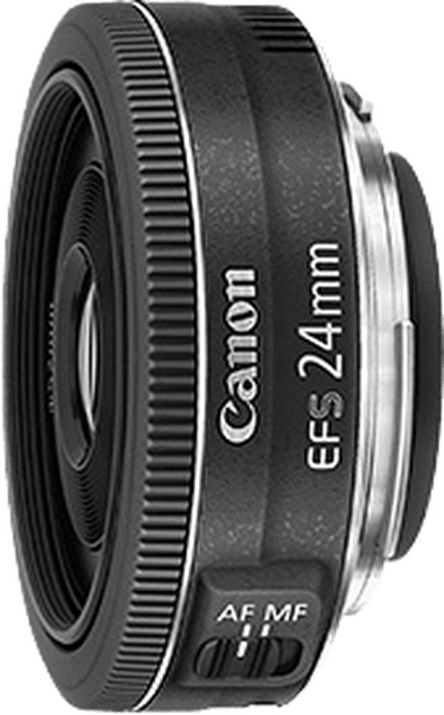
Canon EF-S 24mm F/2.8 STM
Canon · 24 mm · f/2.8
Score Breakdown
This lens score is calculated from published specifications.
General | |
|---|---|
About This LensThe Canon EF-S 24mm F/2.8 STM is a wide-angle prime for Canon's APS-C cameras, and its EF-S mount fits them directly. On the smaller sensor, 24mm gives a moderate wide view rather than a dramatic one. That framing suits street photography, travel, interiors and relaxed groups. Canon launched this lens in 2014, and it is still in production today. The main trade-off is size against flexibility. You get a lens that barely changes the camera's shape, but every shot is framed at one focal length. For photographers who value carrying a camera everywhere, that is often a fair swap. | |
| Brand | Canon |
| Release Year | 2014 |
Production Status ⓘCurrent status of lens manufacturing (e.g., in production, discontinued). |  In Production |
Lens Mount ⓘThe lens mount will tell you what type of lens range you can fit onto the camera body. Often the same camera company will have different lens ranges for different cameras. | Canon EF-S |
System ⓘIndicates which camera system the lens is designed to attach to. | Canon EOS APS-C |
Maximum Format ⓘLargest sensor size compatible with the lens. |  APS-C |
Physical57/100 | |
About the BuildAt 4.4 oz (125 g) and just 0.9 in (22.8 mm) long, this lens is a true pancake. It barely extends past the camera's mount, so the whole outfit stays easy to carry. The 2.69 in (68.2 mm) body width keeps the lens discreet on small cameras. The front accepts 52mm screw-in filters, a handy size for adding a polariser or protective glass. | |
| Lens Weight | 125 g |
Lens Diameter ⓘWidth of the lens at its widest point | 68.2 mm |
Lens Length ⓘHow long the lens is from front to back. | 22.8 mm |
Front Filter Compatible ⓘSome lenses are compatible with front filters, some are compatible with back filters and some are compatible with both. Front filters are usually more convenient to add and remove. |  Yes |
Front Filter Size ⓘDiameter of attachable filters. | 52 mm |
Optics77/100 | |
About the OpticsThe single 24mm focal length sets your working distance. On APS-C it is wide enough for streets, rooms and groups, yet close to a normal view for walk-around shooting. With no zoom you compose by moving, which many street and travel photographers prefer. The maximum aperture is a fixed f/2.8. It admits more light than smaller apertures would, which helps indoors, in cafes and in evening street light. That extra light can help keep shutter speeds usable for handheld work, depending on how much light the scene offers. Do not expect strong background blur. At typical working distances, 24mm at f/2.8 tends to render much of the scene in focus, which suits reportage but limits subject separation. Stopped down, the seven-blade aperture shapes out-of-focus highlights. Close focus is useful for a wide prime. At 0.5 ft (16 cm) you can photograph food, textures and market stalls from right beside them. Maximum magnification reaches 0.27x, so the image on the sensor is roughly a quarter of the subject's real size. Our optics score for this lens is 77 out of 100. | |
Focal Range ⓘShortest to longest focal length of the lens (zoom range start - end ) | 24 mm |
Aperture Range ⓘLargest aperture at the lens's shortest focal length to longest focal length (aperture range start - end) | 2.8 |
| Focal Length Angle of View | 59.1667° |
Flange Focal Distance ⓘDistance from lens mount to sensor. | 44 mm |
Diaphragm Type ⓘStructure and design of the aperture |  Automatic |
Blades ⓘNumber of diaphragm blades in aperture | 7020 |
Zoom Lens ⓘZoom allows you to vary the focal length, change between long shots and close-ups | No |
Closest Focusing Distance ⓘMinimum distance for a subject to be in focus. | 16 cm01500 |
Maximum Magnification ⓘLargest size a subject can be reproduced | 0.27x |
| Autofocus Mode |  Yes |
| Manual Mode |  Yes |
| Manual Focusing Ring |  Yes |
Features0/100 | |
About the FeaturesThere is no image stabilisation in this lens. At 24mm, steady hands often carry you through dim rooms. Video shooters may notice shake, though, unless the camera body itself provides stabilisation. A wall or a small tripod steadies the camera when the light drops further. Weather sealing is absent too, so this is not a lens for rain or dust. There is no fluorine coating on the front glass either. Those omissions matter most if you shoot outdoors in poor conditions. For fair-weather street work, neither gap will slow you down. | |
Weather Sealing ⓘWeather sealing capabilities will give you more confidence when shooting in unfavourable conditions. | No |
Fluorine Coating ⓘCoating to repel water and oil from lens elements. | No |
| Built In Lens Hood | No |
| Lens Hood Type |  Round |
Teleconverter ⓘA teleconverter (extender) is an extra piece of equipment that fits between the lens and the camera body to enhance magnification | No |
| Image Stabilization | No |
Construction15/100 | |
About the ConstructionThe optical layout is simple: six elements in five groups. Canon includes aspherical elements, whose specially shaped surfaces help correct optical faults such as distortion. Distortion can make straight edges appear curved, so that correction matters when you photograph buildings and street corners. Our construction score for this lens is 15 out of 100. | |
Elements ⓘLens elements refer to individual pieces of glass within the lens. | 6 |
| Groups | 5 |
Aspherical Elements ⓘThe number of aspherical lens elements which can help correct aberrations such as spherical aberration. | 1 |
Bi Aspherical Elements ⓘElements with two non-spherical surfaces | 0 |
Low Dispersion ⓘElements that reduce chromatic aberration | 0 |
Super Low Dispersion ⓘAdvanced elements further reducing chromatic aberration | 0 |
CA Reduction ⓘBuilt-in features to reduce chromatic aberration | 0 |
Internal Focusing ⓘInternal Focusing means that the lens does not change in size during focusing, and the front element does not rotate. | No |