
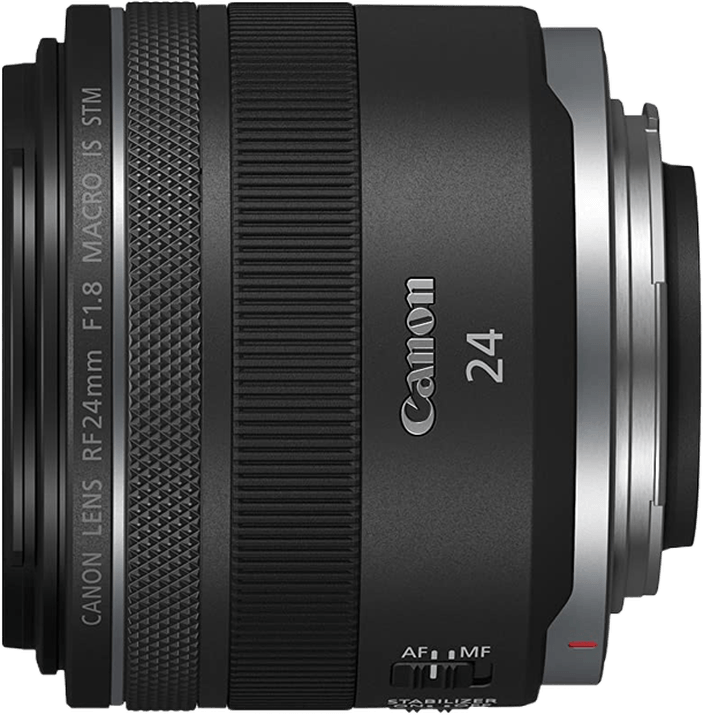
Canon RF 24mm F/1.8 Macro IS STM
Canon · 24 mm · f/1.8 · Image Stabilization
Score Breakdown
This lens score is calculated from published specifications.
General | |
|---|---|
About This LensThis Canon wide-angle prime fits full-frame RF-mount bodies. It suits landscape and architecture work, and it gives environmental portraits room for their setting. Street scenes with context also fit its wide view. Canon introduced the lens in 2022, and it remains in production. The f/1.8 aperture and the light 9.5 oz (270 g) body make it a practical companion for evening work around town. The main trade-off sits in the focal length. At 24mm, backgrounds separate only gently, so it favours pictures led by the scene rather than by a blurred backdrop. Its fixed single focal length keeps the design simple. | |
| Brand | Canon |
| Release Year | 2022 |
Production Status ⓘCurrent status of lens manufacturing (e.g., in production, discontinued). |  In Production |
Lens Mount ⓘThe lens mount will tell you what type of lens range you can fit onto the camera body. Often the same camera company will have different lens ranges for different cameras. | Canon RF |
System ⓘIndicates which camera system the lens is designed to attach to. | Canon EOS R |
Maximum Format ⓘLargest sensor size compatible with the lens. |  Full Frame |
Physical64/100 | |
About the BuildAt 9.5 oz (270 g) and 2.48 in (63.1 mm) long, it adds little weight or bulk to a camera. The 2.93 in (74.4 mm) body width keeps the shape compact. A 52mm front thread accepts common screw-in filters directly. That thread matches a size many photographers already own. | |
| Lens Weight | 270 g |
Lens Diameter ⓘWidth of the lens at its widest point | 74.4 mm |
Lens Length ⓘHow long the lens is from front to back. | 63.1 mm |
Front Filter Compatible ⓘSome lenses are compatible with front filters, some are compatible with back filters and some are compatible with both. Front filters are usually more convenient to add and remove. |  Yes |
Front Filter Size ⓘDiameter of attachable filters. | 52 mm |
Optics86/100 | |
About the OpticsThe 24mm focal length takes in a broad scene from a normal standing distance. That suits tight interiors, building facades and layered landscapes where the setting matters. It also lets a portrait keep the subject's surroundings in the frame. The f/1.8 maximum aperture passes plenty of light for handheld work in dim rooms or at dusk. Wide open, it still keeps generous depth of field at this focal length. Faces stay mostly sharp with their setting, which suits scene-led street and interior pictures. Stopping down a little brings whole rooms into clear focus. Close focusing reaches 0.5 ft (14 cm), so the lens can work near detail without stepping back. The Macro name reflects real close-up intent, but maximum magnification is 0.5x, half life size. That falls short of true 1:1 macro. It suits flowers, food and scene details, not life-size insect frames. The wide view rewards tidy foreground arrangement, because everything from near to far can enter the frame. Up close, depth of field turns shallow even at 24mm, so precise focus placement matters for detail shots. That shallow zone gives close object studies a sense of depth. | |
Focal Range ⓘShortest to longest focal length of the lens (zoom range start - end ) | 24 mm |
Aperture Range ⓘLargest aperture at the lens's shortest focal length to longest focal length (aperture range start - end) | 1.8 |
| Focal Length Angle of View | 84.06668552322992° |
Flange Focal Distance ⓘDistance from lens mount to sensor. | 20 mm |
Diaphragm Type ⓘStructure and design of the aperture |  Automatic |
Blades ⓘNumber of diaphragm blades in aperture | 9020 |
Zoom Lens ⓘZoom allows you to vary the focal length, change between long shots and close-ups | No |
Closest Focusing Distance ⓘMinimum distance for a subject to be in focus. | 14.000000000000002 cm01500 |
Maximum Magnification ⓘLargest size a subject can be reproduced | 0.5x |
| Autofocus Mode |  Yes |
| Manual Mode |  Yes |
| Manual Focusing Ring |  Yes |
Features28/100 | |
About the FeaturesImage stabilisation is built in. It helps hold the camera steady for handheld frames in dim interiors and on evening streets. It also steadies close work, where small hand movements show at 0.5x magnification. That support matters most indoors, where a 24mm lens spends much of its time. Beyond stabilisation, the feature list is thin, and this section scores 28 out of 100. There is no weather sealing, so the lens needs care in rain or dust. There is no fluorine coating, which would otherwise help the front glass shed water and smudges. Keep a cloth handy. | |
Weather Sealing ⓘWeather sealing capabilities will give you more confidence when shooting in unfavourable conditions. | No |
Fluorine Coating ⓘCoating to repel water and oil from lens elements. | No |
| Built In Lens Hood | No |
| Lens Hood Type |  Petal |
Teleconverter ⓘA teleconverter (extender) is an extra piece of equipment that fits between the lens and the camera body to enhance magnification | No |
| Image Stabilization | Yes |
IS Efficiency ⓘIS efficiency refers to the effectiveness of the image stabilization system in compensating for the blurring effects of camera shake, quantified by the number of stops of stabilization it provides. | 5.5 stops |
Construction31/100 | |
About the ConstructionThe optical design includes aspherical surfaces and low-dispersion glass. Aspherical shaping helps correct distortion, which matters when straight architecture lines must stay straight. Low-dispersion glass helps reduce chromatic aberration, where colour fringes appear along high-contrast edges such as bare branches against bright sky. Both features address faults a wide-angle lens commonly shows. | |
Elements ⓘLens elements refer to individual pieces of glass within the lens. | 11 |
| Groups | 9 |
Aspherical Elements ⓘThe number of aspherical lens elements which can help correct aberrations such as spherical aberration. | 1 |
Bi Aspherical Elements ⓘElements with two non-spherical surfaces | 0 |
Low Dispersion ⓘElements that reduce chromatic aberration | 1 |
Super Low Dispersion ⓘAdvanced elements further reducing chromatic aberration | 0 |
CA Reduction ⓘBuilt-in features to reduce chromatic aberration | 0 |
Internal Focusing ⓘInternal Focusing means that the lens does not change in size during focusing, and the front element does not rotate. | No |