
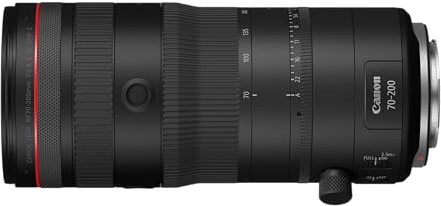
Canon RF 70-200mm F2.8 L IS USM Z
Canon · 70–200 mm · f/2.8 · L · Image Stabilization
Score Breakdown
Scores combine our editorial testing with published lab data.
General | |
|---|---|
About This LensThis 2024 Canon zoom brings a bright 70–200mm range to full-frame RF cameras, and it remains in production. That range suits portraits, indoor sport, stage work and weddings, where you often cannot simply step closer to the subject. Wildlife at moderate distances also fits, though 200mm limits far-off subjects. The trade-off is size. A constant f/2.8 telephoto zoom needs a large optical package, and this one is no exception. It suits photographers who need the brightness at 200mm more than a light carry. | |
| Brand | Canon |
| Release Year | 2024 |
Production Status ⓘCurrent status of lens manufacturing (e.g., in production, discontinued). |  In Production In Production |
Pro Branding ⓘSpecific branding codes used for professional-tier lenses. | L |
Lens Mount ⓘThe lens mount will tell you what type of lens range you can fit onto the camera body. Often the same camera company will have different lens ranges for different cameras. | Canon RF |
System ⓘIndicates which camera system the lens is designed to attach to. | Canon EOS R |
Maximum Format ⓘLargest sensor size compatible with the lens. |  Full Frame Full Frame |
Physical100/100 | |
About the BuildIt weighs 2 lb 7.2 oz (1110 g) and measures 7.83 in (199 mm) long and 3.48 in (88.5 mm) wide. That bulk is noticeable on long handheld days. A screw-in filter must match the 82mm thread on the front. | |
| Lens Weight | 1110 g |
Lens Diameter ⓘWidth of the lens at its widest point | 88.5 mm |
Lens Length ⓘHow long the lens is from front to back. | 199 mm |
Front Filter Compatible ⓘSome lenses are compatible with front filters, some are compatible with back filters and some are compatible with both. Front filters are usually more convenient to add and remove. |  Yes Yes |
Front Filter Size ⓘDiameter of attachable filters. | 82 mm |
Optics83/100 | |
About the OpticsThe zoom makes distant subjects larger and lets you reframe without moving. At 200mm a striker, an actor on stage or a bride across a crowded room fills the frame. Zoom out to 70mm for a full-length portrait, or to keep following action that drifts toward you. The f/2.8 maximum stays constant through the zoom, so the light reaching the sensor never drops as you zoom in. In a dim arena or evening reception this keeps shutter speeds workable. At 200mm the wide aperture also blurs backgrounds strongly, lifting a subject off busy surroundings. Depth of field is not constant, though: at the same f/2.8 it runs much shallower at 200mm than at 70mm. Eleven aperture blades help keep out-of-focus highlights round when you stop down. Close focus is 1.6 ft (49 cm) at 70mm, and the minimum distance grows at 200mm. Even so, the long end reaches 0.3x magnification, enough to fill the frame with a bouquet or a small award. The longer working distance at 200mm also suits nervous animals or discreet ceremony shots. | |
Focal Range ⓘShortest to longest focal length of the lens (zoom range start - end ) | 70–200 mm |
Aperture Range ⓘLargest aperture at the lens's shortest focal length to longest focal length (aperture range start - end) | 2.8 |
| Focal Length Angle of View | 34°–12° |
Flange Focal Distance ⓘDistance from lens mount to sensor. | 20 mm |
Diaphragm Type ⓘStructure and design of the aperture |  Automatic Automatic |
Blades ⓘNumber of diaphragm blades in aperture | 11020 |
Zoom Lens ⓘZoom allows you to vary the focal length, change between long shots and close-ups |  Yes Yes |
Zoom Mechanism ⓘSystem enabling zoom function |  Manual Manual |
Zoom Ring ⓘIf zooming is adjusted using a zoom ring |  Yes Yes |
Zoom Type ⓘThe design or approach to zooming |  Rotary Rotary |
Closest Focusing Distance ⓘMinimum distance for a subject to be in focus. | 49 cm01500 |
Maximum Magnification ⓘLargest size a subject can be reproduced | 0.3x |
| Autofocus Mode |  Yes Yes |
| Manual Mode |  Yes Yes |
| Manual Focusing Ring |  Yes Yes |
Features99/100 | |
About the FeaturesImage stabilisation provides 5.5 stops, a strong figure for a stabilised telephoto zoom of this kind. It steadies the camera at slower shutter speeds, making handheld work in dim venues practical. It counters camera shake rather than subject motion, so a sprinting player still needs a fast shutter. Shake shows more at 200mm, so the help matters most at the long end. For static subjects such as portraits, speeches or perched birds, it can replace a tripod. Weather sealing helps keep rain and dust out during outdoor matches and wildlife walks. A fluorine coating on the front glass helps water and grime release, so cleaning after a wet day is quick. | |
Weather Sealing ⓘWeather sealing capabilities will give you more confidence when shooting in unfavourable conditions. |  Yes Yes |
Fluorine Coating ⓘCoating to repel water and oil from lens elements. |  Yes Yes |
| Built In Lens Hood | No |
| Lens Hood Type |  Round Round |
Zoom Lock ⓘZoom lock allows the zoom ring to be locked at the desired focal length | No |
Teleconverter ⓘA teleconverter (extender) is an extra piece of equipment that fits between the lens and the camera body to enhance magnification |  Yes Yes |
| Image Stabilization | Yes |
IS Efficiency ⓘIS efficiency refers to the effectiveness of the image stabilization system in compensating for the blurring effects of camera shake, quantified by the number of stops of stabilization it provides. | 5.5 stops |
Construction56/100 | |
About the ConstructionThree aspherical elements help correct optical faults, including distortion and spherical aberration, which helps when backgrounds hold railings or court lines. Three low-dispersion elements, two of them Super UD, help reduce coloured fringes. Those fringes can appear along high-contrast edges, such as a player lit against dark stands. | |
Elements ⓘLens elements refer to individual pieces of glass within the lens. | 18 |
| Groups | 15 |
Aspherical Elements ⓘThe number of aspherical lens elements which can help correct aberrations such as spherical aberration. | 3 |
Bi Aspherical Elements ⓘElements with two non-spherical surfaces | 0 |
Low Dispersion ⓘElements that reduce chromatic aberration | 3 |
Super Low Dispersion ⓘAdvanced elements further reducing chromatic aberration | 2 |
CA Reduction ⓘBuilt-in features to reduce chromatic aberration | 0 |
Internal Focusing ⓘInternal Focusing means that the lens does not change in size during focusing, and the front element does not rotate. |  Yes Yes |