
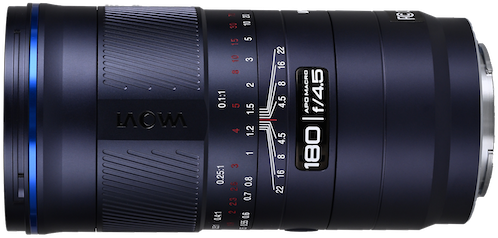
Laowa 180mm f/4.5 1.5X Ultra Macro APO
Laowa · 180 mm · f/4.5
Score Breakdown
This lens score is calculated from published specifications.
General | |
|---|---|
About This LensThis 180mm macro prime is built for extreme close-ups of insects, flowers and other small natural subjects. Its 1.5x magnification records detail beyond life size. The long focal length also adds working distance between you and a wary subject. The trade-off is speed. The f/4.5 maximum aperture admits less light than faster primes, and there is no stabilisation, so plan on support and extra light in dim conditions. Laowa released the lens in 2025, and it remains in production. Versions are made for Sony E, Canon EF, Canon RF, Fujifilm X, Leica L and Nikon Z, so choose the version matching your camera. The Sony E version covers full frame. | |
| Brand | Laowa |
| Release Year | 2025 |
Lens Mount ⓘThe lens mount will tell you what type of lens range you can fit onto the camera body. Often the same camera company will have different lens ranges for different cameras. | Nikon Z |
System ⓘIndicates which camera system the lens is designed to attach to. | Nikon Z |
Physical64/100 | |
About the BuildThe Sony E version weighs 1 lb 2.4 oz (521 g) and measures 5.29 in (134.4 mm) long, a moderate package for a 180mm prime. The front takes 62mm screw-in filters, and any filter must match that thread to fit directly. | |
Lens Diameter ⓘWidth of the lens at its widest point | 68 mm |
Lens Length ⓘHow long the lens is from front to back. | 134 mm |
Front Filter Compatible ⓘSome lenses are compatible with front filters, some are compatible with back filters and some are compatible with both. Front filters are usually more convenient to add and remove. |  Yes |
Front Filter Size ⓘDiameter of attachable filters. | 62 mm |
Optics70/100 | |
About the OpticsThe 180mm focal length does the close-up work here. It frames small subjects from farther away than a short macro lens allows. Easily startled insects like butterflies and dragonflies stay easier to photograph at that distance. The extra clearance also keeps your shadow and lighting gear out of the scene. The lens focuses as close as 1 ft (30 cm). That nearest focus and the 1.5x peak are separate figures, not one setting. Magnification reaches 1.5x. True macro is 1:1, meaning life size on the sensor, and this lens goes half as far again. A subject a few mm across can fill the frame. Expect razor-thin depth of field at that scale, where a tiny focus error blurs the subject. Focus stacking is the usual route when you need more depth. The fixed f/4.5 aperture sets the light budget. Indoors or in forest shade you will raise ISO or add flash. Daylit meadows and gardens rarely cause trouble. Used at ordinary distances for portraits or details, 180mm at f/4.5 still separates the subject from a busy background. Still-life shooters can also use it when there is room to back away. | |
Focal Range ⓘShortest to longest focal length of the lens (zoom range start - end ) | 180 mm |
Aperture Range ⓘLargest aperture at the lens's shortest focal length to longest focal length (aperture range start - end) | 4.5 |
| Focal Length Angle of View | 13.7° |
Flange Focal Distance ⓘDistance from lens mount to sensor. | 16 mm |
Diaphragm Type ⓘStructure and design of the aperture |  Automatic |
Blades ⓘNumber of diaphragm blades in aperture | 9020 |
Zoom Lens ⓘZoom allows you to vary the focal length, change between long shots and close-ups | No |
Closest Focusing Distance ⓘMinimum distance for a subject to be in focus. | 30 cm01500 |
Maximum Magnification ⓘLargest size a subject can be reproduced | 1.5x |
| Autofocus Mode |  Yes |
| Manual Mode |  Yes |
| Manual Focusing Ring |  Yes |
Features0/100 | |
About the FeaturesThere is no built-in stabilisation. At 1.5x magnification, even small camera movements show up strongly in the frame. A tripod, focusing rail or other firm support does the steadying work. That support holds the camera steady; it cannot hold a live subject still. There is no weather sealing. For dewy morning grass or humid woodland, keep the lens dry and shield it from dust yourself. The front element also lacks a fluorine coating, which would have helped shed water and oil, so marks need more patient cleaning. A flash setup can supply the light the f/4.5 aperture misses. | |
Weather Sealing ⓘWeather sealing capabilities will give you more confidence when shooting in unfavourable conditions. | No |
Fluorine Coating ⓘCoating to repel water and oil from lens elements. | No |
| Built In Lens Hood | No |
| Lens Hood Type |  Round |
Teleconverter ⓘA teleconverter (extender) is an extra piece of equipment that fits between the lens and the camera body to enhance magnification | No |
| Image Stabilization | No |
Construction38/100 | |
About the ConstructionThe 12 elements in 9 groups include two low-dispersion elements. Low-dispersion glass helps reduce chromatic aberration, where different colours focus differently and leave coloured fringes along high-contrast edges. Those edges appear readily at high magnification, on shiny beetle shells or dew-lit grass stems. The APO name in the title states the same correction goal. | |
Elements ⓘLens elements refer to individual pieces of glass within the lens. | 12 |
| Groups | 9 |
Aspherical Elements ⓘThe number of aspherical lens elements which can help correct aberrations such as spherical aberration. | 0 |
Bi Aspherical Elements ⓘElements with two non-spherical surfaces | 0 |
Low Dispersion ⓘElements that reduce chromatic aberration | 2 |
Super Low Dispersion ⓘAdvanced elements further reducing chromatic aberration | 0 |
CA Reduction ⓘBuilt-in features to reduce chromatic aberration | 0 |
Internal Focusing ⓘInternal Focusing means that the lens does not change in size during focusing, and the front element does not rotate. |  Yes |