
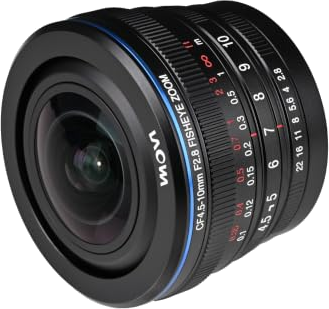
Laowa 4.5-10mm f/2.8 CF Fisheye
Laowa · 4.5–10 mm · f/2.8
Score Breakdown
Scores combine our editorial testing with published lab data.
43
SCORE /100
What We Like
+Unique dual fisheye design—circular at 4.5mm and diagonal at 10mm, offering two distinct creative looks
+Constant f/2.8 aperture throughout zoom range for consistent exposure and low-light capability
+Exceptionally compact at 338g and 68.9 x 59.3mm—ideal for travel, handheld, gimbal, and FPV use
+True parfocal lens maintains focus throughout zoom range for seamless video transitions without refocusing
+Very close 10cm minimum focus distance enables exaggerated perspective and foreground emphasis
+Affordable at $399 for a compact parfocal zoom fisheye with wide availability across multiple mounts
Worth Knowing
−Manual focus only with no electrical contacts—requires manual focus activation, no EXIF aperture data recorded, slows operation compared to autofocus
−No filter thread due to bulging front element, limiting protective and creative filter options
−Extreme ultra-wide field of view can result in photographer's own body parts appearing in frame, requiring careful composition
−APS-C/MFT-only image circle—on full-frame cameras requires crop mode and loses the 180° circular effect
General | |
|---|---|
About This LensThe Laowa 4.5-10mm f/2.8 CF Zoom Fisheye is a compact parfocal zoom lens designed for creators who want to capture the world uniquely. It transitions smoothly from a dramatic circular fisheye effect at 4.5mm to an immersive diagonal fisheye perspective at 10mm, offering an 180° ultra-wide field of view, a constant f/2.8 aperture, and close focusing capability. Lightweight at 330g with constant f/2.8 and close focusing, it excels at distinctive in-camera effects across multiple mounts at $399. The manual focus operation does slow things down and an inaccurate distance scale is a real black mark against a lens that otherwise feels really well made. | |
| Brand | Laowa |
| Release Year | 2026 |
Production Status ⓘCurrent status of lens manufacturing (e.g., in production, discontinued). |  In Production In Production |
Lens Mount ⓘThe lens mount will tell you what type of lens range you can fit onto the camera body. Often the same camera company will have different lens ranges for different cameras. | Sony E |
System ⓘIndicates which camera system the lens is designed to attach to. | Sony E APS-C |
Maximum Format ⓘLargest sensor size compatible with the lens. |  APS-C APS-C |
Physical50/100 | |
| Lens Weight | 338 g |
Lens Diameter ⓘWidth of the lens at its widest point | 68.9 mm |
Lens Length ⓘHow long the lens is from front to back. | 59.3 mm |
Front Filter Compatible ⓘSome lenses are compatible with front filters, some are compatible with back filters and some are compatible with both. Front filters are usually more convenient to add and remove. | No |
Optics63/100 | |
Focal Range ⓘShortest to longest focal length of the lens (zoom range start - end ) | 4.5–10 mm |
Aperture Range ⓘLargest aperture at the lens's shortest focal length to longest focal length (aperture range start - end) | 2.8 |
Flange Focal Distance ⓘDistance from lens mount to sensor. | 18 mm |
Diaphragm Type ⓘStructure and design of the aperture |  Manual Manual |
Blades ⓘNumber of diaphragm blades in aperture | 7020 |
Zoom Lens ⓘZoom allows you to vary the focal length, change between long shots and close-ups |  Yes Yes |
Zoom Mechanism ⓘSystem enabling zoom function |  Manual Manual |
Zoom Ring ⓘIf zooming is adjusted using a zoom ring |  Yes Yes |
Zoom Type ⓘThe design or approach to zooming |  Rotary Rotary |
Closest Focusing Distance ⓘMinimum distance for a subject to be in focus. | 10 cm01500 |
Maximum Magnification ⓘLargest size a subject can be reproduced | 0.27x |
| Autofocus Mode | No |
| Manual Mode |  Yes Yes |
| Manual Focusing Ring |  Yes Yes |
Features | |
Weather Sealing ⓘWeather sealing capabilities will give you more confidence when shooting in unfavourable conditions. | No |
Fluorine Coating ⓘCoating to repel water and oil from lens elements. | No |
| Built In Lens Hood | No |
Zoom Lock ⓘZoom lock allows the zoom ring to be locked at the desired focal length | No |
Teleconverter ⓘA teleconverter (extender) is an extra piece of equipment that fits between the lens and the camera body to enhance magnification | No |
| Image Stabilization | No |
Construction15/100 | |
Elements ⓘLens elements refer to individual pieces of glass within the lens. | 13 |
| Groups | 9 |
Bi Aspherical Elements ⓘElements with two non-spherical surfaces | 0 |
Low Dispersion ⓘElements that reduce chromatic aberration | 4 |
Super Low Dispersion ⓘAdvanced elements further reducing chromatic aberration | 0 |
CA Reduction ⓘBuilt-in features to reduce chromatic aberration | 0 |
Internal Focusing ⓘInternal Focusing means that the lens does not change in size during focusing, and the front element does not rotate. | No |