
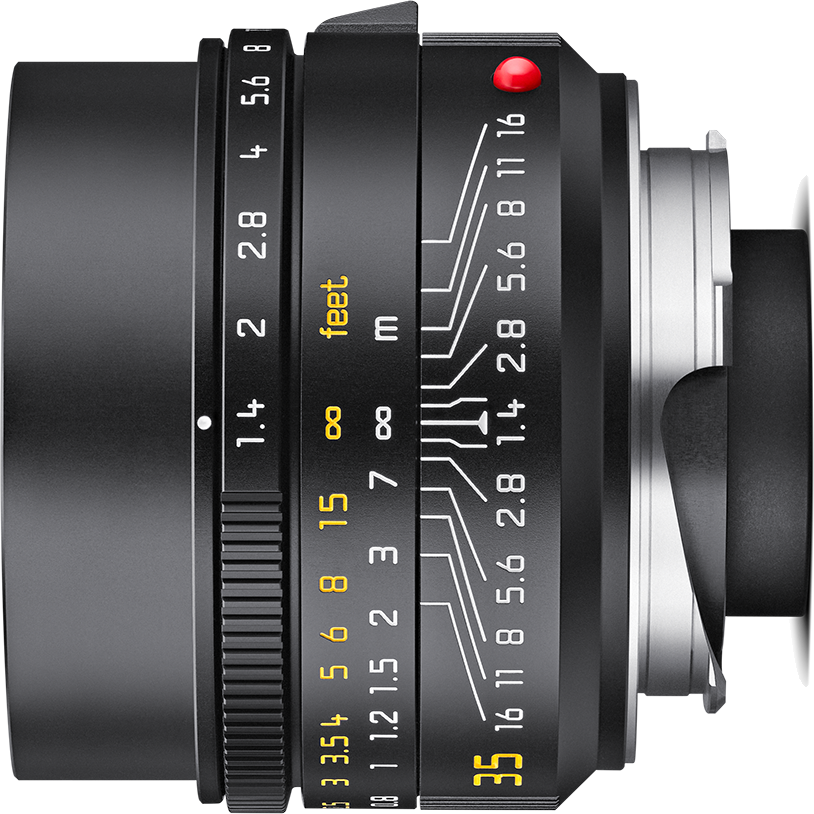
Leica Summilux-M 35mm f/1.4 ASPH.
Leica · 35 mm · f/1.4
Score Breakdown
Scores combine our editorial testing with published lab data.
General | |
|---|---|
About This LensLeica launched this 35mm f/1.4 prime in 2022 for the M mount, and it covers full frame. It is a recent design rather than a carry-over from an older generation. One fixed focal length and a bright aperture make it a natural fit for street photography, reportage and travel. It also suits environmental portraits, where a person and their surroundings share the frame. Framing changes only as you move. The trade-off is convenience. Focusing is manual, there is no stabilisation, and the body is not sealed against dust or moisture. In return you get a compact, simple lens that rewards a deliberate, unhurried way of working. | |
| Brand | Leica |
| Release Year | 2022 |
Version ⓘThe iteration or release number of a particular lens model. | I |
Lens Mount ⓘThe lens mount will tell you what type of lens range you can fit onto the camera body. Often the same camera company will have different lens ranges for different cameras. | Leica M |
System ⓘIndicates which camera system the lens is designed to attach to. | Leica M |
Maximum Format ⓘLargest sensor size compatible with the lens. |  Full Frame |
Physical64/100 | |
About the BuildThe lens weighs 11.9 oz (338 g) and measures just 1.81 in (46 mm) long and 2.28 in (58 mm) wide. That is a small, light package, so an M camera stays easy to carry all day. It also accepts screw-in filters, which must match the 46mm thread. | |
| Lens Weight | 338 g |
Lens Diameter ⓘWidth of the lens at its widest point | 58 mm |
Lens Length ⓘHow long the lens is from front to back. | 46 mm |
Front Filter Compatible ⓘSome lenses are compatible with front filters, some are compatible with back filters and some are compatible with both. Front filters are usually more convenient to add and remove. |  Yes |
Front Filter Size ⓘDiameter of attachable filters. | 46 mm |
Optics75/100 | |
About the OpticsThe 35mm focal length sits between wide and normal on a full-frame camera. The view has only a mild wide bias, so scenes look natural, which suits candid street work and reportage. Faces keep their proportions when you step closer for a portrait. The frame still holds enough surroundings to give a subject context. The f/1.4 aperture is the main reason to choose this lens over slower options. It lets you shoot handheld in dim restaurants, galleries and evening streets without pushing ISO too far. Opened wide, it also gives a shallow depth of field that lifts a subject away from a busy background. Eleven aperture blades help keep the opening round when you stop down. Out-of-focus highlights then stay smooth rather than angular, which flatters portraits and night street scenes. The lens focuses as close as 1.3 ft (40 cm), enough for a plate on a table or a market detail. Focusing is manual, with no autofocus motor. The ring gives direct control over where the plane of focus sits, which matters at f/1.4, where the sharp zone is thin. | |
Focal Range ⓘShortest to longest focal length of the lens (zoom range start - end ) | 35 mm |
Aperture Range ⓘLargest aperture at the lens's shortest focal length to longest focal length (aperture range start - end) | 1.4 |
| Focal Length Angle of View | 62.5° |
Flange Focal Distance ⓘDistance from lens mount to sensor. | 27.8 mm |
Diaphragm Type ⓘStructure and design of the aperture |  Manual |
Blades ⓘNumber of diaphragm blades in aperture | 11020 |
Zoom Lens ⓘZoom allows you to vary the focal length, change between long shots and close-ups | No |
Closest Focusing Distance ⓘMinimum distance for a subject to be in focus. | 40 cm01500 |
Maximum Magnification ⓘLargest size a subject can be reproduced | 0.11x |
| Autofocus Mode | No |
| Manual Mode |  Yes |
| Manual Focusing Ring |  Yes |
Features | |
About the FeaturesThere is no image stabilisation. At 35mm you can use fairly slow shutter speeds handheld before shake appears. In very dim light, raise the ISO or steady the camera against a doorframe or table. The body is not weather sealed, so heavy rain and sea spray are best avoided. There is no fluorine coating on the front element either. Smudges and rain spots will not shed on their own, so carry a cloth and clean gently. As a fixed prime, the lens has no zoom ring or autofocus electronics. That keeps the design simple and the body slim, and it leaves the aperture and focus rings as the only controls you need. | |
Weather Sealing ⓘWeather sealing capabilities will give you more confidence when shooting in unfavourable conditions. | No |
Fluorine Coating ⓘCoating to repel water and oil from lens elements. | No |
| Built In Lens Hood |  Yes |
| Lens Hood Type |  Round |
Teleconverter ⓘA teleconverter (extender) is an extra piece of equipment that fits between the lens and the camera body to enhance magnification | No |
| Image Stabilization | No |
Construction15/100 | |
About the ConstructionNine elements sit in five groups, and one of them is aspherical. A specially shaped surface like this helps correct distortion and spherical aberration. That correction is useful for a 35mm lens that frames buildings, doorways and street furniture alongside people. | |
Elements ⓘLens elements refer to individual pieces of glass within the lens. | 9 |
| Groups | 5 |
Aspherical Elements ⓘThe number of aspherical lens elements which can help correct aberrations such as spherical aberration. | 1 |
Bi Aspherical Elements ⓘElements with two non-spherical surfaces | 0 |
Low Dispersion ⓘElements that reduce chromatic aberration | 0 |
Super Low Dispersion ⓘAdvanced elements further reducing chromatic aberration | 0 |
CA Reduction ⓘBuilt-in features to reduce chromatic aberration | 0 |
Internal Focusing ⓘInternal Focusing means that the lens does not change in size during focusing, and the front element does not rotate. | No |