
Meike AF 50mm f/1.8
Meike · 50 mm · f/1.8
Score Breakdown
This lens score is calculated from published specifications.
General | |
|---|---|
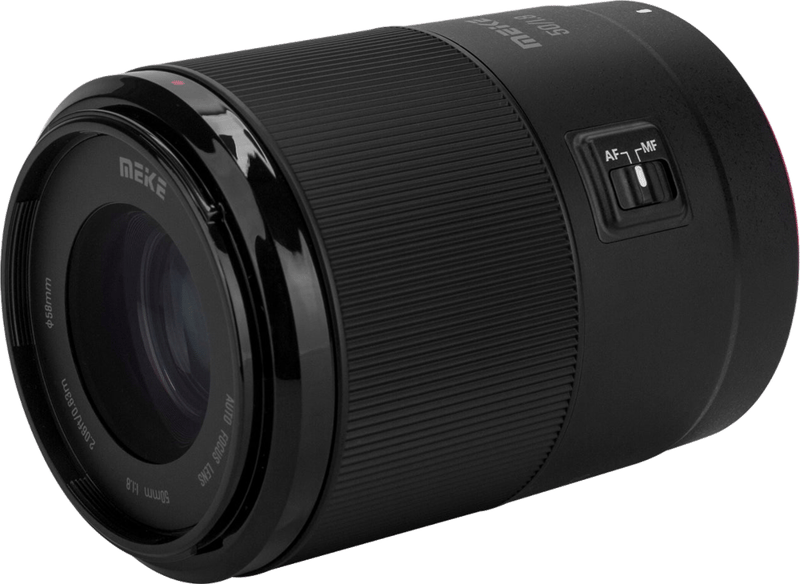
About This LensThe Meike AF 50mm f/1.8 is a standard prime for mirrorless cameras, launched in 2024 and still in production. It comes in Sony E, Nikon Z and Leica L mounts, so pick the version made for your camera. The Sony E version covers full-frame sensors. A 50mm prime suits portraits, street photography and everyday pictures of family and friends. The bright f/1.8 aperture works in dim light. Framing is fixed, so you move closer or further back to change the composition. The trade-off is the plain feature set. There is no stabilisation, weather sealing or fluorine coating. The lens leans on its bright aperture and low weight instead. | |
| Brand | Meike |
| Release Year | 2024 |
Production Status ⓘCurrent status of lens manufacturing (e.g., in production, discontinued). |  In Production |
Lens Mount ⓘThe lens mount will tell you what type of lens range you can fit onto the camera body. Often the same camera company will have different lens ranges for different cameras. | Sony E |
System ⓘIndicates which camera system the lens is designed to attach to. | Sony E |
Maximum Format ⓘLargest sensor size compatible with the lens. |  Full Frame |
Physical64/100 | |
About the BuildThe lens weighs 13.5 oz (382 g), light enough to carry all day. It measures 2.87 in (73 mm) across, and the Sony E version is 4.02 in (102 mm) long. A screw-in filter attaches directly to the 58mm thread, so any polariser or ND filter must match that size. | |
| Lens Weight | 382 g |
Lens Diameter ⓘWidth of the lens at its widest point | 73 mm |
Lens Length ⓘHow long the lens is from front to back. | 102 mm |
Front Filter Compatible ⓘSome lenses are compatible with front filters, some are compatible with back filters and some are compatible with both. Front filters are usually more convenient to add and remove. |  Yes |
Front Filter Size ⓘDiameter of attachable filters. | 58 mm |
Optics85/100 | |
About the OpticsThe 50mm focal length gives the standard view on a full-frame Sony E body. It frames one person comfortably at portrait distance, and it captures street scenes, interiors and gatherings with a natural sense of space. The f/1.8 maximum aperture is the main photographic draw. Wide open, the lens lets you photograph indoors without flash and keep working as light fades. It also produces shallow depth of field at portrait distance, so a face stands out from a cluttered background. Nine aperture blades keep the opening close to round as you stop down. Out-of-focus highlights then hold a smooth shape instead of obvious edges. That helps evening portraits, where distant street lights fill the background. Closest focus sits at 2.1 ft (63 cm), enough for tight head-and-shoulders portraits and detail shots at table distance. That range keeps a friendly gap from a seated subject, which helps relaxed expressions. The optics specification scores 85 out of 100 here. | |
Focal Range ⓘShortest to longest focal length of the lens (zoom range start - end ) | 50 mm |
Aperture Range ⓘLargest aperture at the lens's shortest focal length to longest focal length (aperture range start - end) | 1.8 |
| Focal Length Angle of View | 46.4° |
Flange Focal Distance ⓘDistance from lens mount to sensor. | 18 mm |
Diaphragm Type ⓘStructure and design of the aperture |  Automatic |
Blades ⓘNumber of diaphragm blades in aperture | 9020 |
Zoom Lens ⓘZoom allows you to vary the focal length, change between long shots and close-ups | No |
Closest Focusing Distance ⓘMinimum distance for a subject to be in focus. | 63 cm01500 |
| Autofocus Mode |  Yes |
| Manual Mode |  Yes |
| Manual Focusing Ring |  Yes |
Features0/100 | |
About the FeaturesThere is no stabilisation in this lens. For handheld shots you depend on shutter speed, a steady hold, or in-body stabilisation where your camera provides it. The gap shows up most when you stop down in dim light, because you must then use a slower shutter speed. Weather sealing is absent, so keep the lens covered in rain, spray or dust. The front element also lacks a fluorine coating, so mist and fingerprints need a gentler, more patient wipe. A 58mm protective filter can shield the front glass in rough conditions. | |
Weather Sealing ⓘWeather sealing capabilities will give you more confidence when shooting in unfavourable conditions. | No |
Fluorine Coating ⓘCoating to repel water and oil from lens elements. | No |
| Built In Lens Hood | No |
| Lens Hood Type |  Petal |
Teleconverter ⓘA teleconverter (extender) is an extra piece of equipment that fits between the lens and the camera body to enhance magnification | No |
| Image Stabilization | No |
Construction38/100 | |
About the ConstructionInside are 11 elements in 7 groups, including one low-dispersion element. Low-dispersion glass helps reduce chromatic aberration, the coloured fringing that shows up along high-contrast edges when colours focus differently. This can matter for backlit portraits, where bright sky rims a shoulder or hair. No aspherical elements feature in the design, and the construction specification scores 38 out of 100 here. Focusing is internal on the Sony E version, so the barrel keeps a constant length. | |
Elements ⓘLens elements refer to individual pieces of glass within the lens. | 11 |
| Groups | 7 |
Aspherical Elements ⓘThe number of aspherical lens elements which can help correct aberrations such as spherical aberration. | 0 |
Bi Aspherical Elements ⓘElements with two non-spherical surfaces | 0 |
Low Dispersion ⓘElements that reduce chromatic aberration | 1 |
Super Low Dispersion ⓘAdvanced elements further reducing chromatic aberration | 0 |
CA Reduction ⓘBuilt-in features to reduce chromatic aberration | 0 |
Internal Focusing ⓘInternal Focusing means that the lens does not change in size during focusing, and the front element does not rotate. |  Yes |