
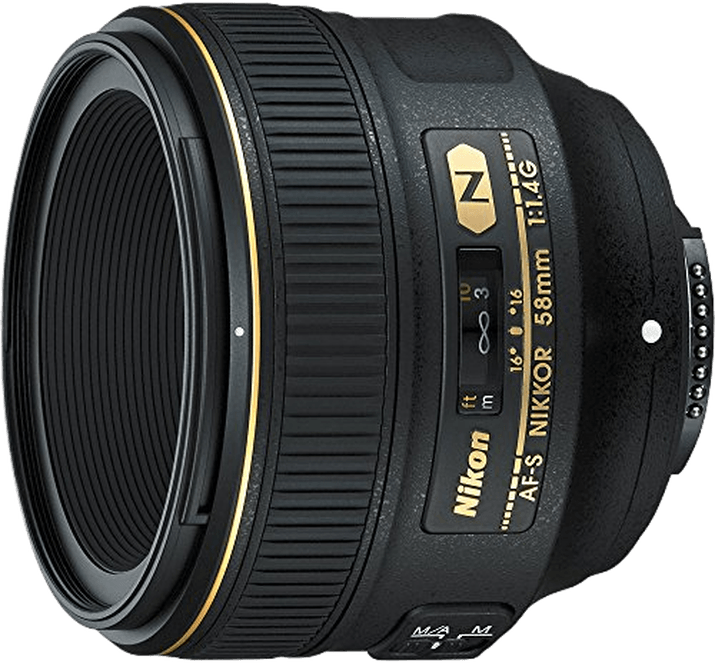
Nikon AF-S NIKKOR 58mm F/1.4G
Nikon · 58 mm · f/1.4
Score Breakdown
This lens score is calculated from published specifications.
General | |
|---|---|
About This LensThis Nikon prime pairs a 58mm focal length with an f/1.4 aperture for full-frame F-mount photographers. That combination suits portraits, street work and dim interiors, where the wide aperture carries most of the load. The 58mm length sits just above a standard normal lens. It gives portraits a little extra reach while keeping a natural perspective for everyday scenes. The trade-off is a plain feature set. There is no stabilization or fluorine coating, and the design dates from 2013, though Nikon still builds it. Buyers choose it for the bright aperture and handy length rather than a long spec list. | |
| Brand | Nikon |
| Release Year | 2013 |
Production Status ⓘCurrent status of lens manufacturing (e.g., in production, discontinued). |  In Production |
Lens Mount ⓘThe lens mount will tell you what type of lens range you can fit onto the camera body. Often the same camera company will have different lens ranges for different cameras. | Nikon F |
System ⓘIndicates which camera system the lens is designed to attach to. | Nikon F |
Maximum Format ⓘLargest sensor size compatible with the lens. |  Full Frame |
Physical64/100 | |
About the BuildAt 13.6 oz (385 g) and 2.76 in (70 mm) long, this is a small, light prime that is easy to carry all day. The 3.35 in (85 mm) diameter stays modest for a fast lens. The front accepts screw-in filters at 72mm, so any filter attached directly must match that thread. | |
| Lens Weight | 385 g |
Lens Diameter ⓘWidth of the lens at its widest point | 85 mm |
Lens Length ⓘHow long the lens is from front to back. | 70 mm |
Front Filter Compatible ⓘSome lenses are compatible with front filters, some are compatible with back filters and some are compatible with both. Front filters are usually more convenient to add and remove. |  Yes |
Front Filter Size ⓘDiameter of attachable filters. | 72 mm |
Optics87/100 | |
About the OpticsOn a full-frame body, 58mm suits head-and-shoulder portraits and tightens street scenes slightly. The perspective stays natural for both. The f/1.4 maximum aperture is the main strength. It admits about four times the light of a typical f/2.8 zoom at its widest, which helps in evening streets, restaurants and window-lit rooms. You can often keep sensitivity low as light falls. Wide open, depth of field is very shallow. A subject separates cleanly from a busy background, though focus placement becomes critical, especially on the eyes in a portrait. Set f/2.8 or f/4 and more of a face comes into focus. Nine blades help out-of-focus highlights stay round when you stop down. At middle apertures, the lens behaves like a standard prime for reportage. Closest focus is 1.9 ft (58 cm), enough for half-length portraits and still-life details. The extra reach over a normal lens also lets you work a touch farther back with a sitter. These optical specifications score 87 out of 100. | |
Focal Range ⓘShortest to longest focal length of the lens (zoom range start - end ) | 58 mm |
Aperture Range ⓘLargest aperture at the lens's shortest focal length to longest focal length (aperture range start - end) | 1.4 |
| Focal Length Angle of View | 40.91276517663726° |
Flange Focal Distance ⓘDistance from lens mount to sensor. | 46.5 mm |
Diaphragm Type ⓘStructure and design of the aperture |  Automatic |
Blades ⓘNumber of diaphragm blades in aperture | 9020 |
Zoom Lens ⓘZoom allows you to vary the focal length, change between long shots and close-ups | No |
Closest Focusing Distance ⓘMinimum distance for a subject to be in focus. | 57.99999999999999 cm01500 |
Maximum Magnification ⓘLargest size a subject can be reproduced | 0.13x |
| Autofocus Mode |  Yes |
| Manual Mode |  Yes |
| Manual Focusing Ring |  Yes |
Features32/100 | |
About the FeaturesWeather sealing guards the lens against dust and moisture, so light rain or a dusty trail need not end a shoot. It is the standout feature in a short list. There is no image stabilization. Camera shake matters less at 58mm than on a long telephoto, so the omission bites less here. Handheld work in poor light still loses margin, and a steady stance or faster shutter helps. Daytime shooters may never notice. The front glass has no fluorine coating, so fingerprints and water marks take more deliberate cleaning. A lens cloth in the bag covers it. The features score here is 32. | |
Weather Sealing ⓘWeather sealing capabilities will give you more confidence when shooting in unfavourable conditions. |  Yes |
Fluorine Coating ⓘCoating to repel water and oil from lens elements. | No |
| Built In Lens Hood | No |
| Lens Hood Type |  Petal |
Teleconverter ⓘA teleconverter (extender) is an extra piece of equipment that fits between the lens and the camera body to enhance magnification | No |
| Image Stabilization | No |
Construction15/100 | |
About the ConstructionThe build uses 9 elements in 6 groups and includes aspherical elements. These specially shaped surfaces help correct optical faults such as distortion and spherical aberration. That correction matters when straight edges, like doorframes or horizons, sit behind a portrait subject. The construction score here is 15 out of 100. | |
Elements ⓘLens elements refer to individual pieces of glass within the lens. | 9 |
| Groups | 6 |
Aspherical Elements ⓘThe number of aspherical lens elements which can help correct aberrations such as spherical aberration. | 1 |
Bi Aspherical Elements ⓘElements with two non-spherical surfaces | 0 |
Low Dispersion ⓘElements that reduce chromatic aberration | 0 |
Super Low Dispersion ⓘAdvanced elements further reducing chromatic aberration | 0 |
CA Reduction ⓘBuilt-in features to reduce chromatic aberration | 0 |
Internal Focusing ⓘInternal Focusing means that the lens does not change in size during focusing, and the front element does not rotate. | No |