
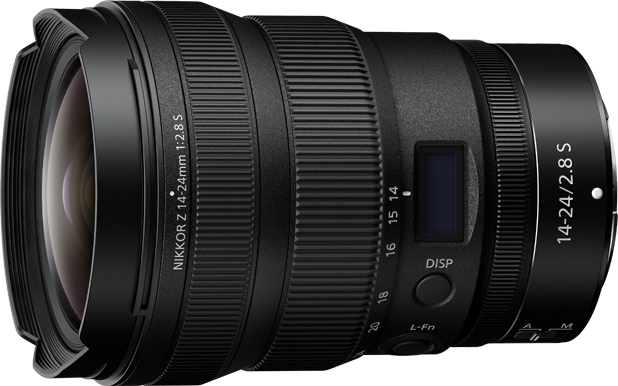
Nikon NIKKOR Z 14-24mm F/2.8 S
Nikon · 14–24 mm · f/2.8 · S-Line
Score Breakdown
Scores combine our editorial testing with published lab data.
General | |
|---|---|
About This LensThis Nikon ultra-wide zoom covers 14–24mm for full-frame Nikon Z cameras. It suits landscape, architecture and interior photographers who must fit a broad scene from a fixed position. The fast constant aperture also serves night-sky work. Nikon introduced the lens in 2020. Distant animals and players can occupy little of the frame from a remote viewpoint. Check whether the wide view fits your intended subjects. The lens has no built-in stabilisation. It can complement a standard zoom when you need a wider view. Choose your position carefully, because including more of a scene can also bring unwanted foreground objects into the picture. | |
| Brand | Nikon |
| Release Year | 2020 |
Production Status ⓘCurrent status of lens manufacturing (e.g., in production, discontinued). |  In Production In Production |
Pro Branding ⓘSpecific branding codes used for professional-tier lenses. | S-Line |
Lens Mount ⓘThe lens mount will tell you what type of lens range you can fit onto the camera body. Often the same camera company will have different lens ranges for different cameras. | Nikon Z |
System ⓘIndicates which camera system the lens is designed to attach to. | Nikon Z |
Maximum Format ⓘLargest sensor size compatible with the lens. |  Full Frame Full Frame |
Physical100/100 | |
About the BuildThe lens weighs 1 lb 6.9 oz (650 g) and measures 3.48 in (88.5 mm) across and 4.9 in (124.5 mm) long. Its HB-97 hood accepts 112mm screw-in filters. They attach to the hood, rather than directly to the lens barrel. Check that the hood and filter are fitted securely before using a polariser or neutral-density filter outdoors. | |
| Lens Weight | 650 g |
Lens Diameter ⓘWidth of the lens at its widest point | 88.5 mm |
Lens Length ⓘHow long the lens is from front to back. | 124.5 mm |
Front Filter Compatible ⓘSome lenses are compatible with front filters, some are compatible with back filters and some are compatible with both. Front filters are usually more convenient to add and remove. |  Yes Yes |
Front Filter Size ⓘDiameter of attachable filters. | 112 mm |
Optics80/100 | |
About the OpticsThe 14mm end gives a broad view for interiors, landscapes and architecture. How much fits depends on your position and the scene. Near objects can appear large against a distant background. Zooming towards 24mm narrows the view without a lens change, while moving the camera changes perspective as well as framing. The f/2.8 maximum aperture stays available through the zoom. That helps in dim interiors and after sunset, when a wide view needs all the light it can get. It also gathers light for stars at night. Depth of field depends on aperture, focus distance and focal length. At f/2.8, a close foreground can be sharp while the background is soft. Stop down when more depth is needed, and inspect both near and distant details. A wide view alone does not ensure that everything is in focus. Close focusing reaches 0.9 ft (28 cm), which supports a strong foreground. A nearby rock or railing can anchor a wide landscape, with distant peaks completing the frame. The viewpoint becomes a compositional tool, since near objects loom larger than distant ones. | |
Focal Range ⓘShortest to longest focal length of the lens (zoom range start - end ) | 14–24 mm |
Aperture Range ⓘLargest aperture at the lens's shortest focal length to longest focal length (aperture range start - end) | 2.8 |
| Focal Length Angle of View | 114.19°–84.07° |
Flange Focal Distance ⓘDistance from lens mount to sensor. | 16 mm |
Diaphragm Type ⓘStructure and design of the aperture |  Automatic Automatic |
Blades ⓘNumber of diaphragm blades in aperture | 9020 |
Zoom Lens ⓘZoom allows you to vary the focal length, change between long shots and close-ups |  Yes Yes |
Zoom Mechanism ⓘSystem enabling zoom function |  Manual Manual |
Zoom Ring ⓘIf zooming is adjusted using a zoom ring |  Yes Yes |
Zoom Type ⓘThe design or approach to zooming |  Rotary Rotary |
Closest Focusing Distance ⓘMinimum distance for a subject to be in focus. | 28 cm01500 |
Maximum Magnification ⓘLargest size a subject can be reproduced | 0.13x |
| Autofocus Mode |  Yes Yes |
| Manual Mode |  Yes Yes |
| Manual Focusing Ring |  Yes Yes |
Features52/100 | |
About the FeaturesThe lens is sealed against dust and moisture, which suits coastal landscapes and dusty trails. A fluorine coating on the front glass helps water and oil slide off, which makes cleaning easier. Blow grit away first rather than wiping it across the glass. There is no image stabilisation in the lens. A camera with body stabilisation can help with shake. For long exposures, use firm support and check for movement in the scene. There is no zoom lock switch; check the selected focal length when composing. | |
Weather Sealing ⓘWeather sealing capabilities will give you more confidence when shooting in unfavourable conditions. |  Yes Yes |
Fluorine Coating ⓘCoating to repel water and oil from lens elements. |  Yes Yes |
| Built In Lens Hood | No |
| Lens Hood Type |  Petal Petal |
Zoom Lock ⓘZoom lock allows the zoom ring to be locked at the desired focal length | No |
Teleconverter ⓘA teleconverter (extender) is an extra piece of equipment that fits between the lens and the camera body to enhance magnification | No |
| Image Stabilization | No |
Construction54/100 | |
About the ConstructionAspherical elements are part of the design. Their shaped surfaces help correct distortion, the fault that bends straight lines in an architectural frame. Low-dispersion glass is also used. It helps reduce chromatic aberration, the coloured fringes that can appear along high-contrast edges such as dark branches against a bright sky. The full arrangement holds 16 elements in 11 groups. | |
Elements ⓘLens elements refer to individual pieces of glass within the lens. | 16 |
| Groups | 11 |
Aspherical Elements ⓘThe number of aspherical lens elements which can help correct aberrations such as spherical aberration. | 3 |
Bi Aspherical Elements ⓘElements with two non-spherical surfaces | 0 |
Low Dispersion ⓘElements that reduce chromatic aberration | 4 |
Super Low Dispersion ⓘAdvanced elements further reducing chromatic aberration | 0 |
CA Reduction ⓘBuilt-in features to reduce chromatic aberration | 0 |
Internal Focusing ⓘInternal Focusing means that the lens does not change in size during focusing, and the front element does not rotate. |  Yes Yes |