
OM System ED 45mm f/1.2 PRO
OM System · 45 mm · f/1.2 · PRO
Score Breakdown
Scores combine our editorial testing with published lab data.
General | |
|---|---|
About This LensOM System made this prime for Micro Four Thirds cameras, and portraiture is its natural work. On that format, 45mm acts as a short telephoto, letting you frame a face from a comfortable distance. Wedding and event photographers get a discreet lens for people in varied light. Its f/1.2 aperture defines that role. The trade-off is the single focal length. You change framing by moving rather than zooming, which suits deliberate portrait work. There is no built-in stabilisation, and the design dates from 2017. It is an established lens rather than a new release. | |
| Brand | OM System |
| Release Year | 2017 |
Pro Branding ⓘSpecific branding codes used for professional-tier lenses. | PRO |
Lens Mount ⓘThe lens mount will tell you what type of lens range you can fit onto the camera body. Often the same camera company will have different lens ranges for different cameras. | Micro Four Thirds |
System ⓘIndicates which camera system the lens is designed to attach to. | Micro Four Thirds |
Maximum Format ⓘLargest sensor size compatible with the lens. | Micro Four Thirds |
Physical100/100 | |
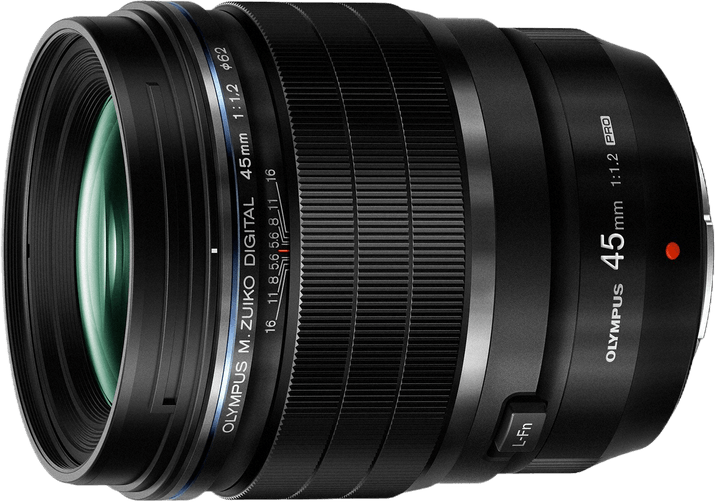
About the BuildAt 14.5 oz (410 g) it stays comfortable on a compact body through a long shoot. The 2.76 in (70 mm) width and 3.34 in (84.9 mm) length make it short for such a fast prime. Screw-in filters must match the 62mm thread. | |
| Lens Weight | 410 g |
Lens Diameter ⓘWidth of the lens at its widest point | 70 mm |
Lens Length ⓘHow long the lens is from front to back. | 84.9 mm |
Front Filter Compatible ⓘSome lenses are compatible with front filters, some are compatible with back filters and some are compatible with both. Front filters are usually more convenient to add and remove. |  Yes |
Front Filter Size ⓘDiameter of attachable filters. | 62 mm |
Optics88/100 | |
About the OpticsThe 45mm focal length gives the working distance of a short telephoto. Faces keep natural proportions, and your subject can relax instead of posing at close quarters. It also frames half-body and seated poses without crowding. The reach suits candid detail shots across a room. The f/1.2 maximum aperture is the headline specification. It admits far more light than a smaller maximum, so indoor portraits stay practical in dim reception rooms and window-lit interiors. It also lets you work without flash where a burst would spoil the mood. Depth of field at f/1.2 is shallow even on the smaller sensor. A head-and-shoulders portrait separates cleanly from a busy background, and backgrounds dissolve into soft blur. Place your focus point on the near eye, because the zone of sharpness is narrow. Nine aperture blades keep the opening rounder when you stop down, so out-of-focus highlights at night stay smooth rather than forming hard-edged shapes. Focusing reaches 1.6 ft (50 cm), which covers portrait distances well. Small details such as hands or a bouquet stay in range too. The optics specification scores 88. | |
Focal Range ⓘShortest to longest focal length of the lens (zoom range start - end ) | 45 mm |
Aperture Range ⓘLargest aperture at the lens's shortest focal length to longest focal length (aperture range start - end) | 1.2 |
| Focal Length Angle of View | 27° |
Flange Focal Distance ⓘDistance from lens mount to sensor. | 19.25 mm |
Diaphragm Type ⓘStructure and design of the aperture |  Automatic |
Blades ⓘNumber of diaphragm blades in aperture | 9020 |
Zoom Lens ⓘZoom allows you to vary the focal length, change between long shots and close-ups | No |
Closest Focusing Distance ⓘMinimum distance for a subject to be in focus. | 50 cm01500 |
Maximum Magnification ⓘLargest size a subject can be reproduced | 0.1x |
| Autofocus Mode |  Yes |
| Manual Mode |  Yes |
| Manual Focusing Ring |  Yes |
Features32/100 | |
About the FeaturesWeather sealing guards the lens against dust and moisture. Outdoor portrait sessions can continue through light rain or at a windswept coast, and the sealed body gives confidence on a working day. There is no image stabilisation inside the lens. At 45mm, handheld shooting is steadier than with a long telephoto. Dim venues still leave you relying on the camera body or your own steady hold. The features specification scores 32. The front element has no fluorine coating. Rain spots and finger marks will not shed as easily as on coated glass, so keep a cleaning cloth in the bag. A protective filter screws straight onto the 62mm thread if you want extra front-glass protection. | |
Weather Sealing ⓘWeather sealing capabilities will give you more confidence when shooting in unfavourable conditions. |  Yes |
Fluorine Coating ⓘCoating to repel water and oil from lens elements. | No |
| Built In Lens Hood | No |
| Lens Hood Type |  Round |
Teleconverter ⓘA teleconverter (extender) is an extra piece of equipment that fits between the lens and the camera body to enhance magnification | No |
| Image Stabilization | No |
Construction55/100 | |
About the ConstructionOne aspherical element has a specially shaped surface that helps correct distortion and spherical aberration. A single ED element and a single Super ED element use low-dispersion glass. This glass helps reduce colour fringing along high-contrast edges such as rim-lit hair against a bright sky. | |
Elements ⓘLens elements refer to individual pieces of glass within the lens. | 14 |
| Groups | 10 |
Aspherical Elements ⓘThe number of aspherical lens elements which can help correct aberrations such as spherical aberration. | 1 |
Bi Aspherical Elements ⓘElements with two non-spherical surfaces | 0 |
Low Dispersion ⓘElements that reduce chromatic aberration | 1 |
Super Low Dispersion ⓘAdvanced elements further reducing chromatic aberration | 1 |
CA Reduction ⓘBuilt-in features to reduce chromatic aberration | 0 |
Internal Focusing ⓘInternal Focusing means that the lens does not change in size during focusing, and the front element does not rotate. |  Yes |