
OM System ED 7-14mm f/2.8 PRO
OM System · 7–14 mm · f/2.8 · PRO
Score Breakdown
This lens score is calculated from published specifications.
General | |
|---|---|
About This LensThis OM System zoom, introduced in 2015, covers 7–14mm on Micro Four Thirds cameras. It suits tight interiors, architecture, night skies and wide landscapes. At 7mm the perspective is dramatic, while 14mm keeps framing easier to manage. The constant f/2.8 aperture keeps the same maximum at every focal length, which helps in dim churches and evening streets. The main trade-offs are the lack of autofocus and weather sealing. You focus by hand, and you should keep the lens dry. The lens remains in production today. | |
| Brand | OM System |
| Release Year | 2015 |
Production Status ⓘCurrent status of lens manufacturing (e.g., in production, discontinued). |  In Production |
Pro Branding ⓘSpecific branding codes used for professional-tier lenses. | PRO |
Lens Mount ⓘThe lens mount will tell you what type of lens range you can fit onto the camera body. Often the same camera company will have different lens ranges for different cameras. | Micro Four Thirds |
System ⓘIndicates which camera system the lens is designed to attach to. | Micro Four Thirds |
Maximum Format ⓘLargest sensor size compatible with the lens. |  Full Frame |
Physical93/100 | |
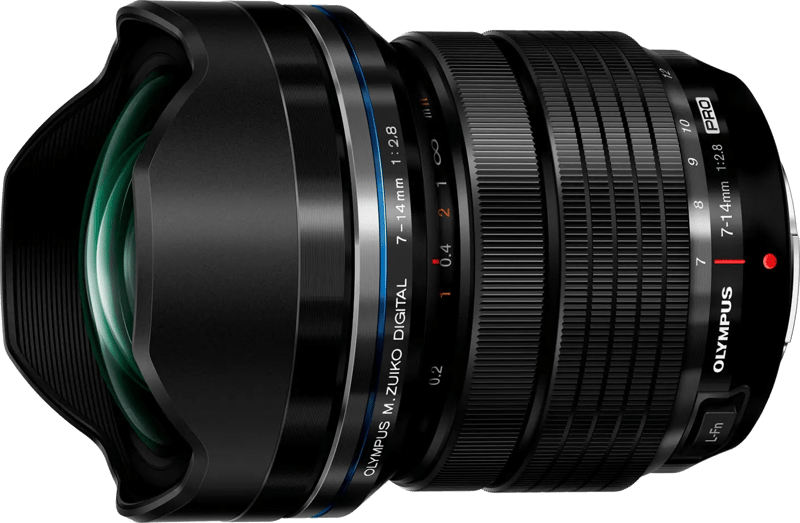
About the BuildThe lens weighs 1 lb 2.8 oz (534 g) and measures 4.17 in (105.8 mm) long. That makes it a modest load on a small body. The body is 3.11 in (78.9 mm) across. There is no front filter thread, so screw-in ND or polarising filters cannot attach directly. It earns a physical score of 93/100. | |
| Lens Weight | 534 g |
Lens Diameter ⓘWidth of the lens at its widest point | 78.9 mm |
Lens Length ⓘHow long the lens is from front to back. | 105.8 mm |
Front Filter Compatible ⓘSome lenses are compatible with front filters, some are compatible with back filters and some are compatible with both. Front filters are usually more convenient to add and remove. | No |
Optics56/100 | |
About the OpticsThe 7mm end frames whole rooms from a corner and cathedral naves from a doorway. The 14mm end gives a less extreme view when you want the scene calmer. Both ends reward strong foreground interest, since distant subjects look small at these focal lengths. Focusing down to 0.7 ft (20 cm) lets you set a rock or flower close to the camera. The landscape behind it can still stay sharp. That near-far approach is a natural fit for this range. The f/2.8 maximum holds through the zoom. It helps indoors without flash and after sunset, and it gathers light for night skies. Depth of field stays deep at 7–14mm, though, so blurred backgrounds are largely out of reach. Compose with lines and scale instead. The lens does not autofocus, so you focus by hand. At these focal lengths the zone of sharpness is generous, which makes manual focusing more forgiving. Even so, quick candid work is harder than with an autofocus zoom. Our optics score for this lens is 56/100. | |
Focal Range ⓘShortest to longest focal length of the lens (zoom range start - end ) | 7–14 mm |
Aperture Range ⓘLargest aperture at the lens's shortest focal length to longest focal length (aperture range start - end) | 2.8 |
| Focal Length Angle of View | 114.2°–75.4° |
Flange Focal Distance ⓘDistance from lens mount to sensor. | 19.25 mm |
Diaphragm Type ⓘStructure and design of the aperture |  Automatic |
Blades ⓘNumber of diaphragm blades in aperture | 7020 |
Zoom Lens ⓘZoom allows you to vary the focal length, change between long shots and close-ups |  Yes |
Zoom Mechanism ⓘSystem enabling zoom function |  Electric |
Zoom Ring ⓘIf zooming is adjusted using a zoom ring | No |
Zoom Type ⓘThe design or approach to zooming |  Push and Pull |
Closest Focusing Distance ⓘMinimum distance for a subject to be in focus. | 20 cm01500 |
Maximum Magnification ⓘLargest size a subject can be reproduced | 0.12x |
| Autofocus Mode | No |
| Manual Mode | No |
| Manual Focusing Ring | No |
Features0/100 | |
About the FeaturesThe lens has no built-in stabilization. Wide focal lengths forgive slower handheld shutter speeds, so the omission hurts less here than it would on a telephoto. Still, mount the camera on a tripod for long exposures after dark or for interiors lit only by window light. A wall or doorframe can also steady the camera. There is no weather sealing and no fluorine coating. Keep the lens dry in rain, spray and dust. The exposed front glass also picks up fingerprints, so carry a cloth for field cleaning. Zooming is electric, operated by a push-pull motion rather than a twist ring. There is no zoom lock switch. | |
Weather Sealing ⓘWeather sealing capabilities will give you more confidence when shooting in unfavourable conditions. | No |
Fluorine Coating ⓘCoating to repel water and oil from lens elements. | No |
| Built In Lens Hood | No |
| Lens Hood Type |  Dome |
Zoom Lock ⓘZoom lock allows the zoom ring to be locked at the desired focal length | No |
Teleconverter ⓘA teleconverter (extender) is an extra piece of equipment that fits between the lens and the camera body to enhance magnification | No |
| Image Stabilization | No |
Construction65/100 | |
About the ConstructionThe optical design packs 14 elements into 11 groups, with special glass to control the faults wide angles invite. Four aspherical elements, one of them bi-aspherical, help correct distortion, which matters for architecture. Three ED and three Super ED elements help reduce chromatic aberration, the coloured fringes that can appear along high-contrast edges such as branches against a bright sky. Our construction score for this lens is 65/100. | |
Elements ⓘLens elements refer to individual pieces of glass within the lens. | 14 |
| Groups | 11 |
Aspherical Elements ⓘThe number of aspherical lens elements which can help correct aberrations such as spherical aberration. | 4 |
Bi Aspherical Elements ⓘElements with two non-spherical surfaces | 1 |
Low Dispersion ⓘElements that reduce chromatic aberration | 3 |
Super Low Dispersion ⓘAdvanced elements further reducing chromatic aberration | 3 |
CA Reduction ⓘBuilt-in features to reduce chromatic aberration | 6 |
Internal Focusing ⓘInternal Focusing means that the lens does not change in size during focusing, and the front element does not rotate. | No |