
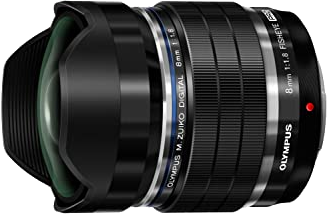
OM System M.Zuiko Digital ED 8mm f/1.8 Fisheye PRO
OM System · 8 mm · f/1.8 · PRO
Score Breakdown
Scores combine our editorial testing with published lab data.
General | |
|---|---|
About This LensOM System's 8mm prime fisheye gives Micro Four Thirds bodies an extreme wide view. That suits tight interiors, crowded event floors and playful landscapes. It was introduced in 2015, so it is an older design. The bright f/1.8 aperture keeps it usable after dark. The main trade-off is the strong fisheye effect on straight lines. It suits photographers who want that look rather than a corrected wide-angle view. | |
| Brand | OM System |
| Release Year | 2015 |
Pro Branding ⓘSpecific branding codes used for professional-tier lenses. | PRO |
Lens Mount ⓘThe lens mount will tell you what type of lens range you can fit onto the camera body. Often the same camera company will have different lens ranges for different cameras. | Micro Four Thirds |
System ⓘIndicates which camera system the lens is designed to attach to. | Micro Four Thirds |
Maximum Format ⓘLargest sensor size compatible with the lens. | Micro Four Thirds |
Physical93/100 | |
About the BuildThe lens weighs 11.1 oz (315 g) and measures 3.15 in (80 mm) long by 2.44 in (62 mm) wide. It is light and compact enough to carry all day. The front accepts no screw-in filters, so polarisers and ND filters have no thread to attach to. | |
| Lens Weight | 315 g |
Lens Diameter ⓘWidth of the lens at its widest point | 62 mm |
Lens Length ⓘHow long the lens is from front to back. | 80 mm |
Front Filter Compatible ⓘSome lenses are compatible with front filters, some are compatible with back filters and some are compatible with both. Front filters are usually more convenient to add and remove. | No |
Optics82/100 | |
About the OpticsThe 8mm focal length packs an entire scene into a single frame on this format. You can stand in a small room and still include the whole space, or fit the full sky above a landscape. Straight lines bend more the closer they sit to the frame edges, and that fisheye character shapes every composition. The f/1.8 maximum aperture gathers a lot of light. That keeps shutter speeds workable in dim interiors, at evening events and for star-filled skies. Depth of field is deep at 8mm anyway, so stopping down is a choice rather than a need. Close focusing to 0.4 ft (12 cm) supports a bold near-and-far composition. You can place a foreground detail inches from the front element and still carry the surrounding scene around it. Near objects loom large while distant parts shrink into the curve. That suits architectural details and playful portraits. Framing needs care, because feet, hands and tripod legs enter the view easily. The focal length is fixed, so you frame by moving yourself. The heavy bend is also hard to hide, so it works best when you use it as the idea of the picture. | |
Focal Range ⓘShortest to longest focal length of the lens (zoom range start - end ) | 8 mm |
Aperture Range ⓘLargest aperture at the lens's shortest focal length to longest focal length (aperture range start - end) | 1.8 |
| Focal Length Angle of View | 180° |
Flange Focal Distance ⓘDistance from lens mount to sensor. | 19.25 mm |
Diaphragm Type ⓘStructure and design of the aperture |  Automatic |
Blades ⓘNumber of diaphragm blades in aperture | 7020 |
Zoom Lens ⓘZoom allows you to vary the focal length, change between long shots and close-ups | No |
Closest Focusing Distance ⓘMinimum distance for a subject to be in focus. | 12 cm01500 |
Maximum Magnification ⓘLargest size a subject can be reproduced | 0.2x |
| Autofocus Mode |  Yes |
| Manual Mode |  Yes |
| Manual Focusing Ring |  Yes |
Features32/100 | |
About the FeaturesWeather sealing is the practical highlight. It helps keep dust and moisture out of the lens during outdoor shoots. That matters for a wide lens pointed at seascapes, forests and city streets in changeable conditions. Two gaps count against it. The lens has no stabilisation of its own, so steady handheld work depends on the camera body. There is no fluorine coating either to help shed water and oil from the front element. For stills, the stabilisation gap matters less. Camera shake shows up far less at 8mm than at long focal lengths. The missing stabilisation bites hardest for handheld video, where a support or a braced posture fills the gap. | |
Weather Sealing ⓘWeather sealing capabilities will give you more confidence when shooting in unfavourable conditions. |  Yes |
Fluorine Coating ⓘCoating to repel water and oil from lens elements. | No |
| Built In Lens Hood |  Yes |
Teleconverter ⓘA teleconverter (extender) is an extra piece of equipment that fits between the lens and the camera body to enhance magnification | No |
| Image Stabilization | No |
Construction58/100 | |
About the ConstructionOne aspherical element uses specially shaped surfaces to help correct distortion and spherical aberration. Two ED and three Super ED elements help reduce chromatic aberration. That is the coloured fringing that can appear along high-contrast edges, such as a bright window frame against a dark interior. Focusing moves internal groups only, so the barrel does not extend as you focus. | |
Elements ⓘLens elements refer to individual pieces of glass within the lens. | 17 |
| Groups | 15 |
Aspherical Elements ⓘThe number of aspherical lens elements which can help correct aberrations such as spherical aberration. | 1 |
Bi Aspherical Elements ⓘElements with two non-spherical surfaces | 0 |
Low Dispersion ⓘElements that reduce chromatic aberration | 2 |
Super Low Dispersion ⓘAdvanced elements further reducing chromatic aberration | 3 |
CA Reduction ⓘBuilt-in features to reduce chromatic aberration | 0 |
Internal Focusing ⓘInternal Focusing means that the lens does not change in size during focusing, and the front element does not rotate. |  Yes |