
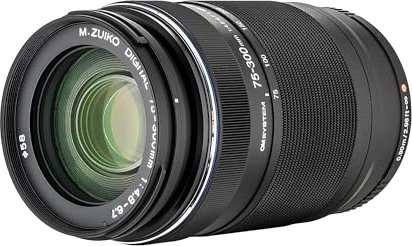
OM System M.Zuiko Digital ED 75-300mm f/4.8-6.7 II
OM System · 75–300 mm · f/4.8–6.7
Score Breakdown
Scores combine our editorial testing with published lab data.
General | |
|---|---|
About This LensThis telephoto zoom gives Micro Four Thirds photographers long reach in a light body. The 75–300mm range suits birds, wildlife and outdoor sport. At 300mm it offers the framing that a full-frame camera would need a much longer lens to match. Even so, it stays easy to carry all day. The trade-off is light gathering. The maximum aperture is narrow at the long end, and there is no built-in stabilisation. Both limits point toward daylight shooting of distant subjects. OM System introduced the design in 2013, and the lens remains in production. | |
| Brand | OM System |
| Release Year | 2013 |
Production Status ⓘCurrent status of lens manufacturing (e.g., in production, discontinued). |  In Production |
Version ⓘThe iteration or release number of a particular lens model. | II |
Lens Mount ⓘThe lens mount will tell you what type of lens range you can fit onto the camera body. Often the same camera company will have different lens ranges for different cameras. | Micro Four Thirds |
System ⓘIndicates which camera system the lens is designed to attach to. | Micro Four Thirds |
Maximum Format ⓘLargest sensor size compatible with the lens. | Micro Four Thirds |
Physical64/100 | |
About the BuildAt 14.9 oz (423 g) and 4.59 in (116.5 mm) long, this is a light, compact telephoto zoom. The barrel measures 2.72 in (69 mm) across. You can handhold it through a long afternoon without strain. It takes 58mm screw-in filters. | |
| Lens Weight | 423 g |
Lens Diameter ⓘWidth of the lens at its widest point | 69 mm |
Lens Length ⓘHow long the lens is from front to back. | 116.5 mm |
Front Filter Compatible ⓘSome lenses are compatible with front filters, some are compatible with back filters and some are compatible with both. Front filters are usually more convenient to add and remove. |  Yes |
Front Filter Size ⓘDiameter of attachable filters. | 58 mm |
Optics49/100 | |
About the OpticsThis lens scores 49/100 on our optics specification measures. The zoom covers both moderate telephoto framing and extreme reach. At 75mm you can cover sports across a pitch or animals at middle distance. Zoom to 300mm and distant birds fill the frame. Shooting from a distance also compresses perspective, so animals and habitat stack into layered frames. The aperture is the main constraint. It opens to f/4.8 at 75mm and drops to f/6.7 by 300mm. In daylight that stays workable. In shade you will need higher ISO settings to keep the shutter fast. Long focal lengths still blur backgrounds at f/6.7, so bird portraits keep pleasant separation. Birds in flight push that demand hardest. Reach and shutter speed both draw on the same limited light, so bright days give the best chance. Closest focusing is 3 ft (90 cm). That lets you frame approachable subjects tightly, such as butterflies or birds at a feeder. Maximum magnification reaches 0.18x, so small subjects appear reasonably large in the frame. Seven aperture blades help keep out-of-focus highlights round when stopped down. | |
Focal Range ⓘShortest to longest focal length of the lens (zoom range start - end ) | 75–300 mm |
Aperture Range ⓘLargest aperture at the lens's shortest focal length to longest focal length (aperture range start - end) | 4.8–6.7 |
| Focal Length Angle of View | 16°–4.1° |
Flange Focal Distance ⓘDistance from lens mount to sensor. | 19.25 mm |
Diaphragm Type ⓘStructure and design of the aperture |  Automatic |
Blades ⓘNumber of diaphragm blades in aperture | 7020 |
Zoom Lens ⓘZoom allows you to vary the focal length, change between long shots and close-ups |  Yes |
Zoom Mechanism ⓘSystem enabling zoom function |  Manual |
Zoom Ring ⓘIf zooming is adjusted using a zoom ring |  Yes |
Zoom Type ⓘThe design or approach to zooming |  Rotary |
Closest Focusing Distance ⓘMinimum distance for a subject to be in focus. | 90 cm01500 |
Maximum Magnification ⓘLargest size a subject can be reproduced | 0.18x |
| Autofocus Mode |  Yes |
| Manual Mode |  Yes |
| Manual Focusing Ring |  Yes |
Features19/100 | |
About the FeaturesImage stabilisation is absent from this lens. At 300mm even slight hand movement shows in the frame. You will need fast shutter speeds or steady support for sharp handheld results. A monopod earns its place during long waits at a hide. It scores 19/100 on our features measures. The fluorine coating helps the front element shed water and oil. Fingerprints, spray and dust wipe away easily with a soft cloth. That suits seaside wildlife photography and other damp outings. There is no weather sealing, so keep the lens dry in rain or dust. A zoom lock is absent too. Carried facing down, the barrel may creep outward on its own. | |
Weather Sealing ⓘWeather sealing capabilities will give you more confidence when shooting in unfavourable conditions. | No |
Fluorine Coating ⓘCoating to repel water and oil from lens elements. |  Yes |
| Built In Lens Hood | No |
| Lens Hood Type |  Round |
Zoom Lock ⓘZoom lock allows the zoom ring to be locked at the desired focal length | No |
Teleconverter ⓘA teleconverter (extender) is an extra piece of equipment that fits between the lens and the camera body to enhance magnification | No |
| Image Stabilization | No |
Construction40/100 | |
About the ConstructionFocusing happens inside the barrel, so the lens keeps a constant length while you focus. The optical formula includes two ED elements and one Super ED element. This special glass helps reduce chromatic aberration, the coloured fringes that appear along high-contrast edges such as a bird against bright sky. | |
Elements ⓘLens elements refer to individual pieces of glass within the lens. | 18 |
| Groups | 13 |
Aspherical Elements ⓘThe number of aspherical lens elements which can help correct aberrations such as spherical aberration. | 0 |
Bi Aspherical Elements ⓘElements with two non-spherical surfaces | 0 |
Low Dispersion ⓘElements that reduce chromatic aberration | 2 |
Super Low Dispersion ⓘAdvanced elements further reducing chromatic aberration | 1 |
CA Reduction ⓘBuilt-in features to reduce chromatic aberration | 0 |
Internal Focusing ⓘInternal Focusing means that the lens does not change in size during focusing, and the front element does not rotate. |  Yes |