
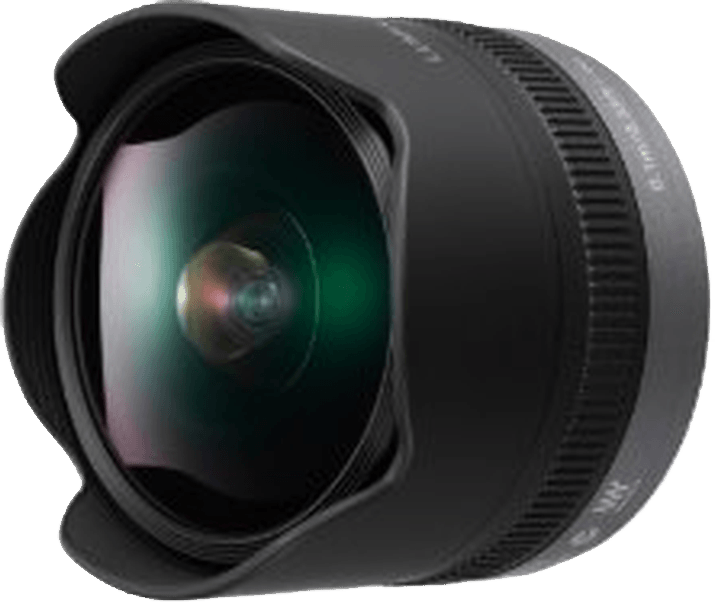
Panasonic 8mm f/3.5 G Prime Lens Micro Four Third
Panasonic · 8 mm · f/3.5
Score Breakdown
This lens score is calculated from published specifications.
General | |
|---|---|
About This LensThis Panasonic 8mm f/3.5 is a fisheye prime for Micro Four Thirds cameras. Its extreme wide view suits tight interiors. It also works for close, energetic subjects such as skateboarding. The wide frame keeps the action and its setting in one shot. Panasonic released this lens in 2010 and later discontinued it, so it is an older design. It suits Micro Four Thirds owners who want a deliberate fisheye look for interiors or experimental wide images. Creative portraits and abstract frames are further natural uses. The main trade-off is the fixed f/3.5 aperture, which limits work in dim light. | |
| Brand | Panasonic |
| Release Year | 2010 |
Production Status ⓘCurrent status of lens manufacturing (e.g., in production, discontinued). |  Discontinued |
Lens Mount ⓘThe lens mount will tell you what type of lens range you can fit onto the camera body. Often the same camera company will have different lens ranges for different cameras. | Micro Four Thirds |
System ⓘIndicates which camera system the lens is designed to attach to. | Micro Four Thirds |
Maximum Format ⓘLargest sensor size compatible with the lens. | Micro Four Thirds |
Physical57/100 | |
About the BuildAt 5.8 oz (165 g), this lens is light enough to leave on the camera all day. It measures 2.04 in (51.7 mm) long and 2.39 in (60.7 mm) across, so it adds little bulk to a compact body. | |
| Lens Weight | 165 g |
Lens Diameter ⓘWidth of the lens at its widest point | 60.7 mm |
Lens Length ⓘHow long the lens is from front to back. | 51.7 mm |
Front Filter Compatible ⓘSome lenses are compatible with front filters, some are compatible with back filters and some are compatible with both. Front filters are usually more convenient to add and remove. | No |
Optics70/100 | |
About the OpticsThe 8mm focal length gives an extreme wide fisheye view on the Micro Four Thirds sensor. You can photograph a full interior from one corner, or stand near a moving rider and still include the whole scene. Straight lines near the frame edges bend outward, the signature look of a fisheye. At this width, distant subjects shrink quickly, so the lens rewards close, foreground-led compositions. Its one maximum aperture, f/3.5, is on the slow side for a prime lens. Daylight and brightly lit interiors pose no problem. In dim rooms you must raise ISO or steady the camera, because the aperture opens no wider. Closest focusing sits at 0.3 ft (10 cm). You can work very near a subject and still keep its surroundings in the frame. Maximum magnification is 0.2x, so even nearby subjects appear at modest scale in the final image. The aperture has 7 blades. Stopped down, point lights take on a seven-sided shape in the background. The optics specification scores 70 of 100. | |
Focal Range ⓘShortest to longest focal length of the lens (zoom range start - end ) | 8 mm |
Aperture Range ⓘLargest aperture at the lens's shortest focal length to longest focal length (aperture range start - end) | 3.5 |
| Focal Length Angle of View | 180° |
Flange Focal Distance ⓘDistance from lens mount to sensor. | 19.25 mm |
Diaphragm Type ⓘStructure and design of the aperture |  Automatic |
Blades ⓘNumber of diaphragm blades in aperture | 7020 |
Zoom Lens ⓘZoom allows you to vary the focal length, change between long shots and close-ups | No |
Closest Focusing Distance ⓘMinimum distance for a subject to be in focus. | 10 cm01500 |
Maximum Magnification ⓘLargest size a subject can be reproduced | 0.2x |
| Autofocus Mode |  Yes |
| Manual Mode |  Yes |
| Manual Focusing Ring |  Yes |
Features0/100 | |
About the FeaturesThis lens has no image stabilization. At 8mm, camera shake records less blur than it would at longer focal lengths. Handheld shutter speeds can therefore be slower before blur appears. Even so, any stabilization would have to come from the camera body. For a moving subject, a faster shutter speed matters more than support, because support steadies the camera rather than the subject. The lens has no weather sealing, so keep it dry in rain or heavy dust. There is no fluorine coating either, so the front element needs careful cleaning to shed fingerprints and dirt. With no front filter thread, you cannot attach a protective filter directly. Given the open front and missing seal, this lens deserves extra care in rough conditions. | |
Weather Sealing ⓘWeather sealing capabilities will give you more confidence when shooting in unfavourable conditions. | No |
Fluorine Coating ⓘCoating to repel water and oil from lens elements. | No |
| Built In Lens Hood |  Yes |
| Lens Hood Type |  Petal |
Teleconverter ⓘA teleconverter (extender) is an extra piece of equipment that fits between the lens and the camera body to enhance magnification | No |
| Image Stabilization | No |
Construction38/100 | |
About the ConstructionThe optical path holds 10 elements in 9 groups. One low-dispersion element helps reduce chromatic aberration, where colours focus differently and form coloured fringes along high-contrast edges. Bright window frames in an interior shot are the kind of edge where fringes can show. Focusing is internal, meaning the adjustments happen among the elements inside the lens. The construction specification scores 38 of 100. | |
Elements ⓘLens elements refer to individual pieces of glass within the lens. | 10 |
| Groups | 9 |
Aspherical Elements ⓘThe number of aspherical lens elements which can help correct aberrations such as spherical aberration. | 0 |
Bi Aspherical Elements ⓘElements with two non-spherical surfaces | 0 |
Low Dispersion ⓘElements that reduce chromatic aberration | 1 |
Super Low Dispersion ⓘAdvanced elements further reducing chromatic aberration | 0 |
CA Reduction ⓘBuilt-in features to reduce chromatic aberration | 0 |
Internal Focusing ⓘInternal Focusing means that the lens does not change in size during focusing, and the front element does not rotate. |  Yes |