
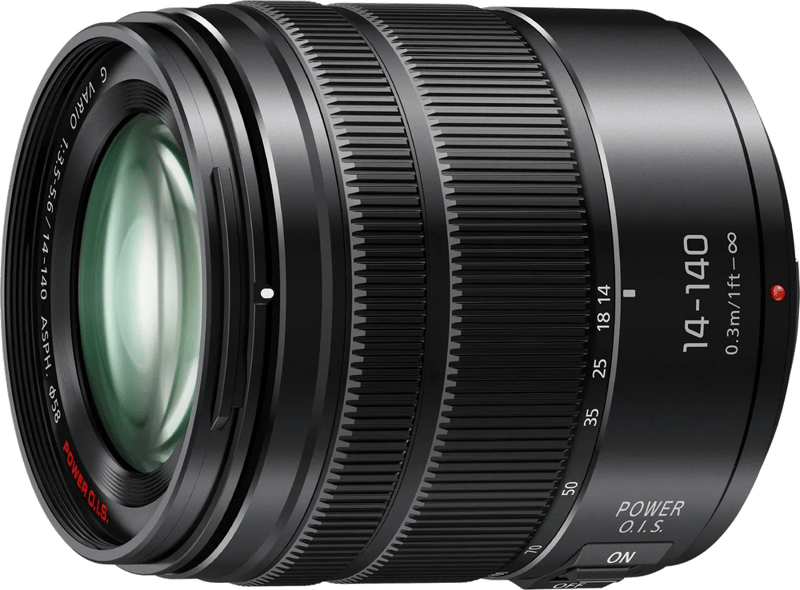
Panasonic LUMIX G Series 14-140mm f/3.5-5.6
Panasonic · 14–140 mm · f/3.5–5.6 · Image Stabilization
Score Breakdown
This product does not have an overall score yet.
General | |
|---|---|
About This LensThis Micro Four Thirds zoom covers 14–140mm, from a wide view to a long reach. It suits travel and family days when one lens must handle buildings, group shots and distant detail. People who shoot varied outdoor subjects will get the most from it. Released in 2019, it weighs only 9.3 oz (265 g), light for a zoom with this range. The main trade-off is brightness. The maximum aperture starts at f/3.5 and falls to f/5.6 at 140mm. The 10x zoom range means you can leave other lenses at home. For Micro Four Thirds owners it makes a practical single-lens travel kit. | |
| Brand | Panasonic |
| Release Year | 2019 |
Version ⓘThe iteration or release number of a particular lens model. | II |
Lens Mount ⓘThe lens mount will tell you what type of lens range you can fit onto the camera body. Often the same camera company will have different lens ranges for different cameras. | Micro Four Thirds |
System ⓘIndicates which camera system the lens is designed to attach to. | Micro Four Thirds |
Maximum Format ⓘLargest sensor size compatible with the lens. | Micro Four Thirds |
Physical | |
About the BuildThe lens measures 2.64 in (67 mm) across and 2.95 in (75 mm) long, so it stays compact on a small body. A screw-in filter must match the 58mm thread on the front, a common size among camera lenses. | |
| Lens Weight | 265 g |
Lens Diameter ⓘWidth of the lens at its widest point | 67 mm |
Lens Length ⓘHow long the lens is from front to back. | 75 mm |
Front Filter Compatible ⓘSome lenses are compatible with front filters, some are compatible with back filters and some are compatible with both. Front filters are usually more convenient to add and remove. |  Yes |
Front Filter Size ⓘDiameter of attachable filters. | 58 mm |
Optics | |
About the OpticsThe 14mm end frames streets, interiors and group pictures without backing away. At 140mm the reach pulls in distant subjects such as boats on a lake, players on a far sideline or a shy garden bird. The long end also flatters a portrait. The maximum aperture runs from f/3.5 at 14mm to f/5.6 at 140mm. Daylight and window-lit rooms suit it well. In dim evening light you will lean on higher ISO settings instead. The aperture also keeps background blur modest, so distractions behind a portrait subject remain visible. Between those ends the zoom gives a smooth spread of framing choices. You can tighten a view from a whole scene to a single figure without moving. That helps when walking closer is not possible, such as at a school play, on a boat tour or from a fixed viewing spot. For close work the lens focuses as near as 1 ft (30 cm). Its maximum magnification reaches 0.5x, enough to fill the frame with a flower, a plate of food or a market detail. These are separate ratings, so the nearest focus and the strongest magnification may not occur together. | |
Focal Range ⓘShortest to longest focal length of the lens (zoom range start - end ) | 14–140 mm |
Aperture Range ⓘLargest aperture at the lens's shortest focal length to longest focal length (aperture range start - end) | 3.5–5.6 |
| Focal Length Angle of View | 75°–8.8° |
Flange Focal Distance ⓘDistance from lens mount to sensor. | 19.25 mm |
Diaphragm Type ⓘStructure and design of the aperture |  Automatic |
Blades ⓘNumber of diaphragm blades in aperture | 7020 |
Zoom Lens ⓘZoom allows you to vary the focal length, change between long shots and close-ups |  Yes |
Zoom Mechanism ⓘSystem enabling zoom function |  Manual |
Zoom Ring ⓘIf zooming is adjusted using a zoom ring |  Yes |
Zoom Type ⓘThe design or approach to zooming |  Rotary |
Closest Focusing Distance ⓘMinimum distance for a subject to be in focus. | 30 cm01500 |
Maximum Magnification ⓘLargest size a subject can be reproduced | 0.5x |
| Autofocus Mode |  Yes |
| Manual Mode |  Yes |
| Manual Focusing Ring |  Yes |
Features | |
About the FeaturesImage stabilization is built in. It helps keep handheld frames steady at the 140mm end, where small camera movements show most in your pictures. At 14mm it matters less, since shake is less visible at wide settings. Weather sealing helps when you shoot in dust or moisture. That suits coastal walks, dusty trails and damp family days out with a travel camera. There is no fluorine coating on the front glass and no zoom lock. Without a lock the zoom ring cannot be fixed in place when the camera hangs from a strap. | |
Weather Sealing ⓘWeather sealing capabilities will give you more confidence when shooting in unfavourable conditions. |  Yes |
Fluorine Coating ⓘCoating to repel water and oil from lens elements. | No |
| Built In Lens Hood | No |
| Lens Hood Type |  Petal |
Zoom Lock ⓘZoom lock allows the zoom ring to be locked at the desired focal length | No |
Teleconverter ⓘA teleconverter (extender) is an extra piece of equipment that fits between the lens and the camera body to enhance magnification | No |
| Image Stabilization | Yes |
Construction | |
About the ConstructionThree aspherical elements help correct optical faults such as distortion, where straight edges appear curved. Two low-dispersion elements help reduce chromatic aberration, the coloured fringes that can appear along high-contrast edges like branches against a bright sky. Focusing is internal, so the barrel does not extend while the lens focuses. | |
Elements ⓘLens elements refer to individual pieces of glass within the lens. | 14 |
| Groups | 12 |
Aspherical Elements ⓘThe number of aspherical lens elements which can help correct aberrations such as spherical aberration. | 3 |
Bi Aspherical Elements ⓘElements with two non-spherical surfaces | 0 |
Low Dispersion ⓘElements that reduce chromatic aberration | 2 |
Super Low Dispersion ⓘAdvanced elements further reducing chromatic aberration | 0 |
CA Reduction ⓘBuilt-in features to reduce chromatic aberration | 0 |
Internal Focusing ⓘInternal Focusing means that the lens does not change in size during focusing, and the front element does not rotate. |  Yes |