
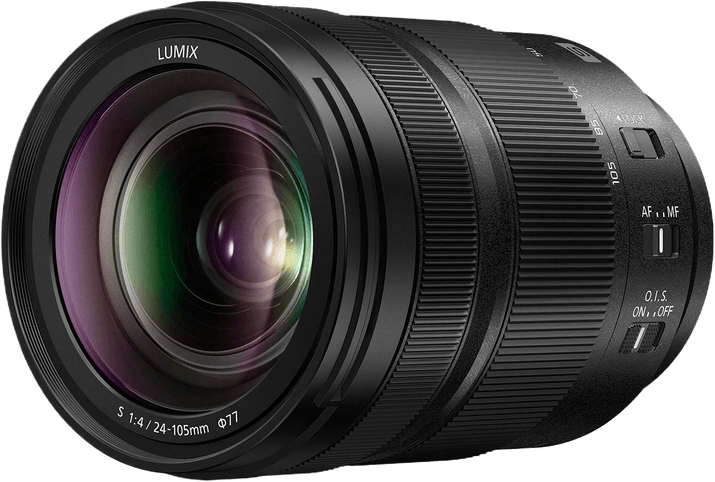
Panasonic LUMIX S 24-105mm F/4 Macro O.I.S.
Panasonic · 24–105 mm · f/4
Score Breakdown
Scores combine our editorial testing with published lab data.
General | |
|---|---|
About This LensThis Panasonic standard zoom serves full frame Leica L mount cameras. Its 24–105mm span suits photographers who want one lens for varied everyday work. The wide end handles interiors, streets and groups. The long end frames portraits and travel details. That coverage makes it a practical single-lens travel choice. Panasonic launched the lens in 2019, and it remains in production. The main trade-off is brightness. The maximum aperture is f/4, a modest opening that gathers less light than a faster zoom would. The lens also lacks built-in image stabilisation, which matters for handheld work in dim conditions. | |
| Brand | Panasonic |
| Release Year | 2019 |
Production Status ⓘCurrent status of lens manufacturing (e.g., in production, discontinued). |  In Production |
Lens Mount ⓘThe lens mount will tell you what type of lens range you can fit onto the camera body. Often the same camera company will have different lens ranges for different cameras. | Leica L |
System ⓘIndicates which camera system the lens is designed to attach to. | Leica L |
Maximum Format ⓘLargest sensor size compatible with the lens. |  Full Frame |
Physical64/100 | |
About the BuildIt weighs 1 lb 8 oz (680 g), a moderate load for a full frame standard zoom. The barrel is 3.31 in (84 mm) wide and 4.65 in (118 mm) long. Screw-in filters must match the 77mm thread on the front, and a polariser or ND filter attaches directly. | |
| Lens Weight | 680 g |
Lens Diameter ⓘWidth of the lens at its widest point | 84 mm |
Lens Length ⓘHow long the lens is from front to back. | 118 mm |
Front Filter Compatible ⓘSome lenses are compatible with front filters, some are compatible with back filters and some are compatible with both. Front filters are usually more convenient to add and remove. |  Yes |
Front Filter Size ⓘDiameter of attachable filters. | 77 mm |
Optics72/100 | |
About the OpticsThe 24–105mm range handles most everyday framing without lens changes. At 24mm it takes in room interiors, building exteriors and group shots. At 105mm it tightens onto portraits and distant details from a fixed position. Event and travel photographers can move between wide scenes and close faces by turning the zoom ring. The maximum aperture stays at f/4 across the whole zoom. Exposure therefore holds constant as you zoom, which simplifies manual settings during changing light. At 24mm, f/4 also renders plenty of depth for layered interiors. The opening is modest, though, and dim venues may call for raised ISO. At 105mm, f/4 still gives portraits some separation, especially with the subject well clear of the background. The lens also handles close subjects. It focuses as near as 1 ft (30 cm). Maximum magnification reaches 0.5x, half life size. The name includes Macro, but true macro means 1:1 magnification. Half life size still fills the frame with flowers or product details. Nine aperture blades help keep out-of-focus areas smooth at stopped-down settings, which flatters portraits at 105mm. Our optics score for this lens is 72. | |
Focal Range ⓘShortest to longest focal length of the lens (zoom range start - end ) | 24–105 mm |
Aperture Range ⓘLargest aperture at the lens's shortest focal length to longest focal length (aperture range start - end) | 4 |
| Focal Length Angle of View | 84.07°–23.29° |
Flange Focal Distance ⓘDistance from lens mount to sensor. | 20 mm |
Diaphragm Type ⓘStructure and design of the aperture |  Automatic |
Blades ⓘNumber of diaphragm blades in aperture | 9020 |
Zoom Lens ⓘZoom allows you to vary the focal length, change between long shots and close-ups |  Yes |
Zoom Mechanism ⓘSystem enabling zoom function |  Manual |
Zoom Ring ⓘIf zooming is adjusted using a zoom ring |  Yes |
Zoom Type ⓘThe design or approach to zooming |  Rotary |
Closest Focusing Distance ⓘMinimum distance for a subject to be in focus. | 30 cm01500 |
Maximum Magnification ⓘLargest size a subject can be reproduced | 0.5x |
| Autofocus Mode |  Yes |
| Manual Mode |  Yes |
| Manual Focusing Ring |  Yes |
Features52/100 | |
About the FeaturesThere is no built-in image stabilisation, the main practical limitation of this lens. Handheld work therefore favours daylight and other well-lit settings. In dim interiors or evening light, a tripod or monopod steadies the camera. Weather sealing helps protect the lens in dusty or damp conditions, which suits outdoor travel days. A fluorine coating on the front helps water and dust wipe away easily. A zoom lock keeps the barrel from extending under its own weight while the lens hangs on the camera. Together these help on changeable-weather days. Our features score for this lens is 52. | |
Weather Sealing ⓘWeather sealing capabilities will give you more confidence when shooting in unfavourable conditions. |  Yes |
Fluorine Coating ⓘCoating to repel water and oil from lens elements. |  Yes |
| Built In Lens Hood | No |
| Lens Hood Type |  Petal |
Zoom Lock ⓘZoom lock allows the zoom ring to be locked at the desired focal length |  Yes |
Teleconverter ⓘA teleconverter (extender) is an extra piece of equipment that fits between the lens and the camera body to enhance magnification | No |
| Image Stabilization | No |
Construction32/100 | |
About the ConstructionThe optical design includes aspherical elements, whose specially shaped surfaces help correct distortion and spherical aberration. Distortion can make straight edges appear curved in wide shots, so this correction matters for building exteriors. Low-dispersion and super-low-dispersion glass helps reduce chromatic aberration. With that fault, colours focus at different points, and fringes appear along high-contrast edges such as a rooftop against bright sky. | |
Elements ⓘLens elements refer to individual pieces of glass within the lens. | 16 |
| Groups | 13 |
Aspherical Elements ⓘThe number of aspherical lens elements which can help correct aberrations such as spherical aberration. | 1 |
Bi Aspherical Elements ⓘElements with two non-spherical surfaces | 0 |
Low Dispersion ⓘElements that reduce chromatic aberration | 1 |
Super Low Dispersion ⓘAdvanced elements further reducing chromatic aberration | 1 |
CA Reduction ⓘBuilt-in features to reduce chromatic aberration | 0 |
Internal Focusing ⓘInternal Focusing means that the lens does not change in size during focusing, and the front element does not rotate. | No |