
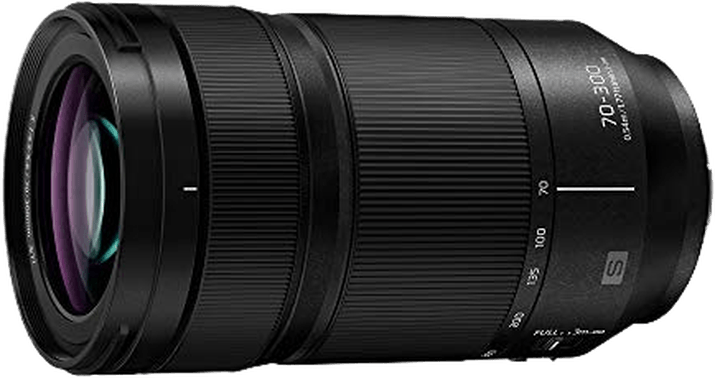
Panasonic LUMIX S 70-300mm F/4.5-5.6 Macro O.I.S.
Panasonic · 70–300 mm · f/4.5–5.6
Score Breakdown
Scores combine our editorial testing with published lab data.
General | |
|---|---|
About This LensThis Panasonic telephoto zoom spans 70–300mm for full-frame Leica L-mount cameras. It was released in 2021 and remains in production, so it is a current design rather than an older model. The range suits wildlife, outdoor sport and distant detail work, where 300mm makes a far subject larger. The short end handles nearer action and tighter portraits. It also focuses close, which broadens the likely subjects beyond distant wildlife. The main trade-off is light gathering. The maximum aperture runs from f/4.5 at 70mm to f/5.6 at 300mm, so the lens favours daylight work over dim interiors. | |
| Brand | Panasonic |
| Release Year | 2021 |
Production Status ⓘCurrent status of lens manufacturing (e.g., in production, discontinued). |  In Production |
Lens Mount ⓘThe lens mount will tell you what type of lens range you can fit onto the camera body. Often the same camera company will have different lens ranges for different cameras. | Leica L |
System ⓘIndicates which camera system the lens is designed to attach to. | Leica L |
Maximum Format ⓘLargest sensor size compatible with the lens. |  Full Frame |
Physical64/100 | |
About the BuildIt weighs 1 lb 11.9 oz (790 g). The body runs 5.83 in (148 mm) long and 3.31 in (84 mm) wide, a moderate package for a 300mm full-frame zoom. The front takes 77mm screw-in filters. It has a physical score of 64 on our 100-point scale. | |
| Lens Weight | 790 g |
Lens Diameter ⓘWidth of the lens at its widest point | 84 mm |
Lens Length ⓘHow long the lens is from front to back. | 148 mm |
Front Filter Compatible ⓘSome lenses are compatible with front filters, some are compatible with back filters and some are compatible with both. Front filters are usually more convenient to add and remove. |  Yes |
Front Filter Size ⓘDiameter of attachable filters. | 77 mm |
Optics59/100 | |
About the OpticsThe long end does the main work here. At 300mm, distant wildlife and outdoor athletes fill the frame from a safe distance. At 70mm, the lens handles nearer action and environmental portraits with less compression. Between those ends, the zoom follows a subject moving nearer. A rotary zoom ring sets each framing by hand. Light gathering is modest. The maximum aperture falls from f/4.5 at 70mm to f/5.6 at 300mm, so the widest setting dims as you zoom in. In bright daylight this rarely matters. In shade or at dusk, you may need to raise ISO or steady the camera. At the long end, f/5.6 still separates a single animal or player from a busy background. Close work is a real strength. The lens focuses as close as 1.8 ft (54 cm). Its maximum magnification reaches 0.5x, or half life size. The name includes Macro, but true macro means 1:1 magnification, and this lens reaches half that. Half life size still suits flowers, dragonflies and small product details. Eleven aperture blades help keep the opening round when stopped down. This helps smooth the out-of-focus highlights behind a distant subject. | |
Focal Range ⓘShortest to longest focal length of the lens (zoom range start - end ) | 70–300 mm |
Aperture Range ⓘLargest aperture at the lens's shortest focal length to longest focal length (aperture range start - end) | 4.5–5.6 |
| Focal Length Angle of View | 34.34976958695978°–8.249679364443303° |
Flange Focal Distance ⓘDistance from lens mount to sensor. | 20 mm |
Diaphragm Type ⓘStructure and design of the aperture |  Automatic |
Blades ⓘNumber of diaphragm blades in aperture | 11020 |
Zoom Lens ⓘZoom allows you to vary the focal length, change between long shots and close-ups |  Yes |
Zoom Mechanism ⓘSystem enabling zoom function |  Manual |
Zoom Ring ⓘIf zooming is adjusted using a zoom ring |  Yes |
Zoom Type ⓘThe design or approach to zooming |  Rotary |
Closest Focusing Distance ⓘMinimum distance for a subject to be in focus. | 54 cm01500 |
Maximum Magnification ⓘLargest size a subject can be reproduced | 0.5x |
| Autofocus Mode |  Yes |
| Manual Mode |  Yes |
| Manual Focusing Ring |  Yes |
Features52/100 | |
About the FeaturesWeather sealing is present, which suits the outdoor shooting this lens invites. A fluorine coating on the front helps water and oil bead off, so the glass wipes clean after a damp morning in the field. The sealing also helps keep dust out on dry trails. A zoom lock holds the barrel in place when the camera hangs from a shoulder. That stops the lens extending on its own during a walk between viewpoints. The lock matters most when the lens is fully extended. The name includes O.I.S., but no stabilisation is recorded for this lens. Without it, handheld frames at 300mm may need faster shutter speeds or a monopod in poor light. | |
Weather Sealing ⓘWeather sealing capabilities will give you more confidence when shooting in unfavourable conditions. |  Yes |
Fluorine Coating ⓘCoating to repel water and oil from lens elements. |  Yes |
| Built In Lens Hood | No |
| Lens Hood Type |  Round |
Zoom Lock ⓘZoom lock allows the zoom ring to be locked at the desired focal length |  Yes |
Teleconverter ⓘA teleconverter (extender) is an extra piece of equipment that fits between the lens and the camera body to enhance magnification | No |
| Image Stabilization | No |
Construction32/100 | |
About the ConstructionThe optical path uses 17 elements in 11 groups, including low-dispersion and super-low-dispersion glass. Such glass helps reduce chromatic aberration, the coloured fringes that can appear along high-contrast edges, for example a bird against a bright sky. This lens scores 32 on our 100-point construction scale. | |
Elements ⓘLens elements refer to individual pieces of glass within the lens. | 17 |
| Groups | 11 |
Aspherical Elements ⓘThe number of aspherical lens elements which can help correct aberrations such as spherical aberration. | 0 |
Bi Aspherical Elements ⓘElements with two non-spherical surfaces | 0 |
Low Dispersion ⓘElements that reduce chromatic aberration | 1 |
Super Low Dispersion ⓘAdvanced elements further reducing chromatic aberration | 1 |
CA Reduction ⓘBuilt-in features to reduce chromatic aberration | 2 |
Internal Focusing ⓘInternal Focusing means that the lens does not change in size during focusing, and the front element does not rotate. | No |