
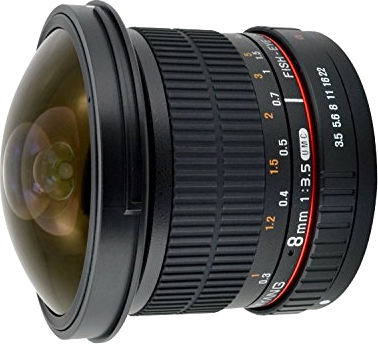
Samyang 8mm F/3.5 AS IF Fisheye UMC CS II DH
Samyang · 8 mm · f/3.5
Score Breakdown
Scores combine our editorial testing with published lab data.
General | |
|---|---|
About This LensThis Samyang prime is a fisheye for APS-C cameras. Its 8mm focal length is ultra-wide, with the bowed lines that define the fisheye look. Interiors, architecture and dramatic skies suit it, and it can make a small room feel spacious. Skate corridors and tunnels play to the same effect. The optical family comes in nine mounts, including Canon EF, Fujifilm X, Sony E, Nikon F, Pentax K and Micro Four Thirds. Pick the version made for your system, because one lens fits only its own mount. It is a manual-focus-only design from 2012 that remains in production. The trade-off is simple: you set focus by hand, so it rewards deliberate framing over fast-changing action. | |
| Brand | Samyang |
| Release Year | 2012 |
Production Status ⓘCurrent status of lens manufacturing (e.g., in production, discontinued). |  In Production In Production |
Version ⓘThe iteration or release number of a particular lens model. | II |
Lens Mount ⓘThe lens mount will tell you what type of lens range you can fit onto the camera body. Often the same camera company will have different lens ranges for different cameras. | Canon EF |
System ⓘIndicates which camera system the lens is designed to attach to. | Canon EOS |
Maximum Format ⓘLargest sensor size compatible with the lens. |  APS-C APS-C |
Physical50/100 | |
About the BuildThe Canon EF version weighs 15.5 oz (440 g). It measures about 3.06 in (77.8 mm) wide and 2.96 in (75.1 mm) long, so it is an easy lens to keep on the camera. That version has no front filter thread, so screw-in filters are not an option. Other mount versions differ in size and weight. | |
| Lens Weight | 440 g |
Lens Diameter ⓘWidth of the lens at its widest point | 77.8 mm |
Lens Length ⓘHow long the lens is from front to back. | 75.1 mm |
Front Filter Compatible ⓘSome lenses are compatible with front filters, some are compatible with back filters and some are compatible with both. Front filters are usually more convenient to add and remove. | No |
Optics55/100 | |
About the OpticsAt 8mm on APS-C, this lens is much wider than a standard wide-angle. Straight lines near the frame edges bow outward, which is the fisheye effect. That makes it a natural choice for tight rooms, stairwells and skies where the curvature becomes part of the picture. The f/3.5 maximum aperture is modest. It matters less here than on a standard lens, because at 8mm the depth of field runs deep even at middle distances. Focus set a little off still renders sharp, which is a real help when you work by hand. Focusing is manual only, using a dedicated focusing ring. Zone focusing works well here. Preset a distance and let the deep field carry the shot. For close work, take more care over the ring, because depth of field shrinks at close range. The Canon EF version focuses as close as 1 ft (30 cm). Its maximum magnification reaches 0.29x, so a near subject fills a large share of the frame. You can move in on a wall detail or a small object and still keep plenty of context around it. | |
Focal Range ⓘShortest to longest focal length of the lens (zoom range start - end ) | 8 mm |
Aperture Range ⓘLargest aperture at the lens's shortest focal length to longest focal length (aperture range start - end) | 3.5 |
| Focal Length Angle of View | 118.1° |
Flange Focal Distance ⓘDistance from lens mount to sensor. | 44 mm |
Diaphragm Type ⓘStructure and design of the aperture |  Manual Manual |
Blades ⓘNumber of diaphragm blades in aperture | 6020 |
Zoom Lens ⓘZoom allows you to vary the focal length, change between long shots and close-ups | No |
Closest Focusing Distance ⓘMinimum distance for a subject to be in focus. | 30 cm01500 |
Maximum Magnification ⓘLargest size a subject can be reproduced | 0.29x |
| Autofocus Mode | No |
| Manual Mode |  Yes Yes |
| Manual Focusing Ring |  Yes Yes |
Features19/100 | |
About the FeaturesImage stabilization is absent. That costs less at 8mm than it would on a longer lens, because a short focal length makes small camera movements less visible. Still, with an f/3.5 aperture in dim interiors, some support for the camera can help. For handheld daylight work, you will rarely miss it. The lens has no weather sealing, so keep it sheltered from rain and dust. No fluorine coating is fitted either, so give the front element ordinary care when you clean it. | |
Weather Sealing ⓘWeather sealing capabilities will give you more confidence when shooting in unfavourable conditions. | No |
Fluorine Coating ⓘCoating to repel water and oil from lens elements. | No |
| Built In Lens Hood | No |
| Lens Hood Type |  Petal Petal |
Teleconverter ⓘA teleconverter (extender) is an extra piece of equipment that fits between the lens and the camera body to enhance magnification |  Yes Yes |
| Image Stabilization | No |
Construction15/100 | |
About the ConstructionThe optical design uses 10 elements in 7 groups. Aspherical elements are part of the build, though their exact number is not published. Their specially shaped surfaces help correct optical faults, including spherical aberration. That correction work runs alongside a design where the bowed look is deliberate. | |
Elements ⓘLens elements refer to individual pieces of glass within the lens. | 10 |
| Groups | 7 |
Aspherical Elements ⓘThe number of aspherical lens elements which can help correct aberrations such as spherical aberration. | 1 |
Bi Aspherical Elements ⓘElements with two non-spherical surfaces | 0 |
Low Dispersion ⓘElements that reduce chromatic aberration | 0 |
Super Low Dispersion ⓘAdvanced elements further reducing chromatic aberration | 0 |
CA Reduction ⓘBuilt-in features to reduce chromatic aberration | 0 |
Internal Focusing ⓘInternal Focusing means that the lens does not change in size during focusing, and the front element does not rotate. | No |