
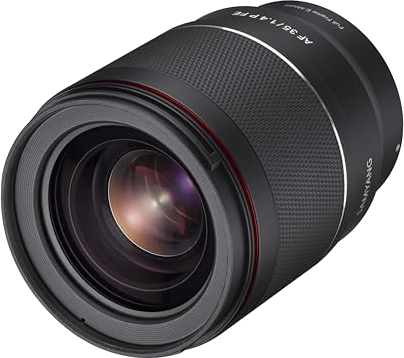
Samyang AF 35mm f/1.4 P FE
Samyang · 35 mm · f/1.4 · Prima
Score Breakdown
Scores combine our editorial testing with published lab data.
68
SCORE /100
What We Like
+Lightest AF 35mm f/1.4 lens available for Sony E-mount at 470g
+Excellent center sharpness and resolution, even at f/1.4 and on high-resolution 60MP sensors
+Industry-leading focus breathing suppression makes it excellent for video as well as stills
+Fast and quiet Linear STM autofocus with accurate tracking performance
+Excellent value—priced around $700 USD, significantly less than competing premium options
+Compact, portable design with weather-sealing at five points for reliable outdoor use
Worth Knowing
−No lens controls—lacks aperture ring, AF/MF switch, and all buttons; requires camera body control
−Edge and corner sharpness lags significantly behind center, especially at wide apertures
−Some optical aberrations noticeable at f/1.4; requires stopping down to f/2.8+ for optimal edge performance
−Minimal accessories; hood fit is reported as loose and may fall off during normal use
General | |
|---|---|
About This LensThe Samyang AF 35mm f/1.4 P FE, released in December 2024, is Samyang's third-generation 35mm design and the first lens in their new Prima series. Weighing only 470g, it's one of the lightest options in this class, while delivering excellent sharpness, smooth rendering, and natural colours, resolving detail on demanding 60MP sensors. The lens excels at focus breathing suppression for stable video, with subject size changes minimized even during close-to-infinity focus transitions. However, Samyang omitted all controls from the barrel—there's no aperture ring, AF/MF switch, or buttons, and the lens exhibits weak edge performance, with edges leaving much to be desired despite excellent center sharpness. | |
| Brand | Samyang |
| Release Year | 2024 |
Production Status ⓘCurrent status of lens manufacturing (e.g., in production, discontinued). |  In Production In Production |
Pro Branding ⓘSpecific branding codes used for professional-tier lenses. | Prima |
Lens Mount ⓘThe lens mount will tell you what type of lens range you can fit onto the camera body. Often the same camera company will have different lens ranges for different cameras. | Sony E |
System ⓘIndicates which camera system the lens is designed to attach to. | Sony E |
Maximum Format ⓘLargest sensor size compatible with the lens. |  Full Frame Full Frame |
Physical64/100 | |
| Lens Weight | 470 g |
Lens Diameter ⓘWidth of the lens at its widest point | 75 mm |
Lens Length ⓘHow long the lens is from front to back. | 99 mm |
Front Filter Compatible ⓘSome lenses are compatible with front filters, some are compatible with back filters and some are compatible with both. Front filters are usually more convenient to add and remove. |  Yes Yes |
Front Filter Size ⓘDiameter of attachable filters. | 67 mm |
Optics87/100 | |
Focal Range ⓘShortest to longest focal length of the lens (zoom range start - end ) | 35 mm |
Aperture Range ⓘLargest aperture at the lens's shortest focal length to longest focal length (aperture range start - end) | 1.4 |
| Focal Length Angle of View | 63.4° |
Flange Focal Distance ⓘDistance from lens mount to sensor. | 18 mm |
Diaphragm Type ⓘStructure and design of the aperture |  Automatic Automatic |
Blades ⓘNumber of diaphragm blades in aperture | 9020 |
Zoom Lens ⓘZoom allows you to vary the focal length, change between long shots and close-ups | No |
Closest Focusing Distance ⓘMinimum distance for a subject to be in focus. | 30 cm01500 |
Maximum Magnification ⓘLargest size a subject can be reproduced | 0.17x |
| Autofocus Mode |  Yes Yes |
| Manual Mode |  Yes Yes |
| Manual Focusing Ring |  Yes Yes |
Features32/100 | |
Weather Sealing ⓘWeather sealing capabilities will give you more confidence when shooting in unfavourable conditions. |  Yes Yes |
Fluorine Coating ⓘCoating to repel water and oil from lens elements. | No |
| Built In Lens Hood | No |
| Lens Hood Type |  Round Round |
Teleconverter ⓘA teleconverter (extender) is an extra piece of equipment that fits between the lens and the camera body to enhance magnification | No |
| Image Stabilization | No |
Construction54/100 | |
Elements ⓘLens elements refer to individual pieces of glass within the lens. | 12 |
| Groups | 10 |
Aspherical Elements ⓘThe number of aspherical lens elements which can help correct aberrations such as spherical aberration. | 3 |
Bi Aspherical Elements ⓘElements with two non-spherical surfaces | 0 |
Low Dispersion ⓘElements that reduce chromatic aberration | 1 |
Super Low Dispersion ⓘAdvanced elements further reducing chromatic aberration | 0 |
CA Reduction ⓘBuilt-in features to reduce chromatic aberration | 0 |
Internal Focusing ⓘInternal Focusing means that the lens does not change in size during focusing, and the front element does not rotate. |  Yes Yes |