
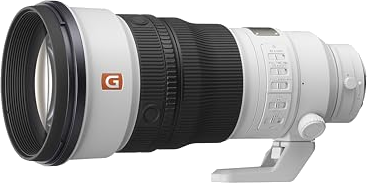
Sony FE 300mm F2.8 GM OSS
Sony · 300 mm · f/2.8 · GM · Image Stabilization
Score Breakdown
This product does not have an overall score yet.
General | |
|---|---|
About This LensThis Sony prime pairs a 300mm focal length with a bright f/2.8 aperture for full-frame E-mount cameras. It suits wildlife, birds and outdoor sport, where subjects often remain far away and light fades late in the day. Sony introduced this design in 2023. The main trade-off is the fixed focal length. There is no zoom for quick reframing, and the weight adds to a long carry. In return, this lens delivers a bright aperture at a long working distance. | |
| Brand | Sony |
| Release Year | 2023 |
Production Status ⓘCurrent status of lens manufacturing (e.g., in production, discontinued). |  In Production In Production |
Pro Branding ⓘSpecific branding codes used for professional-tier lenses. | GM |
Lens Mount ⓘThe lens mount will tell you what type of lens range you can fit onto the camera body. Often the same camera company will have different lens ranges for different cameras. | Sony E |
System ⓘIndicates which camera system the lens is designed to attach to. | Sony E |
Maximum Format ⓘLargest sensor size compatible with the lens. |  Full Frame Full Frame |
Physical | |
About the BuildThe lens weighs 3 lb 3.9 oz (1470 g), excluding the tripod mount. A monopod or tripod can ease the load during long sessions. The body measures 4.88 in (124 mm) across and 10.43 in (265 mm) long, making it a substantial addition to a camera. There is no front screw-in thread. Filters fit a rear drop-in holder instead, with a smaller opening behind the main optics. This lets you use suitable filters without fitting large glass across the front. | |
| Lens Weight | 1470 g |
Lens Diameter ⓘWidth of the lens at its widest point | 124 mm |
Lens Length ⓘHow long the lens is from front to back. | 265 mm |
Front Filter Compatible ⓘSome lenses are compatible with front filters, some are compatible with back filters and some are compatible with both. Front filters are usually more convenient to add and remove. | No |
Optics | |
About the OpticsA 300mm focal length makes distant subjects larger in the frame than a shorter lens from the same position. A bird across a marsh or a player downfield may still look small if far away. Plan your position around the distance, subject size and background you expect. The f/2.8 aperture provides more light than a smaller opening at the same focal length. That can help maintain faster shutter speeds at dawn or dusk. It can also soften a busy background, especially when the background lies well behind the subject. Distance still affects the amount of blur. Close focus reaches 6.6 ft (200 cm), measured from the sensor. Maximum magnification is 0.16x, useful for details such as larger flowers. The minimum focus distance is an optical limit, not a guide to how closely you should approach wildlife. Give animals enough space to behave normally. With no zoom, you adjust framing by changing position when possible. If a subject leaves the frame, re-aim or move to recover it. Cropping later can tighten a loose composition, but it cannot recover anything outside the captured image. | |
Focal Range ⓘShortest to longest focal length of the lens (zoom range start - end ) | 300 mm |
Aperture Range ⓘLargest aperture at the lens's shortest focal length to longest focal length (aperture range start - end) | 2.8 |
| Focal Length Angle of View | 8.167° |
Flange Focal Distance ⓘDistance from lens mount to sensor. | 18 mm |
Diaphragm Type ⓘStructure and design of the aperture |  Automatic Automatic |
Blades ⓘNumber of diaphragm blades in aperture | 11020 |
Zoom Lens ⓘZoom allows you to vary the focal length, change between long shots and close-ups | No |
Closest Focusing Distance ⓘMinimum distance for a subject to be in focus. | 200 cm01500 |
Maximum Magnification ⓘLargest size a subject can be reproduced | 0.16x |
| Autofocus Mode |  Yes Yes |
| Manual Mode |  Yes Yes |
| Manual Focusing Ring |  Yes Yes |
Features | |
About the FeaturesOptical SteadyShot reduces camera shake that becomes visible at 300mm. A steadier view can also help you frame a moving subject. Choose shutter speed for the action itself: stabilization does not stop a running player or a bird in flight. Support remains useful during long waits. Dust and moisture resistance suits outdoor work, though cover is useful in persistent rain. A fluorine coating on the front element helps water and oil wipe away. Remove loose grit before cleaning the glass after a dusty session. | |
Weather Sealing ⓘWeather sealing capabilities will give you more confidence when shooting in unfavourable conditions. |  Yes Yes |
Fluorine Coating ⓘCoating to repel water and oil from lens elements. |  Yes Yes |
| Built In Lens Hood | No |
| Lens Hood Type |  Round Round |
Teleconverter ⓘA teleconverter (extender) is an extra piece of equipment that fits between the lens and the camera body to enhance magnification |  Yes Yes |
| Image Stabilization | Yes |
Construction | |
About the ConstructionThe optical design has 21 elements in 17 groups, including one filter. Three Super ED elements and one ordinary ED element help reduce chromatic aberration. This fault creates coloured fringes along high-contrast edges, such as a dark bird against a bright sky. The two glass types serve that correction within the overall optical design. | |
Elements ⓘLens elements refer to individual pieces of glass within the lens. | 21 |
| Groups | 17 |
Aspherical Elements ⓘThe number of aspherical lens elements which can help correct aberrations such as spherical aberration. | 0 |
Bi Aspherical Elements ⓘElements with two non-spherical surfaces | 0 |
Low Dispersion ⓘElements that reduce chromatic aberration | 1 |
Super Low Dispersion ⓘAdvanced elements further reducing chromatic aberration | 3 |
CA Reduction ⓘBuilt-in features to reduce chromatic aberration | 4 |
Internal Focusing ⓘInternal Focusing means that the lens does not change in size during focusing, and the front element does not rotate. |  Yes Yes |