
Sony FE 50mm F/2.8 Macro SEL50M28
Sony · 50 mm · f/2.8
Score Breakdown
Scores combine our editorial testing with published lab data.
General | |
|---|---|
About This LensThis Sony prime is a macro lens for full-frame E-mount cameras. It handles close-up subjects such as plants, insects and small products, where fine detail matters. The 50mm focal length frames people and everyday scenes naturally too, so it can double as a walk-around lens. Its trade-offs are the f/2.8 maximum aperture and no built-in stabilization, which matter most in low light at close working distances. Sony launched this lens in 2016, so it is an older design, but it remains in production. Those who mainly shoot static subjects will notice these gaps least. A tripod offsets the missing stabilization for tabletop work. | |
| Brand | Sony |
| Release Year | 2016 |
Production Status ⓘCurrent status of lens manufacturing (e.g., in production, discontinued). |  In Production |
Lens Mount ⓘThe lens mount will tell you what type of lens range you can fit onto the camera body. Often the same camera company will have different lens ranges for different cameras. | Sony E |
System ⓘIndicates which camera system the lens is designed to attach to. | Sony E |
Maximum Format ⓘLargest sensor size compatible with the lens. |  Full Frame |
Physical64/100 | |
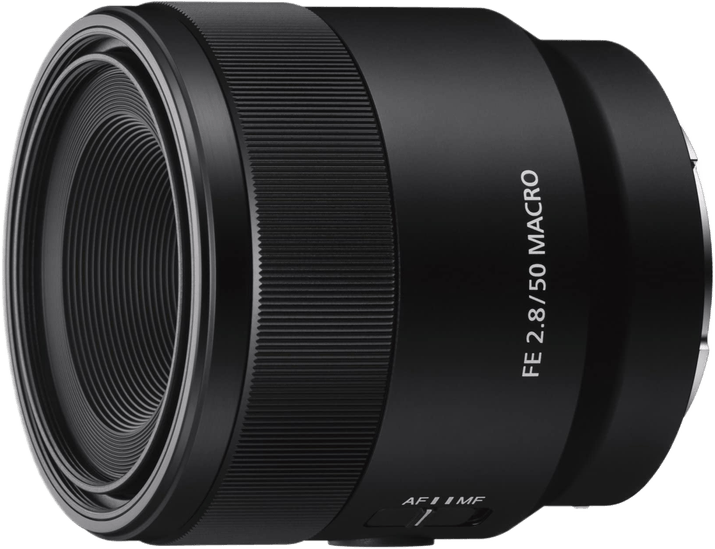
About the BuildAt 8.3 oz (236 g) and 2.8 in (71 mm) long, it is a small, light lens that carries easily. The body measures 2.79 in (70.8 mm) across. The front takes screw-in filters on a 55mm thread. A polariser can cut glare on wet leaves, and a plain filter guards the front element. | |
| Lens Weight | 236 g |
Lens Diameter ⓘWidth of the lens at its widest point | 70.8 mm |
Lens Length ⓘHow long the lens is from front to back. | 71 mm |
Front Filter Compatible ⓘSome lenses are compatible with front filters, some are compatible with back filters and some are compatible with both. Front filters are usually more convenient to add and remove. |  Yes |
Front Filter Size ⓘDiameter of attachable filters. | 55 mm |
Optics78/100 | |
About the OpticsThe headline specification is magnification. This lens reaches 1x, which is true life-size macro: the subject appears on the sensor at actual size. That suits tiny subjects such as insects, coins, stamps and jewellery, where fine texture is the point. It focuses as close as 0.5 ft (16 cm). At that distance the subject sits close to the front element, so light can struggle to reach it. A small LED panel placed beside the lens solves that without spooking live subjects. The maximum aperture is f/2.8. Depth of field at life-size magnification is extremely thin, so close-up work usually stops down for usable sharpness across a subject. Focus stacking, taking several shots at slightly shifted focus, is the common fix. For people and general scenes at ordinary distances, the 50mm focal length gives a natural perspective. Food and indoor product shots also work well at this focal length. At f/2.8, portraits get less background blur than a faster 50mm prime gives wide open. Its optics specification score is 78/100. | |
Focal Range ⓘShortest to longest focal length of the lens (zoom range start - end ) | 50 mm |
Aperture Range ⓘLargest aperture at the lens's shortest focal length to longest focal length (aperture range start - end) | 2.8 |
| Focal Length Angle of View | 46.8° |
Flange Focal Distance ⓘDistance from lens mount to sensor. | 18 mm |
Diaphragm Type ⓘStructure and design of the aperture |  Automatic |
Blades ⓘNumber of diaphragm blades in aperture | 7020 |
Zoom Lens ⓘZoom allows you to vary the focal length, change between long shots and close-ups | No |
Closest Focusing Distance ⓘMinimum distance for a subject to be in focus. | 16 cm01500 |
Maximum Magnification ⓘLargest size a subject can be reproduced | 1x |
| Autofocus Mode |  Yes |
| Manual Mode |  Yes |
| Manual Focusing Ring |  Yes |
Features32/100 | |
About the FeaturesThere is no built-in stabilization. At macro distances even small hand movements show in the frame, so a tripod, a focusing rail or a flash becomes part of the routine. Faster shutter speeds carry the rest of the load, but they demand more light in return. The features score is 32/100. It does carry weather sealing, which helps in damp or dusty outdoor conditions when shooting plants and insects. There is no fluorine coating on the surfaces, so cleaning dust and smears takes a little more care. The sealing matters when working low among plants in dew. | |
Weather Sealing ⓘWeather sealing capabilities will give you more confidence when shooting in unfavourable conditions. |  Yes |
Fluorine Coating ⓘCoating to repel water and oil from lens elements. | No |
| Built In Lens Hood | No |
Teleconverter ⓘA teleconverter (extender) is an extra piece of equipment that fits between the lens and the camera body to enhance magnification | No |
| Image Stabilization | No |
Construction31/100 | |
About the ConstructionThe eight elements in seven groups include aspherical surfaces and low-dispersion glass. The aspherical surfaces help correct distortion and spherical aberration. The low-dispersion glass helps reduce chromatic aberration, which appears as coloured fringes along high-contrast edges such as a shiny beetle's back. Fringes show most easily on small, detailed close-up subjects, so the glass choice suits this lens's purpose. Its construction specification score is 31/100. | |
Elements ⓘLens elements refer to individual pieces of glass within the lens. | 8 |
| Groups | 7 |
Aspherical Elements ⓘThe number of aspherical lens elements which can help correct aberrations such as spherical aberration. | 1 |
Bi Aspherical Elements ⓘElements with two non-spherical surfaces | 0 |
Low Dispersion ⓘElements that reduce chromatic aberration | 1 |
Super Low Dispersion ⓘAdvanced elements further reducing chromatic aberration | 0 |
CA Reduction ⓘBuilt-in features to reduce chromatic aberration | 0 |
Internal Focusing ⓘInternal Focusing means that the lens does not change in size during focusing, and the front element does not rotate. | No |