
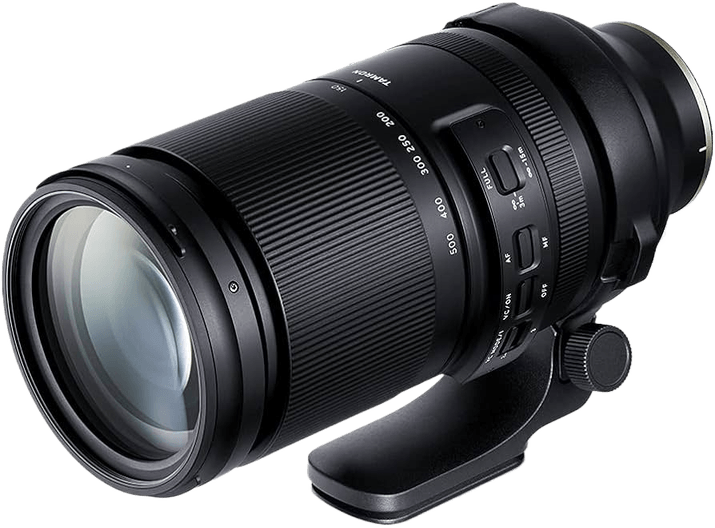
Tamron 150-500mm F/5-6.7 Di III VC VXD A057
Tamron · 150–500 mm · f/5–6.7 · Image Stabilization
Score Breakdown
Scores combine our editorial testing with published lab data.
General | |
|---|---|
About This LensThis Tamron 150–500mm zoom suits distant subjects such as birds, wild mammals and outdoor sport. You can tighten the view on one animal or zoom out to include more of its surroundings. It also suits airshows in suitable conditions. Separate versions fit Sony E, Fujifilm X and Nikon Z cameras. The Sony E version arrived in 2021, Fujifilm X in 2022 and Nikon Z in 2023. Sony E and Nikon Z support full-frame bodies; Fujifilm X cameras use APS-C sensors, which give a narrower view from the same position. The main trade-offs are weight and a maximum aperture that narrows as you zoom. Bright conditions make it easier to keep a fast shutter speed for action. | |
| Brand | Tamron |
| Release Year | 2021 |
Production Status ⓘCurrent status of lens manufacturing (e.g., in production, discontinued). |  In Production In Production |
Version ⓘThe iteration or release number of a particular lens model. | III |
Lens Mount ⓘThe lens mount will tell you what type of lens range you can fit onto the camera body. Often the same camera company will have different lens ranges for different cameras. | Sony E |
System ⓘIndicates which camera system the lens is designed to attach to. | Sony E |
Maximum Format ⓘLargest sensor size compatible with the lens. |  Full Frame Full Frame |
Physical64/100 | |
About the BuildThe Fujifilm X version weighs 3 lb 12.3 oz (1710 g) without its tripod mount and measures 8.26 in (209.9 mm) long. Its body is 3.66 in (93 mm) across. Other mounts differ. Support helps during long sessions. Screw-in filters must match the 82mm front thread. | |
| Lens Weight | 1725 g |
Lens Diameter ⓘWidth of the lens at its widest point | 93 mm |
Lens Length ⓘHow long the lens is from front to back. | 209.6 mm |
Front Filter Compatible ⓘSome lenses are compatible with front filters, some are compatible with back filters and some are compatible with both. Front filters are usually more convenient to add and remove. |  Yes Yes |
Front Filter Size ⓘDiameter of attachable filters. | 82 mm |
Optics48/100 | |
About the OpticsAt 150mm, you can include a larger animal or some of its habitat. Zooming toward 500mm tightens the view from the same position. This helps when your location is fixed. Maximum aperture runs from f/5 at 150mm to f/6.7 at 500mm. As the aperture narrows, shutter speed becomes the working constraint. A bird in flight in soft light may need a higher ISO to keep the shutter fast enough. In strong daylight the aperture is easier to live with. Closest focus is 2 ft (60 cm) at 150mm, measured from the sensor. At that setting, maximum magnification is 0.32x. At 500mm, the minimum distance is longer and magnification falls to 0.27x. A nearby bird can become too close to focus when you zoom in. Long settings can soften a distant background behind a nearby animal. The separation depends on the distances involved, even at f/6.7. Branches directly behind a bird can remain distracting. Moving to a different viewpoint, when possible, can give the subject a clearer backdrop. | |
Focal Range ⓘShortest to longest focal length of the lens (zoom range start - end ) | 150–500 mm |
Aperture Range ⓘLargest aperture at the lens's shortest focal length to longest focal length (aperture range start - end) | 5–6.7 |
| Focal Length Angle of View | 16.41°–4.96° |
Flange Focal Distance ⓘDistance from lens mount to sensor. | 18 mm |
Diaphragm Type ⓘStructure and design of the aperture |  Automatic Automatic |
Blades ⓘNumber of diaphragm blades in aperture | 7020 |
Zoom Lens ⓘZoom allows you to vary the focal length, change between long shots and close-ups |  Yes Yes |
Zoom Mechanism ⓘSystem enabling zoom function |  Manual Manual |
Zoom Ring ⓘIf zooming is adjusted using a zoom ring |  Yes Yes |
Zoom Type ⓘThe design or approach to zooming |  Rotary Rotary |
Closest Focusing Distance ⓘMinimum distance for a subject to be in focus. | 60 cm01500 |
Maximum Magnification ⓘLargest size a subject can be reproduced | 0.32x |
| Autofocus Mode |  Yes Yes |
| Manual Mode |  Yes Yes |
| Manual Focusing Ring |  Yes Yes |
Features88/100 | |
About the FeaturesThe built-in VC stabilization counters the camera shake that long focal lengths magnify. It steadies framing in your hands, so handheld work at 500mm becomes more practical. It does not freeze a running animal, so motion blur remains a shutter-speed decision. Moisture-resistant construction helps outdoors. Use cover in persistent rain. A fluorine coating helps water and oily marks wipe away from the front glass. Remove loose grit before wiping it. The FLEX ZOOM LOCK can hold any zoom position. Slide the zoom ring to engage or release it. This helps prevent the barrel moving under its own weight while carrying or using the lens. | |
Weather Sealing ⓘWeather sealing capabilities will give you more confidence when shooting in unfavourable conditions. |  Yes Yes |
Fluorine Coating ⓘCoating to repel water and oil from lens elements. |  Yes Yes |
| Built In Lens Hood | No |
| Lens Hood Type |  Round Round |
Zoom Lock ⓘZoom lock allows the zoom ring to be locked at the desired focal length |  Yes Yes |
Teleconverter ⓘA teleconverter (extender) is an extra piece of equipment that fits between the lens and the camera body to enhance magnification |  Yes Yes |
| Image Stabilization | Yes |
IS Efficiency ⓘIS efficiency refers to the effectiveness of the image stabilization system in compensating for the blurring effects of camera shake, quantified by the number of stops of stabilization it provides. | 3 stops |
Construction54/100 | |
About the ConstructionThe shared design uses 25 elements in 16 groups. Five LD elements and one XLD element help reduce chromatic aberration, which can leave coloured fringes along high-contrast edges. A bird against bright sky is one place those fringes can show. Two hybrid aspherical elements help correct distortion and spherical aberration, which can bend lines or soften detail. The Fujifilm X version uses internal focusing, so focusing does not extend its barrel. | |
Elements ⓘLens elements refer to individual pieces of glass within the lens. | 25 |
| Groups | 16 |
Aspherical Elements ⓘThe number of aspherical lens elements which can help correct aberrations such as spherical aberration. | 2 |
Bi Aspherical Elements ⓘElements with two non-spherical surfaces | 0 |
Low Dispersion ⓘElements that reduce chromatic aberration | 6 |
Super Low Dispersion ⓘAdvanced elements further reducing chromatic aberration | 0 |
CA Reduction ⓘBuilt-in features to reduce chromatic aberration | 0 |
Internal Focusing ⓘInternal Focusing means that the lens does not change in size during focusing, and the front element does not rotate. | No |