
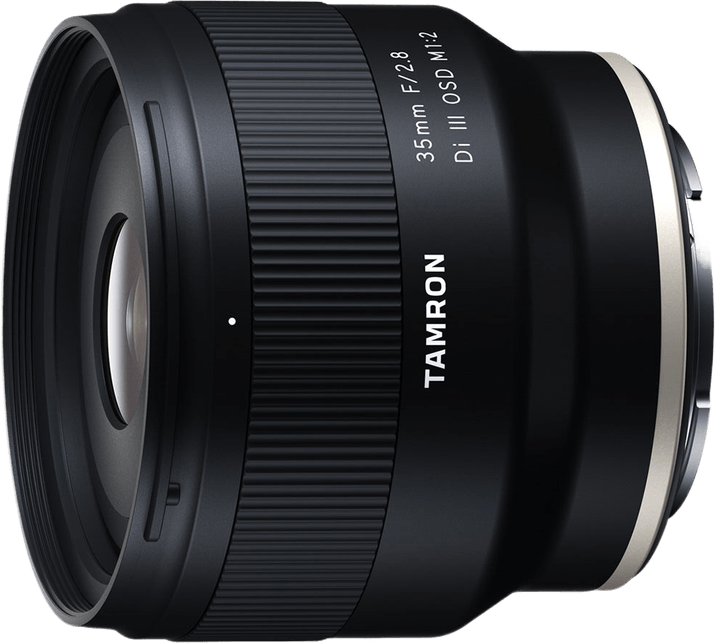
Tamron 35mm F/2.8 Di III OSD F053
Tamron · 35 mm · f/2.8
Score Breakdown
This lens score is calculated from published specifications.
General | |
|---|---|
About This LensThis compact Tamron prime pairs a 35mm focal length with a maximum aperture of f/2.8. It mounts on Sony E cameras and covers full frame. Tamron released it in 2019, and it remains in production. As a prime, it gives up zoom flexibility in exchange for a small body and simple handling. The 35mm length suits street, travel and everyday documentary shooting. It also works indoors, where a moderate view helps in tight rooms. The maximum aperture is the main trade-off. A faster prime would blur backgrounds more strongly and gather more light in dim rooms. | |
| Brand | Tamron |
| Release Year | 2019 |
Production Status ⓘCurrent status of lens manufacturing (e.g., in production, discontinued). |  In Production |
Version ⓘThe iteration or release number of a particular lens model. | III |
Lens Mount ⓘThe lens mount will tell you what type of lens range you can fit onto the camera body. Often the same camera company will have different lens ranges for different cameras. | Sony E |
System ⓘIndicates which camera system the lens is designed to attach to. | Sony E |
Maximum Format ⓘLargest sensor size compatible with the lens. |  Full Frame |
Physical64/100 | |
About the BuildThe lens weighs 7.4 oz (210 g), which is light for a full-frame prime. The body measures 2.87 in (73 mm) across and 2.52 in (64 mm) long, so it sits small on the camera. Screw-in filters attach directly to the 67mm thread. | |
| Lens Weight | 210 g |
Lens Diameter ⓘWidth of the lens at its widest point | 73 mm |
Lens Length ⓘHow long the lens is from front to back. | 64 mm |
Front Filter Compatible ⓘSome lenses are compatible with front filters, some are compatible with back filters and some are compatible with both. Front filters are usually more convenient to add and remove. |  Yes |
Front Filter Size ⓘDiameter of attachable filters. | 67 mm |
Optics77/100 | |
About the OpticsOn full frame, 35mm gives a moderate, natural view. It frames a subject together with useful surroundings, which suits street and documentary work. Indoors, it fits rooms and small groups without forcing you far back. For travel, the same view serves markets, interiors and quiet streets. The f/2.8 maximum admits a moderate amount of light. It handles overcast daylight and lamp-lit interiors, and it can soften backgrounds at portrait distance. Strong subject separation is harder here than with a faster prime, so distant backgrounds stay more present in the frame. Evening streets and restaurants stay reachable with a raised ISO. The extra depth of field at f/2.8 also makes focus more forgiving. Stopped down further, the lens suits scenes where depth of field should run deep. Seven aperture blades help shape out-of-focus highlights. Close work is a real strength. The lens focuses as close as 0.5 ft (15 cm), so you can move right up to a subject. A dish on a table, a flower or a market find can fill much of the frame at that distance. On travel days, this near focus gives the lens a second use alongside wide scenes. Wide open, a close subject separates gently from its background. | |
Focal Range ⓘShortest to longest focal length of the lens (zoom range start - end ) | 35 mm |
Aperture Range ⓘLargest aperture at the lens's shortest focal length to longest focal length (aperture range start - end) | 2.8 |
| Focal Length Angle of View | 63.443975666842476° |
Flange Focal Distance ⓘDistance from lens mount to sensor. | 18 mm |
Diaphragm Type ⓘStructure and design of the aperture |  Automatic |
Blades ⓘNumber of diaphragm blades in aperture | 7020 |
Zoom Lens ⓘZoom allows you to vary the focal length, change between long shots and close-ups | No |
Closest Focusing Distance ⓘMinimum distance for a subject to be in focus. | 15 cm01500 |
Maximum Magnification ⓘLargest size a subject can be reproduced | 0.5x |
| Autofocus Mode |  Yes |
| Manual Mode |  Yes |
| Manual Focusing Ring |  Yes |
Features71/100 | |
About the FeaturesThe lens carries weather sealing, which suits outdoor and travel shooting. The sealing helps when rain or dust catches you out. A fluorine coating on the front glass helps shed water and oil, so fingerprints and dust wipe away easily. These protections suit a lens meant to stay fitted from morning to night. There is no built-in image stabilization. After dark, the shutter speed matters more with this lens. For handheld shots in dim light, plan on a steady hold, a higher ISO or support. Sensor stabilisation in the camera body, where present, may help instead. A tripod steadies the camera for still subjects and long exposures. The features specification scores 71 out of 100. | |
Weather Sealing ⓘWeather sealing capabilities will give you more confidence when shooting in unfavourable conditions. |  Yes |
Fluorine Coating ⓘCoating to repel water and oil from lens elements. |  Yes |
| Built In Lens Hood | No |
| Lens Hood Type |  Dome |
Teleconverter ⓘA teleconverter (extender) is an extra piece of equipment that fits between the lens and the camera body to enhance magnification |  Yes |
| Image Stabilization | No |
Construction31/100 | |
About the ConstructionThe design includes aspherical elements. Their specially shaped surfaces help correct distortion and spherical aberration, faults that can bend straight edges in architectural frames. Low-dispersion glass helps reduce chromatic aberration, which shows as coloured fringes along high-contrast edges. Both choices fit a lens aimed at everyday subjects. | |
Elements ⓘLens elements refer to individual pieces of glass within the lens. | 9 |
| Groups | 8 |
Aspherical Elements ⓘThe number of aspherical lens elements which can help correct aberrations such as spherical aberration. | 1 |
Bi Aspherical Elements ⓘElements with two non-spherical surfaces | 0 |
Low Dispersion ⓘElements that reduce chromatic aberration | 1 |
Super Low Dispersion ⓘAdvanced elements further reducing chromatic aberration | 0 |
CA Reduction ⓘBuilt-in features to reduce chromatic aberration | 0 |
Internal Focusing ⓘInternal Focusing means that the lens does not change in size during focusing, and the front element does not rotate. | No |