
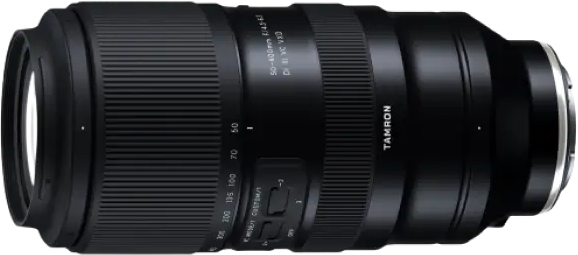
Tamron 50-400mm f/4.5-6.3 Di III VC VXD (Model A067)
Tamron · 50–400 mm · f/4.5–6.3 · Image Stabilization
Score Breakdown
This product does not have an overall score yet.
General | |
|---|---|
About This LensThis Tamron zoom gives a full-frame mirrorless camera a 50–400mm range. Separate versions fit Nikon Z and Sony E bodies. Choose the version that matches your camera mount. The span suits wildlife and outdoor sport where the distance to a subject changes. The Sony E version arrived in 2022 and Nikon Z followed in 2024. The main trade-off is light gathering. The maximum aperture narrows as you zoom, so bright conditions make fast action easier. Both versions share the same optical design. | |
| Brand | Tamron |
| Release Year | 2024 |
Production Status ⓘCurrent status of lens manufacturing (e.g., in production, discontinued). |  In Production In Production |
Lens Mount ⓘThe lens mount will tell you what type of lens range you can fit onto the camera body. Often the same camera company will have different lens ranges for different cameras. | Nikon Z |
System ⓘIndicates which camera system the lens is designed to attach to. | Nikon Z |
Maximum Format ⓘLargest sensor size compatible with the lens. |  Full Frame Full Frame |
Physical | |
About the BuildThe Nikon Z version weighs 2 lb 9.6 oz (1180 g) and runs 7.31 in (185.8 mm) long. Both figures are for the Nikon Z version only. The body is 3.48 in (88.5 mm) across. The front takes screw-in filters of 67mm, so a polariser or ND filter threads straight on. A polariser can cut glare off water around lakes and wetlands. | |
| Lens Weight | 1180 g |
Lens Diameter ⓘWidth of the lens at its widest point | 88.5 mm |
Lens Length ⓘHow long the lens is from front to back. | 185.8 mm |
Front Filter Compatible ⓘSome lenses are compatible with front filters, some are compatible with back filters and some are compatible with both. Front filters are usually more convenient to add and remove. |  Yes Yes |
Front Filter Size ⓘDiameter of attachable filters. | 67 mm |
Optics | |
About the OpticsAt 50mm, you can show a person or animal with some surroundings. Zooming toward 400mm makes a distant subject larger from the same position. The framing available still depends on the distance. The standard short end includes more than a lens that starts at a longer focal length, but it does not replace a wide-angle view. The maximum aperture changes from f/4.5 at 50mm to f/6.3 at 400mm. In woodland shade or fading evening light, a high shutter speed may need a higher ISO. A still subject gives you more freedom to slow the shutter when the camera is steady. Closest focus is 0.8 ft (25 cm) at 50mm, measured from the sensor. Maximum magnification reaches 0.5x from 50mm to 70mm, recording subjects at half their actual size on the sensor. At 400mm, the minimum distance is longer and magnification falls to 0.25x. These limits apply to both mounts. For close flowers or small objects, leave room ahead of the glass and avoid shading the subject. Depth of field is thin at high magnification. Focus on the detail that matters most, then stop down if more must stay sharp. | |
Focal Range ⓘShortest to longest focal length of the lens (zoom range start - end ) | 50–400 mm |
Aperture Range ⓘLargest aperture at the lens's shortest focal length to longest focal length (aperture range start - end) | 4.5–6.3 |
| Focal Length Angle of View | 46.8°–6.183° |
Flange Focal Distance ⓘDistance from lens mount to sensor. | 16 mm |
Diaphragm Type ⓘStructure and design of the aperture |  Automatic Automatic |
Blades ⓘNumber of diaphragm blades in aperture | 9020 |
Zoom Lens ⓘZoom allows you to vary the focal length, change between long shots and close-ups |  Yes Yes |
Zoom Mechanism ⓘSystem enabling zoom function |  Manual Manual |
Zoom Ring ⓘIf zooming is adjusted using a zoom ring |  Yes Yes |
Zoom Type ⓘThe design or approach to zooming |  Rotary Rotary |
Closest Focusing Distance ⓘMinimum distance for a subject to be in focus. | 25 cm01500 |
Maximum Magnification ⓘLargest size a subject can be reproduced | 0.5x |
| Autofocus Mode |  Yes Yes |
| Manual Mode |  Yes Yes |
| Manual Focusing Ring |  Yes Yes |
Features | |
About the FeaturesBuilt-in VC stabilization reduces camera shake and steadies handheld framing. At 400mm, small hand movements have a greater effect on the image. Firm support helps during long waits. A moving animal still needs enough shutter speed for its movement. Moisture-resistant construction helps outdoors. Use cover in persistent rain. A fluorine coating helps water and oily marks wipe away from the front glass. Remove loose grit before using a cloth. The zoom ring works manually. A lock holds it at the retracted 50mm setting for carrying. Release the lock before changing focal length. | |
Weather Sealing ⓘWeather sealing capabilities will give you more confidence when shooting in unfavourable conditions. |  Yes Yes |
Fluorine Coating ⓘCoating to repel water and oil from lens elements. |  Yes Yes |
| Built In Lens Hood | No |
| Lens Hood Type |  Petal Petal |
Zoom Lock ⓘZoom lock allows the zoom ring to be locked at the desired focal length |  Yes Yes |
Teleconverter ⓘA teleconverter (extender) is an extra piece of equipment that fits between the lens and the camera body to enhance magnification | No |
| Image Stabilization | Yes |
Construction | |
About the ConstructionTwo aspherical elements help correct distortion and spherical aberration, which can bend lines or soften detail. Two XLD and three LD elements help reduce coloured fringes along high-contrast edges. A dark bird against bright sky is one place those fringes can appear. | |
Elements ⓘLens elements refer to individual pieces of glass within the lens. | 24 |
| Groups | 18 |
Aspherical Elements ⓘThe number of aspherical lens elements which can help correct aberrations such as spherical aberration. | 2 |
Bi Aspherical Elements ⓘElements with two non-spherical surfaces | 0 |
Super Low Dispersion ⓘAdvanced elements further reducing chromatic aberration | 0 |
CA Reduction ⓘBuilt-in features to reduce chromatic aberration | 0 |
Internal Focusing ⓘInternal Focusing means that the lens does not change in size during focusing, and the front element does not rotate. |  Yes Yes |