
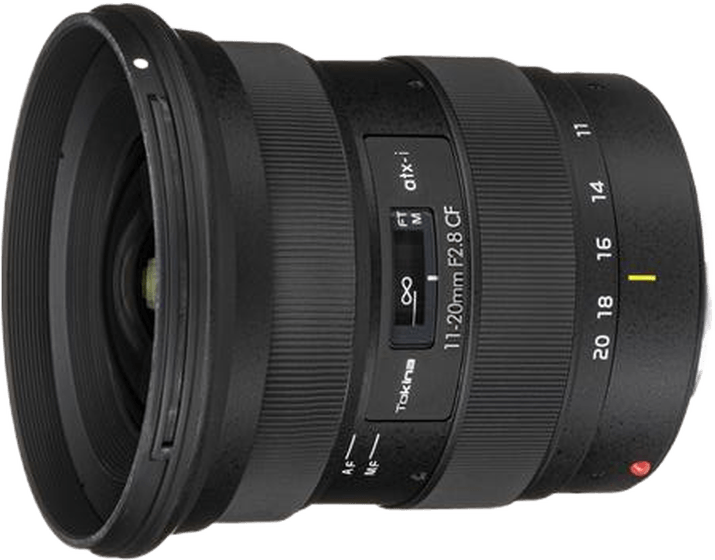
Tokina atx-i 11-20mm F/2.8 CF
Tokina · 11–20 mm · f/2.8 · AT-X
Score Breakdown
Scores combine our editorial testing with published lab data.
General | |
|---|---|
About This LensThe Tokina atx-i 11-20mm F/2.8 CF is an ultra-wide zoom for APS-C cameras. Tokina sells it in Nikon F and Canon EF versions, so pick the one made for your mount. Both versions share the same optical design. It launched in 2020 and remains in production. That range suits anyone shooting interiors, architecture or wide landscapes. At 11mm you can frame a whole room from a corner, and at 20mm scenes look less stretched when you want a calmer view. The constant f/2.8 maximum aperture also keeps evening and night work practical. The main trade-off is the short feature set, which later sections cover. | |
| Brand | Tokina |
| Release Year | 2020 |
Production Status ⓘCurrent status of lens manufacturing (e.g., in production, discontinued). |  In Production In Production |
Pro Branding ⓘSpecific branding codes used for professional-tier lenses. | AT-X |
Lens Mount ⓘThe lens mount will tell you what type of lens range you can fit onto the camera body. Often the same camera company will have different lens ranges for different cameras. | Canon EF |
System ⓘIndicates which camera system the lens is designed to attach to. | Canon EOS |
Maximum Format ⓘLargest sensor size compatible with the lens. |  APS-C APS-C |
Physical85/100 | |
About the BuildIt weighs 1 lb 4.1 oz (570 g) and runs 3.7 in (94 mm) long, with a 3.5 in (89 mm) body. At that weight it is easy to carry through a long interior shoot. The 82mm front thread accepts standard screw-in filters, so a polariser or ND filter mounts directly. | |
| Lens Weight | 570 g |
Lens Diameter ⓘWidth of the lens at its widest point | 89 mm |
Lens Length ⓘHow long the lens is from front to back. | 94 mm |
Front Filter Compatible ⓘSome lenses are compatible with front filters, some are compatible with back filters and some are compatible with both. Front filters are usually more convenient to add and remove. |  Yes Yes |
Front Filter Size ⓘDiameter of attachable filters. | 82 mm |
Optics80/100 | |
About the OpticsOn an APS-C sensor, 11–20mm is a true ultra-wide range. The 11mm end fits whole rooms or courtyard interiors into a frame when walls hem you in. The 20mm end still reads as wide, but it stretches buildings and faces at the edges less strongly. The maximum aperture stays at f/2.8 through the whole zoom, so exposure stays predictable as you zoom. That helps in dim churches, showrooms and evening streets, where you can keep shutter speeds reasonable without pushing ISO. It suits night-sky work too. At 11mm, f/2.8 gathers starlight faster than a slower zoom would, so exposures can stay short enough to hold stars as points. Closest focusing is 0.9 ft (28 cm) from the subject. That lets you place a foreground rock, plant or doorway close to the camera. Wide focal lengths then keep much of the scene sharp behind it. The nine blades keep the aperture round when you stop down, which shapes sunstars and highlights more cleanly. | |
Focal Range ⓘShortest to longest focal length of the lens (zoom range start - end ) | 11–20 mm |
Aperture Range ⓘLargest aperture at the lens's shortest focal length to longest focal length (aperture range start - end) | 2.8 |
| Focal Length Angle of View | 100.98285494871264°–67.40657518970592° |
Flange Focal Distance ⓘDistance from lens mount to sensor. | 44 mm |
Diaphragm Type ⓘStructure and design of the aperture |  Automatic Automatic |
Blades ⓘNumber of diaphragm blades in aperture | 9020 |
Zoom Lens ⓘZoom allows you to vary the focal length, change between long shots and close-ups |  Yes Yes |
Zoom Mechanism ⓘSystem enabling zoom function |  Manual Manual |
Zoom Ring ⓘIf zooming is adjusted using a zoom ring |  Yes Yes |
Zoom Type ⓘThe design or approach to zooming |  Rotary Rotary |
Closest Focusing Distance ⓘMinimum distance for a subject to be in focus. | 28 cm01500 |
Maximum Magnification ⓘLargest size a subject can be reproduced | 0.12x |
| Autofocus Mode |  Yes Yes |
| Manual Mode |  Yes Yes |
| Manual Focusing Ring |  Yes Yes |
Features19/100 | |
About the FeaturesThis lens keeps its feature list short. There is no image stabilization, so any shake correction has to come from your camera or your technique. At 11–20mm the wide view hides small camera movement better than a telephoto would, but the lens itself adds nothing. For handheld shots, brace your elbows or rest the camera on a solid surface. There is no weather sealing either, so keep rain and dust away from it on location. No zoom lock is fitted, so nothing holds the zoom ring at a chosen focal length. And there is no fluorine coating on the front element. The Nikon F version also skips internal focusing. The features score is 19/100. | |
Weather Sealing ⓘWeather sealing capabilities will give you more confidence when shooting in unfavourable conditions. | No |
Fluorine Coating ⓘCoating to repel water and oil from lens elements. | No |
| Built In Lens Hood | No |
| Lens Hood Type |  Petal Petal |
Zoom Lock ⓘZoom lock allows the zoom ring to be locked at the desired focal length | No |
Teleconverter ⓘA teleconverter (extender) is an extra piece of equipment that fits between the lens and the camera body to enhance magnification |  Yes Yes |
| Image Stabilization | No |
Construction15/100 | |
About the ConstructionThe optical formula uses 14 elements in 12 groups, including aspherical elements. Those specially shaped surfaces help reduce distortion and spherical aberration, faults that wide lenses often struggle with. That correction matters when straight edges fill the frame, such as in architecture. No low-dispersion glass appears in the formula. The construction score is 15/100. | |
Elements ⓘLens elements refer to individual pieces of glass within the lens. | 14 |
| Groups | 12 |
Aspherical Elements ⓘThe number of aspherical lens elements which can help correct aberrations such as spherical aberration. | 1 |
Bi Aspherical Elements ⓘElements with two non-spherical surfaces | 0 |
Low Dispersion ⓘElements that reduce chromatic aberration | 0 |
Super Low Dispersion ⓘAdvanced elements further reducing chromatic aberration | 0 |
CA Reduction ⓘBuilt-in features to reduce chromatic aberration | 0 |
Internal Focusing ⓘInternal Focusing means that the lens does not change in size during focusing, and the front element does not rotate. |  Yes Yes |