
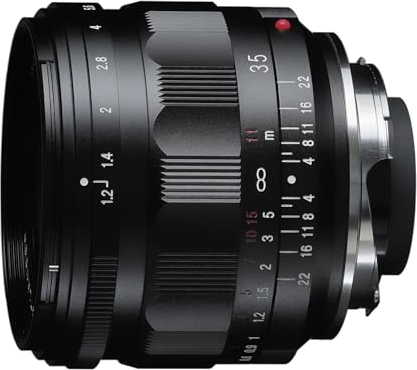
Voigtlander Nokton 35mm f/1.2 Aspherical IV VM
Voigtlander · 35 mm · f/1.2 · NOKTON
Score Breakdown
Scores combine our editorial testing with published lab data.
General | |
|---|---|
About This LensVoigtlander built this lens for Leica M full-frame cameras. The Nokton 35mm f/1.2 Aspherical IV VM is a fast, manual-focus prime. It arrived in 2025 and remains in production. A 35mm lens with an f/1.2 aperture suits street, travel and documentary work. It handles people indoors, at dusk, or on busy pavements. Candid portraits, quiet reportage and dim restaurants are all natural territory. The 35mm view also suits environmental portraits where the scene matters as much as the face. The trade-off is effort. Focus is set entirely by hand, with no autofocus motor to help. That suits slow, deliberate photography more than fast action. The rangefinder patch keeps focusing fairly quick once you are used to it. | |
| Brand | Voigtlander |
| Release Year | 2025 |
Production Status ⓘCurrent status of lens manufacturing (e.g., in production, discontinued). |  In Production In Production |
Version ⓘThe iteration or release number of a particular lens model. | IV |
Pro Branding ⓘSpecific branding codes used for professional-tier lenses. | NOKTON |
Lens Mount ⓘThe lens mount will tell you what type of lens range you can fit onto the camera body. Often the same camera company will have different lens ranges for different cameras. | Leica M |
System ⓘIndicates which camera system the lens is designed to attach to. | Leica M |
Maximum Format ⓘLargest sensor size compatible with the lens. |  Full Frame Full Frame |
Physical93/100 | |
About the BuildAt 10.6 oz (300 g), and 2.43 in (61.8 mm) wide by 2.04 in (51.8 mm) long, this is a small, light lens. It keeps an M kit easy to carry all day. The front takes screw-in filters directly, in a handy 52mm thread. That size is shared by many other primes, so one filter set can serve several lenses. | |
| Lens Weight | 300 g |
Lens Diameter ⓘWidth of the lens at its widest point | 61.8 mm |
Lens Length ⓘHow long the lens is from front to back. | 51.8 mm |
Front Filter Compatible ⓘSome lenses are compatible with front filters, some are compatible with back filters and some are compatible with both. Front filters are usually more convenient to add and remove. |  Yes Yes |
Front Filter Size ⓘDiameter of attachable filters. | 52 mm |
Optics76/100 | |
About the OpticsOn full frame, 35mm gives a natural, slightly wide view. You can fit a person and their surroundings in one frame. Street corners, market stalls and table scenes all suit this framing. Close focus sits at 1.6 ft (50 cm), which covers table scenes, shop counters and portraits at conversational distance. The f/1.2 maximum aperture is the defining strength. It gathers far more light than an f/2 lens, so dim interiors and evening streets stay within reach without pushing sensitivity high. Wide open, depth of field is shallow. A portrait subject stands clear of a busy background. That shallowness also demands precise rangefinder focus on the eye. At portrait distance, even small focus errors show. Stopping down a little deepens that zone for group shots. Twelve aperture blades keep the opening round as you stop down. Out-of-focus lamps and windows then render as smooth circles rather than shapes. | |
Focal Range ⓘShortest to longest focal length of the lens (zoom range start - end ) | 35 mm |
Aperture Range ⓘLargest aperture at the lens's shortest focal length to longest focal length (aperture range start - end) | 1.2 |
| Focal Length Angle of View | 61.5° |
Flange Focal Distance ⓘDistance from lens mount to sensor. | 27.8 mm |
Diaphragm Type ⓘStructure and design of the aperture |  Manual Manual |
Blades ⓘNumber of diaphragm blades in aperture | 12020 |
Zoom Lens ⓘZoom allows you to vary the focal length, change between long shots and close-ups | No |
Closest Focusing Distance ⓘMinimum distance for a subject to be in focus. | 50 cm01500 |
Maximum Magnification ⓘLargest size a subject can be reproduced | 0.08x |
| Autofocus Mode | No |
| Manual Mode |  Yes Yes |
| Manual Focusing Ring |  Yes Yes |
Features | |
About the FeaturesThe feature list is short by design. There is no image stabilization, so dim-light support comes from the wide aperture and a steady hold. A monopod or tripod covers the rest when light falls very low. The lens has no weather sealing. Rain, spray and heavy dust call for shelter or a wipe-down after shooting. No fluorine coating is fitted either, so the front element offers no extra resistance to marks and moisture. Focusing uses the ring alone, coupled to the camera's rangefinder patch. Zone focusing at a set distance is a quick option for fast street work. | |
Weather Sealing ⓘWeather sealing capabilities will give you more confidence when shooting in unfavourable conditions. | No |
Fluorine Coating ⓘCoating to repel water and oil from lens elements. | No |
| Built In Lens Hood | No |
| Lens Hood Type | Other |
Teleconverter ⓘA teleconverter (extender) is an extra piece of equipment that fits between the lens and the camera body to enhance magnification | No |
| Image Stabilization | No |
Construction15/100 | |
About the ConstructionThe optical design uses nine elements in seven groups, with four aspherical elements. Aspherical surfaces carry specially shaped profiles that help correct distortion and spherical aberration. Straight edges, like door frames and shop fronts, are where distortion would show in street work. Spherical aberration, left uncorrected, can soften a wide-open image. The correction matters most at f/1.2, where softening would show. | |
Elements ⓘLens elements refer to individual pieces of glass within the lens. | 9 |
| Groups | 7 |
Aspherical Elements ⓘThe number of aspherical lens elements which can help correct aberrations such as spherical aberration. | 4 |
Bi Aspherical Elements ⓘElements with two non-spherical surfaces | 0 |
Low Dispersion ⓘElements that reduce chromatic aberration | 0 |
Super Low Dispersion ⓘAdvanced elements further reducing chromatic aberration | 0 |
CA Reduction ⓘBuilt-in features to reduce chromatic aberration | 0 |
Internal Focusing ⓘInternal Focusing means that the lens does not change in size during focusing, and the front element does not rotate. | No |