
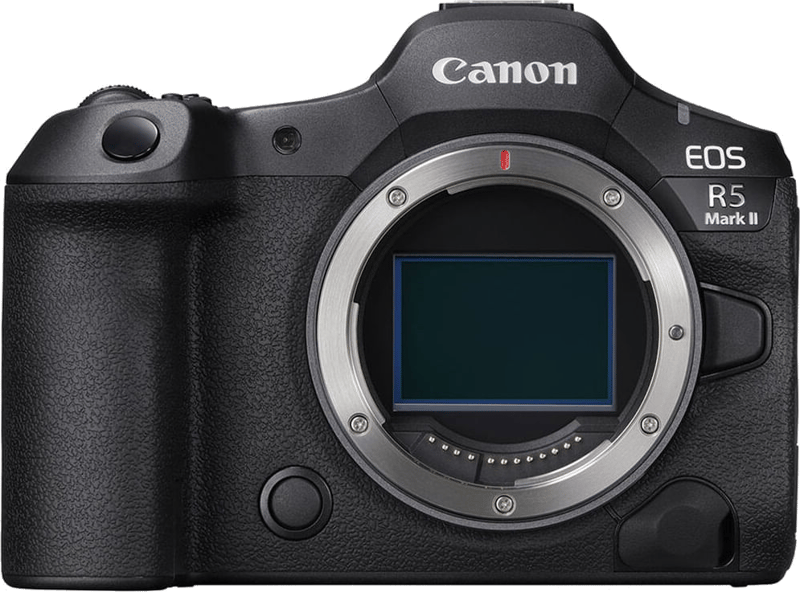
Canon EOS R5 Mark II
Canon · Mirrorless · 45 MP · Full Frame · 8K video
Score Breakdown
This product does not have an overall score yet.
General | |
|---|---|
About This CameraCanon released the EOS R5 Mark II in 2024 as a mirrorless camera built around a 45-megapixel full-frame sensor and the RF lens mount. That combination points it at photographers who want resolution for large prints and heavy crops, along with the speed to handle moving subjects. Video recording reaches 8K, so hybrid shooters can cover stills and high-resolution footage with one body. Framing is through an electronic viewfinder, and a 3.5-inch screen carries the settings between shots. In daily use it stays fairly traditional: no Wi-Fi or Bluetooth, no touch control and a single card slot. It suits anyone who values the imaging hardware over those conveniences. | |
| Brand | Canon |
| Model | R5 II |
Released ⓘRefers to the year this camera was officially made available for sale. | 2024 |
| Camera type |  Mirrorless |
Optics | |
About the OpticsThe 45-megapixel full-frame CMOS sensor is the centrepiece. That resolution gives room to crop heavily or print large while holding fine detail, which suits landscapes, studio work and wildlife alike. For moving subjects, the camera can shoot bursts at up to 30fps. Treat that as the maximum rate rather than a sustained-speed promise. The autofocus system uses 1053 points, so you have many focus positions to choose from when composing. In-body stabilisation reduces camera shake, which helps when you shoot handheld at slower shutter speeds. It does nothing for subject movement, so it will not stop a moving dancer on its own; pair it with a fast shutter for action. Sensitivity runs from ISO 100 to 51200, giving a wide working range for evening interiors and dim venues. The RF mount takes Canon's RF lenses, and the electronic viewfinder puts the view at eye level while you shoot. | |
Megapixels ⓘThe higher the number of megapixels, the more detail the cameras sensor can capture. | 45 MP050 |
Sensor type ⓘThe camera sensor captures light and records the image. Sensors vary in physical size, the number of pixels, and quality. | CMOS |
Sensor format ⓘRefers to the most commonly used sensor sizes. |  Full Frame |
Continuous shooting ⓘThe number of sequential frames per second the camera can write to the memory card when shooting in burst or continuous mode. | 30 fps045 |
Lens mount ⓘThe lens mount will tell you what type of lens range you can fit onto the camera body. Often the same camera company will have different lens ranges for different cameras. | Canon RF |
Image processor ⓘThe image processor in the camera converts the information collected on the sensor for digital storage on the memory card. | Digic X |
Aspect ratio ⓘThe aspect ratio refers to the proportional difference between width and height. The most popular aspect ratios are 3:2 and 4:3. |  4:3 |
Min ISO ⓘRefers to the lowest native (or 'base') ISO setting. Lower ISO are less sensitive to light but make a cleaner image. | 10030200 |
Max ISO ⓘRefers to the highest native (or 'base') ISO setting. Higher ISO is necessary for low-light situations or night photography, but higher ISOs often introduce grain or noise. | 512003003280000 |
Autofocus points ⓘAutofocus points show where the camera is focusing graphically as squares or brackets in Live View or on an electronic viewfinder. These points are also used for light meter readings. | 10530300 |
In-body stabilisation ⓘIn-body Stabilization means the camera has a certain technology embedded that counteracts camera shake. |  Yes |
Viewfinder type ⓘThe viewfinder type is either electronic or optical. Electronic viewfinders will have a small screen in the viewfinder. Optical viewfinders will use prisms and mirrors to look through the lens. | Electronic |
Video | |
About the VideoThe maximum recording resolution is 8K, enough detail for large displays and for cropping into a shot during editing while the image stays crisp. That resolution gives room to work in post. Reframing a composition, punching in on a distant subject or levelling a horizon costs far less image quality when the source footage holds this much detail. Recording at this level fills memory cards faster than lower-resolution footage, so plan capacity before a long shoot and offload footage when you can. Carrying spare cards is wise for extended sessions at maximum resolution. One gap: there is no built-in timelapse mode. Interval sequences need frames triggered one by one or an external timer. | |
Video ⓘIndicates if this camera is capable of recording video. |  Yes |
Max video resolution ⓘThe best resolution this camera can capture video in. Modern cameras can capture up to 8K video. |  8K |
Timelapse built in ⓘA built in time-lapse mode will allow continuous shooting throughout a prolonged period of time to be compressed into a sped up video. | No |
Features | |
About the FeaturesThe 3.5-inch screen is generous in size, but it does not move from the body and it is not touch-sensitive. Menus and settings therefore run through the physical controls, and awkward angles such as overhead framing take more effort. There is no Wi-Fi and no Bluetooth, so the camera cannot exchange files or take remote commands over a wireless link of either kind. Weather sealing is absent, so keep the camera dry and sheltered in rain or dust. It is not built to shrug off the elements. There is no built-in flash and no external flash support, so lighting comes from the scene or gear beyond the camera. GPS is also missing, leaving location tagging to other methods. | |
Builtin flash ⓘA built-in flash will often be positioned right above the lens. This will automatically pop up when you activate it. | No |
External flash ⓘExternal flashes are often connected through a hot shoe at the top of a camera, or a cable at the side of the camera. | No |
GPS ⓘGPS features in a camera will include location metadata to each of your photographs. | No |
Weather sealing ⓘWeather sealing capabilities will give you more confidence when shooting in unfavourable conditions. | No |
Touch screen ⓘTouchscreen allows you to change camera settings and access menus with a swipe of your finger, instead of using buttons. | No |
| Screen size | 3.5" |
Flip screen ⓘA flip screen (or articulating screen) is a second screen which can flip out from the side or top of the camera. This rotating screen allows you more freedom to take photos at different angles. | No |
Live view ⓘLive View feature allows you to see a continuous live video of what is being seen through your lens. | No |
Wi-Fi ⓘBuilt-in Wi-Fi allows you to connect your camera and share images wirelessly. | No |
Bluetooth ⓘBluetooth capabilities allow you wireless control of your camera with other external devices. | No |
Storage & Battery | |
About the Storage & BatteryThe camera writes to a single memory card rather than two. That has a practical consequence: there is no second copy of your files inside the camera, so a card fault during an unrepeatable shoot has no in-camera safety net. Since the body holds no duplicate, offloading stills and footage to a computer or external drive at regular intervals is the straightforward way to protect the work. A dependable, high-capacity card is also a sensible purchase alongside the body. USB charging is not supported, so you cannot top the battery up from a power bank or a laptop between takes. On long days, plan charging stops around the shoot rather than expecting the camera to charge in your bag. | |
| Dual memory card slots | No |
| USB charging | No |