
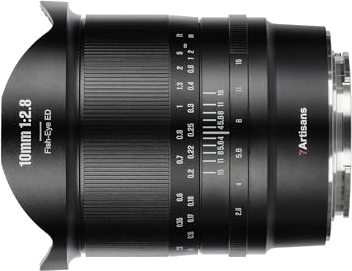
7Artisans 10mm f/2.8 II Fisheye
7Artisans · 10 mm · f/2.8
Score Breakdown
Scores combine our editorial testing with published lab data.
50
SCORE /100
What We Like
+Exceptional 185° angle of view delivers dramatic fisheye perspective in compact, lightweight package
+Bright f/2.8 aperture excels for astrophotography and low-light landscape photography
+Improved Mark II optical design with dual ED elements and 10-blade aperture produces excellent image quality and pronounced sunstars
+Extremely affordable at $278, significantly cheaper than manufacturer alternatives like the $1,999 Sigma 15mm f/1.4
+Versatile multi-mount availability (Sony E, Canon RF, Nikon Z, Leica L) with fully manual operation
+Excellent build quality with metal construction, smooth damped focus/aperture rings, and fluorescent markings for night shooting
Worth Knowing
−Manual focus only may require practice for precise focusing at close distances (0.15m minimum)
−No EXIF data recorded by lens, requiring manual metadata entry in image files
−Cannot accommodate front or rear filter threads, limiting filter options for astrophotography and video
−Extreme curvature of field at very close focus distances requires stopping down for optimal sharpness
General | |
|---|---|
About This LensThe 7Artisans 10mm f/2.8 II is an ultra-wide diagonal fisheye with a 185° viewing angle packed into a compact 75×95mm package weighing 602g. The Mark II improves upon its predecessor with dual extra-low dispersion elements and a more refined 10-blade aperture that produces lovely sun stars. Beautifully built with sturdy metal construction and fabulous image quality featuring impressive sharpness and negligible color fringing, this manual focus lens offers exceptional value at its sub-$300 price point for full-frame mirrorless photographers seeking creative ultra-wide perspectives. | |
| Brand | 7Artisans |
| Release Year | 2024 |
Production Status ⓘCurrent status of lens manufacturing (e.g., in production, discontinued). |  In Production In Production |
Version ⓘThe iteration or release number of a particular lens model. | II |
Lens Mount ⓘThe lens mount will tell you what type of lens range you can fit onto the camera body. Often the same camera company will have different lens ranges for different cameras. | Sony E |
System ⓘIndicates which camera system the lens is designed to attach to. | Sony E |
Maximum Format ⓘLargest sensor size compatible with the lens. |  Full Frame Full Frame |
Physical57/100 | |
| Lens Weight | 602 g |
Lens Diameter ⓘWidth of the lens at its widest point | 75 mm |
Lens Length ⓘHow long the lens is from front to back. | 95 mm |
Front Filter Compatible ⓘSome lenses are compatible with front filters, some are compatible with back filters and some are compatible with both. Front filters are usually more convenient to add and remove. | No |
Optics67/100 | |
Focal Range ⓘShortest to longest focal length of the lens (zoom range start - end ) | 10 mm |
Aperture Range ⓘLargest aperture at the lens's shortest focal length to longest focal length (aperture range start - end) | 2.8 |
| Focal Length Angle of View | 185° |
Flange Focal Distance ⓘDistance from lens mount to sensor. | 18 mm |
Diaphragm Type ⓘStructure and design of the aperture |  Manual Manual |
Blades ⓘNumber of diaphragm blades in aperture | 10020 |
Zoom Lens ⓘZoom allows you to vary the focal length, change between long shots and close-ups | No |
Closest Focusing Distance ⓘMinimum distance for a subject to be in focus. | 15 cm01500 |
| Autofocus Mode | No |
| Manual Mode |  Yes Yes |
| Manual Focusing Ring |  Yes Yes |
Features | |
Weather Sealing ⓘWeather sealing capabilities will give you more confidence when shooting in unfavourable conditions. | No |
Fluorine Coating ⓘCoating to repel water and oil from lens elements. | No |
| Built In Lens Hood |  Yes Yes |
| Lens Hood Type |  Petal Petal |
Teleconverter ⓘA teleconverter (extender) is an extra piece of equipment that fits between the lens and the camera body to enhance magnification | No |
| Image Stabilization | No |
Construction54/100 | |
Elements ⓘLens elements refer to individual pieces of glass within the lens. | 11 |
| Groups | 8 |
Aspherical Elements ⓘThe number of aspherical lens elements which can help correct aberrations such as spherical aberration. | 1 |
Bi Aspherical Elements ⓘElements with two non-spherical surfaces | 0 |
Low Dispersion ⓘElements that reduce chromatic aberration | 2 |
Super Low Dispersion ⓘAdvanced elements further reducing chromatic aberration | 0 |
CA Reduction ⓘBuilt-in features to reduce chromatic aberration | 0 |