
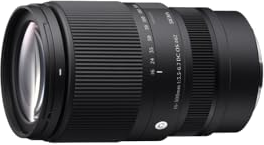
Sigma 16-300mm F3.5-6.7 DC OS Contemporary
Sigma · 16–300 mm · f/3.5–6.7 · Contemporary · Image Stabilization
Score Breakdown
Scores combine our editorial testing with published lab data.
67
SCORE /100
What We Like
+World's largest 18.8x zoom ratio for APS-C mirrorless lenses, covering true wide-angle 16mm to 300mm telephoto
+Exceptional optical stabilization with 6 stops at wide end and 4.5 stops at telephoto, enabling sharp handheld shots in low light
+Compact and lightweight at 615g despite massive zoom range, making it ideal for travel and walkaround photography
+Fast and accurate HLA autofocus motor with suppressed focus breathing, suitable for both stills and video
+Impressive macro capability with 1:2 magnification at 70mm, enabling detailed close-up photography
+Dust- and splash-resistant construction with water-repellent front element coating, designed for outdoor use
Worth Knowing
−Variable aperture f/3.5-6.7 limits low-light gathering ability at telephoto end, requiring slower shutter speeds
−Image quality trade-offs at the telephoto end and periphery due to extreme zoom range requiring compromises
−Autofocus can struggle with fast-moving subjects compared to specialized telephoto or prime lenses
−Limited macro sharpness at closest focusing distance (about 1 inch from front element) with potential shadow casting issues
General | |
|---|---|
About This LensThe Sigma 16-300mm F3.5-6.7 DC OS | Contemporary is the world's first mirrorless lens with an 18.8x zoom ratio, making it an exceptional all-in-one solution for APS-C mirrorless cameras. Measuring just 73.8mm in diameter by 121.4mm in length and weighing just 615g, this remarkably compact superzoom delivers 6 stops of image stabilization at the wide end and 4.5 stops at the telephoto end. While the lens's feature package requires an image quality sacrifice, especially in the periphery and at the long end, Sigma has created perhaps the ultimate all-in-one zoom for APS-C mirrorless cameras, particularly excelling as a travel and versatile general-purpose lens. | |
| Brand | Sigma |
| Release Year | 2025 |
Production Status ⓘCurrent status of lens manufacturing (e.g., in production, discontinued). |  In Production In Production |
Pro Branding ⓘSpecific branding codes used for professional-tier lenses. | Contemporary |
Lens Mount ⓘThe lens mount will tell you what type of lens range you can fit onto the camera body. Often the same camera company will have different lens ranges for different cameras. | Sony E |
System ⓘIndicates which camera system the lens is designed to attach to. | Sony E APS-C |
Maximum Format ⓘLargest sensor size compatible with the lens. |  APS-C APS-C |
Physical85/100 | |
| Lens Weight | 615 g |
Lens Diameter ⓘWidth of the lens at its widest point | 73.8 mm |
Lens Length ⓘHow long the lens is from front to back. | 121.4 mm |
Front Filter Compatible ⓘSome lenses are compatible with front filters, some are compatible with back filters and some are compatible with both. Front filters are usually more convenient to add and remove. |  Yes Yes |
Front Filter Size ⓘDiameter of attachable filters. | 67 mm |
Optics57/100 | |
Focal Range ⓘShortest to longest focal length of the lens (zoom range start - end ) | 16–300 mm |
Aperture Range ⓘLargest aperture at the lens's shortest focal length to longest focal length (aperture range start - end) | 3.5–6.7 |
| Focal Length Angle of View | 83.2°–5.4° |
Flange Focal Distance ⓘDistance from lens mount to sensor. | 18 mm |
Diaphragm Type ⓘStructure and design of the aperture |  Automatic Automatic |
Blades ⓘNumber of diaphragm blades in aperture | 9020 |
Zoom Lens ⓘZoom allows you to vary the focal length, change between long shots and close-ups |  Yes Yes |
Zoom Mechanism ⓘSystem enabling zoom function |  Manual Manual |
Zoom Ring ⓘIf zooming is adjusted using a zoom ring |  Yes Yes |
Zoom Type ⓘThe design or approach to zooming |  Rotary Rotary |
Closest Focusing Distance ⓘMinimum distance for a subject to be in focus. | 17 cm01500 |
Maximum Magnification ⓘLargest size a subject can be reproduced | 0.5x |
| Autofocus Mode |  Yes Yes |
| Manual Mode |  Yes Yes |
| Manual Focusing Ring |  Yes Yes |
Features81/100 | |
Weather Sealing ⓘWeather sealing capabilities will give you more confidence when shooting in unfavourable conditions. |  Yes Yes |
Fluorine Coating ⓘCoating to repel water and oil from lens elements. |  Yes Yes |
| Built In Lens Hood | No |
| Lens Hood Type |  Petal Petal |
Zoom Lock ⓘZoom lock allows the zoom ring to be locked at the desired focal length |  Yes Yes |
Teleconverter ⓘA teleconverter (extender) is an extra piece of equipment that fits between the lens and the camera body to enhance magnification | No |
| Image Stabilization | Yes |
IS Efficiency ⓘIS efficiency refers to the effectiveness of the image stabilization system in compensating for the blurring effects of camera shake, quantified by the number of stops of stabilization it provides. | 6 stops |
Construction55/100 | |
Elements ⓘLens elements refer to individual pieces of glass within the lens. | 20 |
| Groups | 14 |
Aspherical Elements ⓘThe number of aspherical lens elements which can help correct aberrations such as spherical aberration. | 4 |
Bi Aspherical Elements ⓘElements with two non-spherical surfaces | 0 |
Low Dispersion ⓘElements that reduce chromatic aberration | 5 |
Super Low Dispersion ⓘAdvanced elements further reducing chromatic aberration | 1 |
CA Reduction ⓘBuilt-in features to reduce chromatic aberration | 0 |
Internal Focusing ⓘInternal Focusing means that the lens does not change in size during focusing, and the front element does not rotate. |  Yes Yes |