
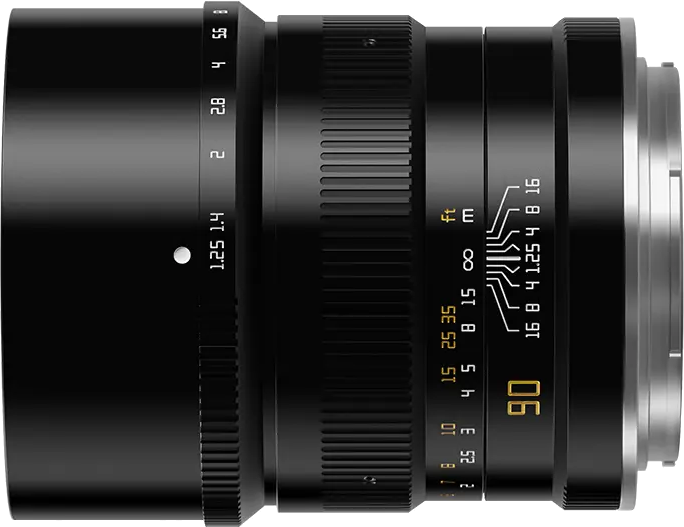
TTArtisan 90mm f/1.25 Mirrorless Version
TTArtisan · 90 mm · f/1.25
Score Breakdown
This product does not have an overall score yet.
General | |
|---|---|
About This LensThe TTArtisan 90mm f/1.25 is a manual-focus portrait prime for medium format mirrorless cameras. It is sold in Fujifilm G and Hasselblad X mount versions, and each version fits only its own system. On these larger sensors, 90mm gives a short telephoto view that flatters faces and leaves a natural working distance between you and the subject. The f/1.25 maximum aperture is the main reason to own this lens. The trade-off is effort: focusing is entirely manual, and the plane of sharpness is thin enough that each focus setting matters. For seated portraits and still life, where you set the pace, the effort is easy to accept. TTArtisan introduced this mirrorless version in 2021. | |
| Brand | TTArtisan |
| Release Year | 2021 |
Lens Mount ⓘThe lens mount will tell you what type of lens range you can fit onto the camera body. Often the same camera company will have different lens ranges for different cameras. | Hasselblad X |
System ⓘIndicates which camera system the lens is designed to attach to. | Hasselblad X |
Physical | |
About the BuildThe front of the lens accepts 77mm screw-in filters. Any filter you screw directly onto the lens must match this 77mm thread. Both mount versions share this thread, so one filter set serves either body. Because the lens opens to f/1.25, an ND filter lets you keep that aperture in bright daylight without overexposing. | |
Lens Diameter ⓘWidth of the lens at its widest point | 82 mm |
Front Filter Compatible ⓘSome lenses are compatible with front filters, some are compatible with back filters and some are compatible with both. Front filters are usually more convenient to add and remove. |  Yes |
Front Filter Size ⓘDiameter of attachable filters. | 77 mm |
Optics | |
About the OpticsThe 90mm focal length and the f/1.25 aperture work together for portraits, still life and quiet detail work. Closest focus is 3.3 ft (100 cm). That is enough for a head-and-shoulders portrait while keeping a comfortable distance from your subject. The f/1.25 opening admits an unusual amount of light. In a window-lit room or an evening studio you can keep ISO settings low instead of raising sensitivity. Stopped down slightly for a touch more depth of field, the lens still gathers light quickly. Depth of field at f/1.25 is extremely thin. A sitter's eyes stay sharp while ears, hair and the background fall away into soft blur. This suits a single subject and a calm, deliberate way of shooting. Ten aperture blades keep the opening round when you stop down, helping out-of-focus highlights stay smooth rather than angular. Because focusing is manual, allow time for each frame. Move the ring, check the eyes, then fine-tune before you release the shutter. Fast-moving subjects are a poor match for this lens. Focus peaking and magnification, where your camera offers them, speed up the check. | |
Focal Range ⓘShortest to longest focal length of the lens (zoom range start - end ) | 90 mm |
Aperture Range ⓘLargest aperture at the lens's shortest focal length to longest focal length (aperture range start - end) | 1.25 |
| Focal Length Angle of View | 27° |
Flange Focal Distance ⓘDistance from lens mount to sensor. | 18.14 mm |
Diaphragm Type ⓘStructure and design of the aperture |  Manual |
Blades ⓘNumber of diaphragm blades in aperture | 10020 |
Zoom Lens ⓘZoom allows you to vary the focal length, change between long shots and close-ups | No |
Closest Focusing Distance ⓘMinimum distance for a subject to be in focus. | 100 cm01500 |
Maximum Magnification ⓘLargest size a subject can be reproduced | 0.16x |
| Autofocus Mode | No |
| Manual Mode |  Yes |
| Manual Focusing Ring |  Yes |
Features | |
About the FeaturesThis lens has no built-in image stabilisation. When the light drops, support the camera on a tripod or monopod, or brace it carefully for handheld frames. That support keeps the camera steady, but it cannot stop a moving subject from blurring. There is no weather sealing. Keep the lens protected from rain, spray, dust and sand, because none of the joints resist moisture. A rain cover or a simple shelter covers most location risks. The front element also lacks a fluorine coating, so dust and fingerprints need gentle cleaning with a proper cloth. | |
Weather Sealing ⓘWeather sealing capabilities will give you more confidence when shooting in unfavourable conditions. | No |
Fluorine Coating ⓘCoating to repel water and oil from lens elements. | No |
| Built In Lens Hood | No |
| Lens Hood Type |  Round |
Teleconverter ⓘA teleconverter (extender) is an extra piece of equipment that fits between the lens and the camera body to enhance magnification | No |
| Image Stabilization | No |
Construction | |
About the ConstructionThe optical design has 11 elements in 7 groups. There are no aspherical, low-dispersion or other special-glass elements. These figures describe the layout of the design, not a measured level of image quality, so judge results from real frames before buying. | |
Elements ⓘLens elements refer to individual pieces of glass within the lens. | 11 |
| Groups | 7 |
Aspherical Elements ⓘThe number of aspherical lens elements which can help correct aberrations such as spherical aberration. | 0 |
Bi Aspherical Elements ⓘElements with two non-spherical surfaces | 0 |
Low Dispersion ⓘElements that reduce chromatic aberration | 0 |
Super Low Dispersion ⓘAdvanced elements further reducing chromatic aberration | 0 |
CA Reduction ⓘBuilt-in features to reduce chromatic aberration | 0 |
Internal Focusing ⓘInternal Focusing means that the lens does not change in size during focusing, and the front element does not rotate. | No |