The DJI Osmo Action 6 is our first choice for filming ski runs. It combines a cold operating limit of -4°F with a removable battery and horizon leveling at up to 4K60. Its square recording mode also gives you room to make both horizontal and vertical clips from one run.
Choose the Insta360 X5 if you want to see yourself and the mountain, then decide where to point the view afterward. The less expensive Action 5 Pro covers straightforward 4K filming. We also include a small wearable camera, a flip-screen option for filming friends, and a rugged compact for people who want photos as much as video.
Our Picks at a Glance
All 8 Cameras
Our first choice for forward-facing ski footage and flexible framing.

For seeing yourself in the run without paying for the X6 upgrades.
Which Camera Fits Your Ski Trip?
A forward-facing action camera records the trail you aim it at. A 360 camera gives you more freedom to reframe a run, but adds editing and exposed lenses. The comparison below separates their recording modes, cold limits, waterproof depths and storage. Waterproof depths apply to the camera without a housing, with its covers correctly closed; they are not crash ratings. Check the expected temperature against the operating limit, then plan spare power for the number of runs you want to film.
- Square 4K capture for different crops
- HorizonSteady at up to 4K60
- Removable battery for spare power
- 50GB usable built-in storage
- Reframe the view after the run
- 360-degree horizon lock
- Replaceable outer lenses
- Flat 4K clip plus 360 backup
- 4K120 for slow-motion ski clips
- Removable battery for longer days
- Front and rear touchscreens
- 47GB usable built-in storage
- 5.3K60 and 4K120 recording
- HyperSmooth stabilization
- Tall 8:7 capture for later crops
- Folding fingers and tripod thread
- 8K spherical video at up to 50 fps
- Flat modes up to 5K60 or 4K120
- 4K InstaFrame with 8K 360 backup
- 47GB available internal storage
- Flip touchscreen for filming friends
- 4K120 for slower playback
- Active HDR at up to 4K60
- Removable battery
- Standalone camera weighs about 1.9 oz
- 4K60 in a small detachable camera
- Action Pod for preview and charging
- Replaceable microSD storage
- 4x optical zoom for tighter photos
- RAW photo capture
- Physical controls instead of touch
- Waterproof body without a housing
The Best Ski Cameras in Detail
Start with the footage you want to bring home. For a ready-to-watch view down the slope, prioritize the recording mode and controls. For a view that follows you around a turn, accept the extra work of a 360 camera. Maximum resolution matters less if using it disables the horizon mode you wanted.
DJI Osmo Action 6
- Video Mode
- 8K30 flat
- Cold Operating Limit
- -4°F
- Waterproof Depth
- 66 ft
- Storage
- microSD + 50GB internal
Strengths
- Square 4K capture for different crops
- HorizonSteady at up to 4K60
- Removable battery for spare power
- 50GB usable built-in storage
Trade-Offs
- 8K does not support HorizonSteady
- Mount and spare battery add to the kit
The DJI Osmo Action 6 earns the top spot because it gives skiers useful framing choices without requiring a 360 edit. Its 4K Custom mode records a square image. You can crop that recording for a phone screen or a wider video later, which is helpful when you cannot repeat a run just to change the camera's orientation.
HorizonSteady works at up to 4K60 in the supported 16:9 and Custom modes. That is a meaningful advantage over the Action 5 Pro, whose full horizon lock stops at 2.7K60. Both offer 4K120 for slow motion, but that does not mean full horizon lock works at 120 fps. Stabilization also trims the edges of the view, so leave space around the skier you are following.
There is 50GB of usable internal storage as well as a microSD slot. Forgetting a card therefore need not end filming before the first lift. The shutter can start recording from power-off through DJI's Snapshot function, reducing the need to navigate a touchscreen between runs.
Current firmware also supports 8K30, but only RockSteady and RockSteady+ stabilization in that mode. Buy this camera for its flexible 4K options, not on the assumption that every headline feature works together. Choose the Action 5 Pro if ordinary 4K footage meets your needs and you would rather put the saving toward a compatible mount and spare battery.
Insta360 X5
- Video Mode
- 8K30 spherical
- Cold Operating Limit
- -4°F
- Waterproof Depth
- 49 ft
- Storage
- microSD
Strengths
- Reframe the view after the run
- 360-degree horizon lock
- Replaceable outer lenses
- Flat 4K clip plus 360 backup
Trade-Offs
- Flat crops use only part of the 8K sphere
- Lens guards are not sealed against water
The Insta360 X5 is our value pick for filming yourself in 360 degrees. It records the surroundings as well as the slope ahead, so an imperfect camera angle is less likely to lose the subject. Reframing lets you switch from the skier to the view without having aimed a conventional camera at both.
Its 8K30 recording covers the whole sphere. Your finished flat video uses only part of that image, so do not compare the 8K label directly with a conventional camera's 8K frame. FlowState stabilization and 360-degree horizon lock help keep the chosen view level as you move. Replaceable outer lenses are another useful feature on a camera with glass exposed on both sides, though replacement does not make it resistant to a fall.
You can reduce editing with InstaFrame 2.0. It saves a flat 4K30 video alongside a 5.7K+ 360 backup, leaving a second chance to change the framing. For full control, check the X5 phone requirements before buying; installing the app does not establish that every editing feature will run well on an older phone.
The Insta360 X6 offers faster 8K capture and a higher-resolution backup in InstaFrame. The X5 remains the more economical choice when 8K30 capture is enough. Keep its lens-guard limit in mind: Insta360 says the guards are not sealed. Its guard instructions matter when melting snow can reach the glass.
DJI Osmo Action 5 Pro

- Video Mode
- 4K120 flat
- Cold Operating Limit
- -4°F
- Waterproof Depth
- 66 ft
- Storage
- microSD + 47GB internal
Strengths
- 4K120 for slow-motion ski clips
- Removable battery for longer days
- Front and rear touchscreens
- 47GB usable built-in storage
Trade-Offs
- Full horizon lock stops at 2.7K60
- No Action 6 square 4K Custom mode
The DJI Action 5 Pro is the sensible saving for a skier who wants a conventional action camera. Its 4K120 option covers slow-motion turns and jumps, while front and rear touchscreens help frame a stationary shot from either side. A removable battery makes a spare more useful than relying on a long charging stop.
You still get a -4°F operating floor, a body rated waterproof to 66 ft and 47GB of usable internal storage alongside microSD. Those are useful similarities to the Action 6.
The saving comes with a specific compromise. Full HorizonSteady lock is limited to 1080p or 2.7K at up to 60 fps. Use a different stabilization mode for 4K, or accept the lower resolution for full leveling. Action 6 is worth the extra if 4K horizon lock and square capture are central to your plan. Otherwise, Action 5 Pro leaves more of the budget for the equipment that keeps the camera running and securely mounted.
GoPro HERO13 Black

- Video Mode
- 5.3K60 flat
- Cold Operating Limit
- 14°F
- Waterproof Depth
- 33 ft
- Storage
- microSD
Strengths
- 5.3K60 and 4K120 recording
- HyperSmooth stabilization
- Tall 8:7 capture for later crops
- Folding fingers and tripod thread
Trade-Offs
- 14°F minimum operating temperature
- Requires HERO13-compatible Enduro batteries
The GoPro HERO13 Black makes most sense for someone who wants GoPro's mounting and shooting options. Its folding mounting fingers and tripod thread give you two built-in attachment routes; the magnetic latch mount is a separate accessory. Check the exact mount you already own before counting it as a saving.
The camera records up to 5.3K60, or 4K120 for slower playback. HyperSmooth stabilization and the tall 8:7 capture option make it useful for turning a run into different crops. The optional Ultra Wide Lens Mod adds a wider view, but it is a separate purchase, not the view you receive with the standard lens cover.
Cold use is the important difference from the Action 6. GoPro's manual gives HERO13 Black an operating floor of 14°F, compared with DJI's -4°F. That makes the DJI the better fit when the expected temperature falls below GoPro's stated range. Neither limit establishes how long the battery will last on your trip.
HERO13 also needs its own compatible Enduro battery. Do not assume spare batteries from an older HERO will transfer. Choose it for the GoPro features you will use; choose Action 6 for the colder operating specification and built-in storage backup.
Insta360 X6

- Video Mode
- 8K50 spherical
- Cold Operating Limit
- -4°F
- Waterproof Depth
- 66 ft
- Storage
- microSD + 47GB internal
Strengths
- 8K spherical video at up to 50 fps
- Flat modes up to 5K60 or 4K120
- 4K InstaFrame with 8K 360 backup
- 47GB available internal storage
Trade-Offs
- Higher cost than X5
- 360 capture still needs framing decisions
The Insta360 X6 is the upgrade for a skier who will use more than basic 360 reframing. It raises ordinary 8K spherical recording to 50 fps, compared with 30 fps on the X5. That gives you a faster capture option while retaining the full 8K sphere, though the final flat crop still uses only part of it.
It is also more capable when you want to record a conventional view. Flat modes reach 5K60 or 4K120, and InstaFrame 2.0 can save a flat 4K30 clip with an 8K 360 backup. That last pairing is the clearest reason to pay more: you can keep the quick result and still have more detail available for a later reframe.
Its 47GB of available internal storage provides a fallback to microSD. The camera also has a removable battery, a -4°F operating floor and waterproofing to 66 ft without a dive case.
The drawback is the higher cost and the work that can follow a day of 360 recording. If you mainly want short clips for your phone, the X5 already supplies the core shoot-first, frame-later benefit. Choose X6 when its faster 8K mode, flat modes or higher-resolution InstaFrame backup solve a clear limit in the footage you make.
Insta360 Ace Pro 2

- Video Mode
- 8K30 flat
- Cold Operating Limit
- -4°F
- Waterproof Depth
- 39 ft
- Storage
- microSD
Strengths
- Flip touchscreen for filming friends
- 4K120 for slower playback
- Active HDR at up to 4K60
- Removable battery
Trade-Offs
- No built-in storage backup
- Flip screen adds little to fixed forward filming
The Insta360 Ace Pro 2 is the most useful choice here for someone who often stops to film a friend. Its 2.5-inch flip touchscreen lets you see the shot from positions where a fixed rear display is awkward. It also turns toward you for a piece to camera at the edge of the run.
The recording options include 8K30 and 4K120, but the modes for difficult light have different limits. Active HDR tops out at 4K60, as does the 16:9 PureVideo option. They offer different ways to handle a bright slope or a dimmer scene; they are not evidence that fast motion in shade will look as clear as footage in good daylight.
The removable battery supports a spare, and the body is rated for operation down to -4°F. With its screen folded down, the camera can still work as a conventional mounted action camera. You do need a microSD card because it has no built-in storage.
For a camera that spends most of the day fixed facing forward, the Action 6 offers a more useful combination of square capture and internal storage. Choose Ace Pro 2 when you will actually use its movable screen.
Insta360 GO Ultra

- Video Mode
- 4K60 flat
- Cold Operating Limit
- -4°F
- Waterproof Depth
- 33 ft (camera only)
- Storage
- microSD
Strengths
- Standalone camera weighs about 1.9 oz
- 4K60 in a small detachable camera
- Action Pod for preview and charging
- Replaceable microSD storage
Trade-Offs
- Battery cannot be swapped
- Action Pod is splash resistant only
The Insta360 GO Ultra separates a small camera from its larger Action Pod. The standalone camera weighs about 1.9 oz and records up to 4K60. You can use the pod to frame a shot, then leave the smaller unit in a suitable mount while it records to its own microSD card.
That is useful for short clips where a full-size action camera gets in the way. It is less attractive for continuous filming in deep cold. In Insta360's -4°F test, the standalone camera lasted 28 to 39 minutes; the maker does not say which recording modes those figures apply to. The battery is not removable, so a spare cannot be swapped in at the lift. Returning the camera to its pod is part of the workflow.
The waterproof claims also apply to different parts. The camera is rated to 33 ft with the required lens guard fitted, while the Action Pod is only splash resistant. A complete camera-and-pod combination does not inherit the standalone camera's underwater rating.
Choose the Action 5 Pro instead for longer recording sessions with replaceable batteries. For skiing, use the maker's suitable action mount and secondary retention where specified; a magnetic attachment by itself is not proof of secure mounting for a fall.
OM SYSTEM Tough TG-7
- Video Mode
- 4K30 flat
- Cold Operating Limit
- 14°F
- Waterproof Depth
- 49 ft
- Storage
- SD / SDHC / SDXC
Strengths
- 4x optical zoom for tighter photos
- RAW photo capture
- Physical controls instead of touch
- Waterproof body without a housing
Trade-Offs
- 4K stops at 30 fps
- Modest zoom for distant race photography
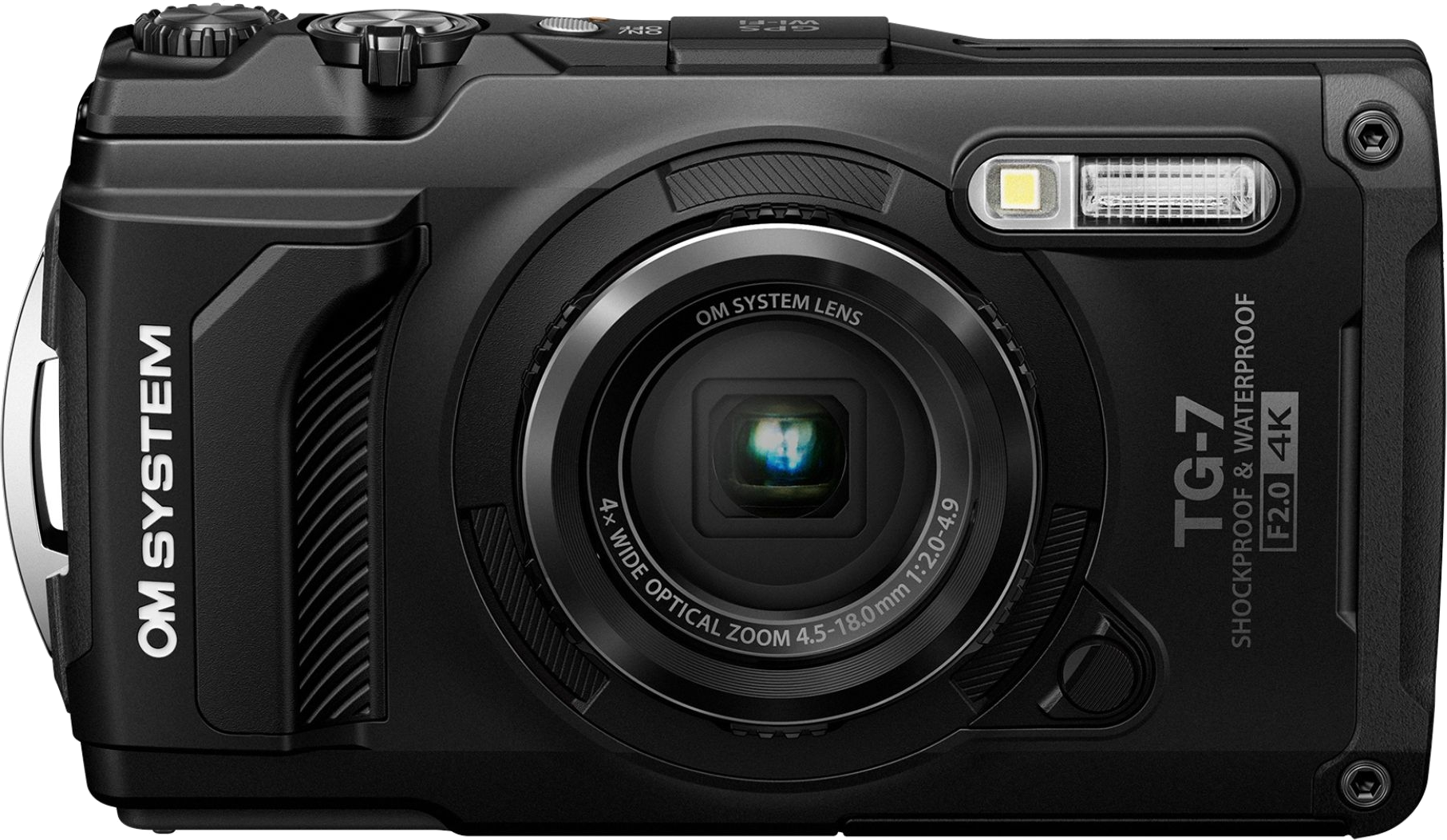
The OM SYSTEM TG-7 is for the person who stops to photograph the trip. Its 4x optical zoom lets you tighten a composition without relying only on a crop. RAW photo capture gives you more editing control over snow and skies than a finished JPEG alone.
This is a rugged compact camera, with waterproofing to 49 ft and freezeproof operation down to 14°F. Its rear screen uses physical controls rather than touch. That removes reliance on touch input, although it does not prove that every button will be easy to use with your particular ski gloves.
The compromise is action video. The TG-7 reaches 4K30, and its shape and controls suit deliberate handheld photography better than recording a whole run from a mount. Its zoom is also modest compared with a dedicated sports camera and telephoto lens. It will not make a distant racer fill the frame from anywhere on the mountain.
Choose the Ace Pro 2 for filming friends nearby in slow motion, or the TG-7 for holiday photos, detail shots and optical zoom. If your main aim is photographing races from the side of the course, a sports photography camera is a different purchase from a camera to wear while skiing.
What Else Changes the Buying Decision?
Which Mounts Do You Need?
Decide whether you want the view ahead, a shot of your skis, or a third-person view before choosing a bundle. A chest mount and a pole solve different problems. DJI's accessory compatibility list shows its chest strap supports both Action 6 and Action 5 Pro. Other adapters, frames and housings are not automatically shared between generations.
For a 360 camera, include the compatible action pole and required attachment in your budget. Also check your resort's rules. A camera mount that fits the camera is not, by itself, approval to attach it to a helmet. Follow the helmet maker's instructions for that exact model. Giro's snow-helmet manual, for example, warns that adhesives can damage helmet materials. Do not treat a generic adhesive mount as universally suitable.
Will One Battery Cover Your Ski Day?
Plan around the mode you will use and how you will replace or recharge the battery. A maker's longest runtime often comes from a lower resolution with screens off. For example, DJI's Action 6 cold result of 167 minutes at -4°F uses 1080p24 with RockSteady on, Wi-Fi off and screens off. It is not a 4K120 result or a promise for a day of lifts and filming.
The removable-battery cameras offer a straightforward way to carry more recording capacity. GO Ultra instead depends on its Action Pod for recharging. Charging temperatures are a separate limit from operating temperatures: DJI lists 41°F as the Action 6's minimum charging temperature. Allow the camera and battery to reach the maker's permitted charging range, and dry the camera before opening its covers. Do not buy a power bank on the assumption that it lets you charge a frozen battery on the slope.
Our Verdict
Choose the DJI Osmo Action 6 for flexible 4K ski footage and the option of horizon lock at 4K60. Choose the Insta360 X5 when you want to reframe the run around yourself. The Action 5 Pro is the better saving when ordinary 4K capture matters more than the newer camera's framing modes. Match the camera to that job, then budget for the mount, storage and power it needs.
Our Three Top Picks Side by Side
- Video
- 100 (highest)
- Storage & Battery
- 95
- Features
- 92
- Optics
- 87
- Video
- 91
- Storage & Battery
- 95
- Features
- 83
- Optics
- 88 (highest)
- Video
- 91
- Storage & Battery
- 95
- Features
- 92
- Optics
- 87