
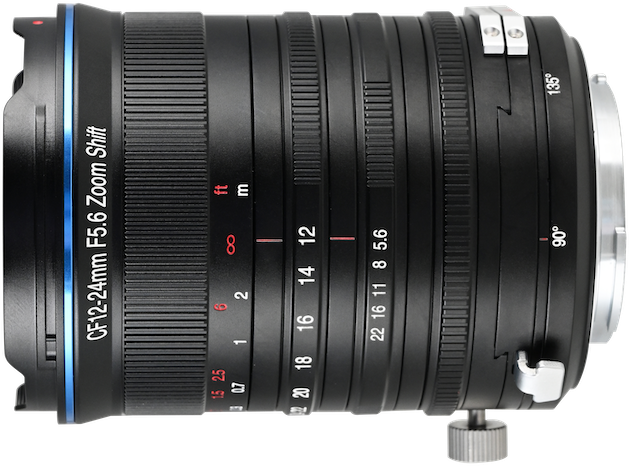
Laowa CF 12-24mm f/5.6 Zoom-Shift
Laowa · 12–24 mm · f/5.6
Score Breakdown
Scores combine our editorial testing with published lab data.
General | |
|---|---|
About This LensThis Laowa zoom spans 12–24mm on APS-C cameras, giving an ultra-wide view for interiors, architecture and landscapes. It is made in six versions: Nikon Z, Canon EF-M, Canon RF, Fujifilm X, Leica L and Sony E. You need the version that matches your camera's mount. The f/5.6 maximum aperture and manual-only focusing set the main trade-off. The lens works best in daylight or on a tripod. Laowa introduced it in 2024, and it remains in production. A rotary ring on the barrel controls zooming. The lens suits photographers who frame each shot with care. | |
| Brand | Laowa |
| Release Year | 2024 |
Lens Mount ⓘThe lens mount will tell you what type of lens range you can fit onto the camera body. Often the same camera company will have different lens ranges for different cameras. | Canon RF |
System ⓘIndicates which camera system the lens is designed to attach to. | Canon EOS R |
Maximum Format ⓘLargest sensor size compatible with the lens. |  APS-C APS-C |
Physical57/100 | |
About the BuildThe lens weighs 1 lb 4.3 oz (575 g). The Nikon Z version measures 3.15 in (80 mm) across and 3.89 in (98.9 mm) long, and its front thread takes 77mm screw-in filters directly. Other mount versions use different or unlisted figures, so check yours before buying filters. | |
| Lens Weight | 575 g |
Lens Diameter ⓘWidth of the lens at its widest point | 80 mm |
Lens Length ⓘHow long the lens is from front to back. | 98.9 mm |
Optics52/100 | |
About the OpticsOn an APS-C sensor, 12mm is extremely wide. It lets you stand inside a small room and still include walls, ceiling and foreground in one frame. At 24mm the view calms down enough for streetscapes or wider groups, giving a useful choice between drama and restraint. Between those ends, the zoom lets you tune how much space each shot includes. The maximum aperture stays at f/5.6 across the whole zoom. That is fine in daylight and bright interiors. In a dim church or evening street scene, you will need a higher ISO or a tripod to keep shutter speeds usable. Depth of field runs deep at these focal lengths, though, so near and far details stay sharp together. Close focusing at 0.5 ft (15 cm) opens up near-far compositions. You can set the lens almost against a doorway detail or rock in the foreground and still keep the wider scene behind it. Focusing is manual only. The dedicated ring gives precise control over where sharpness lands. It slows you down when scenes move quickly. Our optics specification score for this lens is 52 out of 100. | |
Focal Range ⓘShortest to longest focal length of the lens (zoom range start - end ) | 12–24 mm |
Aperture Range ⓘLargest aperture at the lens's shortest focal length to longest focal length (aperture range start - end) | 5.6 |
| Focal Length Angle of View | 99.4°–63.9° |
Flange Focal Distance ⓘDistance from lens mount to sensor. | 20 mm |
Diaphragm Type ⓘStructure and design of the aperture |  Manual Manual |
Blades ⓘNumber of diaphragm blades in aperture | 9020 |
Zoom Lens ⓘZoom allows you to vary the focal length, change between long shots and close-ups |  Yes Yes |
Zoom Mechanism ⓘSystem enabling zoom function |  Manual Manual |
Zoom Ring ⓘIf zooming is adjusted using a zoom ring |  Yes Yes |
Zoom Type ⓘThe design or approach to zooming |  Rotary Rotary |
Closest Focusing Distance ⓘMinimum distance for a subject to be in focus. | 15 cm01500 |
| Autofocus Mode | No |
| Manual Mode |  Yes Yes |
| Manual Focusing Ring |  Yes Yes |
Features | |
About the FeaturesThere is no image stabilization. These focal lengths make camera shake less visible than a telephoto would, so handheld daylight shooting stays practical. Its absence matters most for handheld video or slow exposures in poor light. Weather sealing is absent, so keep the lens dry in dust or drizzle. The Nikon Z version also has no fluorine coating, meaning the front glass has no added resistance to smudges and dirt. A zoom lock is missing too, so the zoom ring cannot be fixed at one focal length. None of these omissions prevents careful use. | |
Weather Sealing ⓘWeather sealing capabilities will give you more confidence when shooting in unfavourable conditions. | No |
Fluorine Coating ⓘCoating to repel water and oil from lens elements. | No |
| Built In Lens Hood |  Yes Yes |
Zoom Lock ⓘZoom lock allows the zoom ring to be locked at the desired focal length | No |
Teleconverter ⓘA teleconverter (extender) is an extra piece of equipment that fits between the lens and the camera body to enhance magnification | No |
| Image Stabilization | No |
Tilt Shift | |
| Tilt Range | N/A |
| Shift Range | 7 mm |
| Tiltshift Rotation | N/A |
| Lens Rotation |  Yes Yes |
Construction31/100 | |
About the ConstructionThe Nikon Z version includes two aspherical elements among its 15 elements in 11 groups. Specially shaped surfaces like these help correct distortion and spherical aberration. Distortion can make straight edges appear curved, so that correction matters for the architecture and interiors this lens is meant for. The construction specification score is 31 out of 100. | |
Elements ⓘLens elements refer to individual pieces of glass within the lens. | 15 |
| Groups | 11 |
Aspherical Elements ⓘThe number of aspherical lens elements which can help correct aberrations such as spherical aberration. | 2 |
Bi Aspherical Elements ⓘElements with two non-spherical surfaces | 0 |
Super Low Dispersion ⓘAdvanced elements further reducing chromatic aberration | 0 |
CA Reduction ⓘBuilt-in features to reduce chromatic aberration | 0 |
Internal Focusing ⓘInternal Focusing means that the lens does not change in size during focusing, and the front element does not rotate. | No |