
Samyang 8mm F/2.8 UMC Fisheye II
Samyang · 8 mm · f/2.8
Score Breakdown
Scores combine our editorial testing with published lab data.
General | |
|---|---|
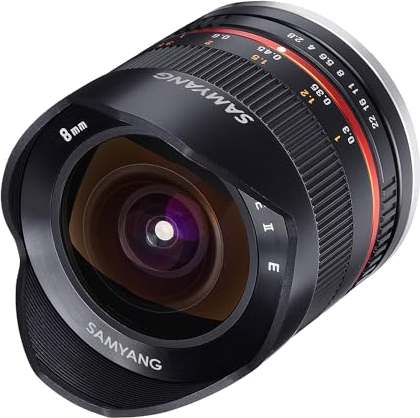
About This LensThis Samyang fisheye gives an APS-C camera an extreme wide view. At 8mm it frames a whole room from a doorway, or a whole sky from open ground. Curved fisheye geometry bends walls and horizons, which suits expressive, deliberate pictures rather than straight-line architectural records. Samyang offers this design in Sony E, Canon EF-M, Fujifilm X and Samsung NX mounts, so each version matches one mirrorless system. The optical family dates from 2014 and remains in production. The trade-off is simplicity. Focusing is manual, and the lens carries no stabilisation, sealing or filter thread. Photographers who accept those limits get a very light, very wide tool for creative framing. | |
| Brand | Samyang |
| Release Year | 2014 |
Production Status ⓘCurrent status of lens manufacturing (e.g., in production, discontinued). |  In Production In Production |
Version ⓘThe iteration or release number of a particular lens model. | II |
Lens Mount ⓘThe lens mount will tell you what type of lens range you can fit onto the camera body. Often the same camera company will have different lens ranges for different cameras. | Sony E |
System ⓘIndicates which camera system the lens is designed to attach to. | Sony E APS-C |
Maximum Format ⓘLargest sensor size compatible with the lens. |  APS-C APS-C |
Physical50/100 | |
About the BuildAt 9.2 oz (260 g), this lens is light enough to carry all day. The barrel measures 2.36 in (60 mm) across and 2.54 in (64.4 mm) long, so it suits a compact mirrorless body. The front element has no filter thread, so screw-in filters cannot be attached. | |
| Lens Weight | 260 g |
Lens Diameter ⓘWidth of the lens at its widest point | 60 mm |
Lens Length ⓘHow long the lens is from front to back. | 64.4 mm |
Front Filter Compatible ⓘSome lenses are compatible with front filters, some are compatible with back filters and some are compatible with both. Front filters are usually more convenient to add and remove. | No |
Optics61/100 | |
About the OpticsFraming is the reason to buy this lens. On an APS-C sensor, 8mm takes in far more than a typical rectilinear wide angle. A small interior becomes a complete scene, and a landscape gains an enveloping sky. Straight lines near the frame edges curve outward, and that curvature is the effect many photographers want. The F/2.8 maximum aperture admits plenty of light. It keeps dim interiors and evening streets workable without flash, and it allows lower ISO settings when the light drops. At 8mm, slight camera movement shows less in the frame than at longer focal lengths, so handheld shooting stays practical. Close focusing at 1 ft (30 cm) opens a useful trick. The camera can sit almost beside a foreground subject, such as a doorway frame or a rock by water. The fisheye view still holds the whole scene around it. Near objects stretch dramatically, which adds energy to interiors and landscapes alike. Focusing is manual through a dedicated ring. Depth of field at 8mm is broad at ordinary distances, so setting focus is quick and forgiving. On specifications alone, Optics scores 61 out of 100. | |
Focal Range ⓘShortest to longest focal length of the lens (zoom range start - end ) | 8 mm |
Aperture Range ⓘLargest aperture at the lens's shortest focal length to longest focal length (aperture range start - end) | 2.8 |
| Focal Length Angle of View | 120.88° |
Flange Focal Distance ⓘDistance from lens mount to sensor. | 18 mm |
Diaphragm Type ⓘStructure and design of the aperture |  Manual Manual |
Blades ⓘNumber of diaphragm blades in aperture | 6020 |
Zoom Lens ⓘZoom allows you to vary the focal length, change between long shots and close-ups | No |
Closest Focusing Distance ⓘMinimum distance for a subject to be in focus. | 30 cm01500 |
Maximum Magnification ⓘLargest size a subject can be reproduced | 0.14x |
| Autofocus Mode | No |
| Manual Mode |  Yes Yes |
| Manual Focusing Ring |  Yes Yes |
Features19/100 | |
About the FeaturesThe feature list is short. There is no image stabilisation, so low-light shooting relies on a steady hold. There is also no weather sealing, so rain, dust and spray call for care between shots. The front element gets no fluorine coating to repel dirt, and it has no filter thread to take a protective filter. Gentle, deliberate cleaning with a blower and a soft cloth is therefore the routine after dusty or sandy conditions. On specifications alone, Features scores 19 out of 100. | |
Weather Sealing ⓘWeather sealing capabilities will give you more confidence when shooting in unfavourable conditions. | No |
Fluorine Coating ⓘCoating to repel water and oil from lens elements. | No |
| Built In Lens Hood |  Yes Yes |
| Lens Hood Type |  Petal Petal |
Teleconverter ⓘA teleconverter (extender) is an extra piece of equipment that fits between the lens and the camera body to enhance magnification |  Yes Yes |
| Image Stabilization | No |
Construction31/100 | |
About the ConstructionThe optical block includes aspherical elements and low-dispersion glass. An aspherical element uses a specially shaped surface to help correct optical faults such as spherical aberration. Low-dispersion glass helps reduce chromatic aberration, where different colours focus differently and leave coloured fringes along high-contrast edges. Bright windows against dark interiors are one place such edges appear. | |
Elements ⓘLens elements refer to individual pieces of glass within the lens. | 11 |
| Groups | 8 |
Aspherical Elements ⓘThe number of aspherical lens elements which can help correct aberrations such as spherical aberration. | 1 |
Bi Aspherical Elements ⓘElements with two non-spherical surfaces | 0 |
Low Dispersion ⓘElements that reduce chromatic aberration | 1 |
Super Low Dispersion ⓘAdvanced elements further reducing chromatic aberration | 0 |
CA Reduction ⓘBuilt-in features to reduce chromatic aberration | 0 |
Internal Focusing ⓘInternal Focusing means that the lens does not change in size during focusing, and the front element does not rotate. | No |