
Product specifications and highlights restored from our saved catalogue records. The original article date and recommendations are unchanged.
I’ve also photographed sports events such as rugby matches. So I understand some of the issues in picking the best Canon camera for sports photography. The main criteria for choosing a sports camera are the following:
- Shutter speed (or “time value” to Canon users!)
- Frame rate
- Buffer size
- Autofocus
Mirrorless models offer all those camera features in spades. And the Canon R3 and the R5 are neck-and-neck. But the R3 comes out on top.
The R5 is almost the complete package. It’s on par with the Sony a1 and the Nikon Z9. However, its RAW frame rate is a little on the low side.
The R3 has a faster shutter speed, better frame rate, vehicle tracking, and Eye Control AF (autofocus). Plus, it has made gains in dynamic range, low-light performance, and ISO limit. The only problem is that its sensor is too small… But which one is the best camera for you?
What is the Best Canon Camera to Buy for Sports Photography?
Here’s a summary of all the main contenders when choosing a digital camera for sports photography.
Best Canon Camera for Sports Photography (in Detail!)
Here’s a list of the top 10 Canon cameras for sports photography with their main features, pros and cons, and detailed write-ups.
Canon EOS R3
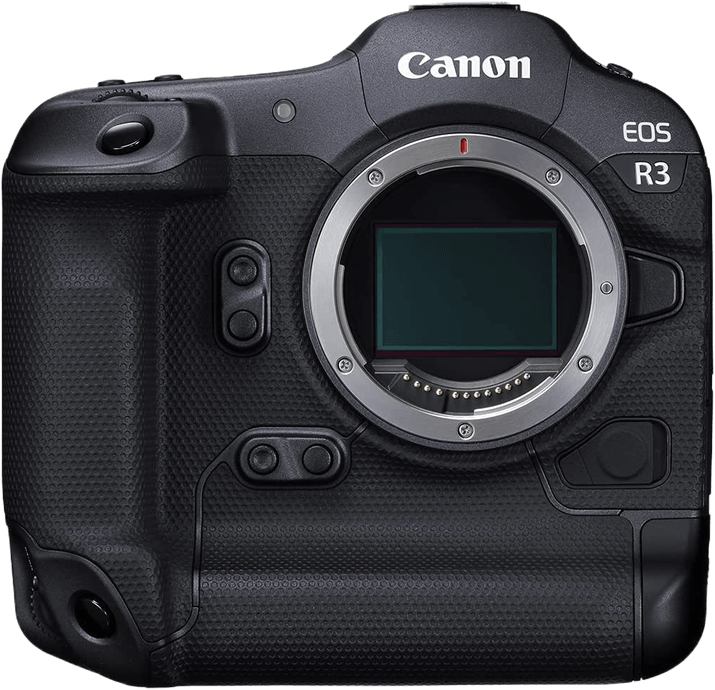
- Resolution
- 24 MP
- Sensor
- Full Frame
- Video
- 6K
- Weight
- 1015 g
Highlights
- A high frame rate of 30 fps
- Less noise with BSI stacked sensor
- 8 stops of image stabilization
- 6K / 60p RAW video
- 620-shot battery life
Trade-Offs
- Relatively expensive
- Low-resolution for some photographers
- No 8K video
- Slowed frame rate with an SD card or low battery
Canon EOS R5
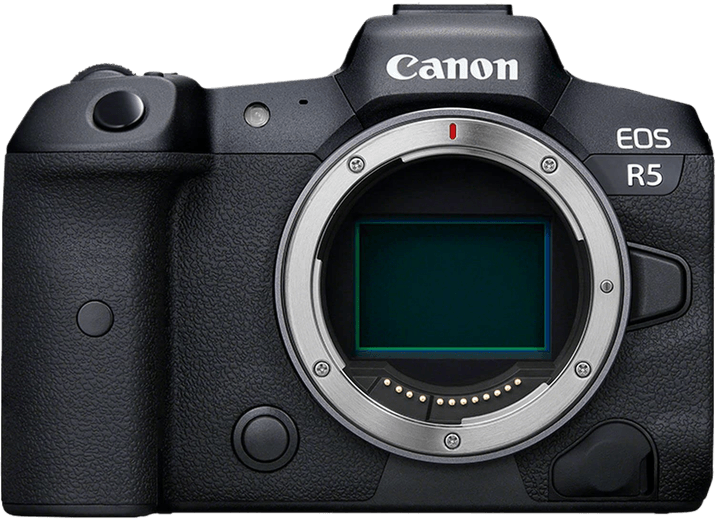
- Resolution
- 45 MP
- Sensor
- Full Frame
- Video
- 8K
- Weight
- 680 g
Highlights
- Large 45 MP sensor
- High frame rate of 20 fps
- In-Body Image Stabilization (IBIS)
- Body, face, eye, and animal tracking
- 8K/30p Ultra HD video
Trade-Offs
- Expensive
- Complicated autofocus setup
- Noise reduction applied to RAW files
- Hard to customize
- Overheats shooting video
Canon EOS R6
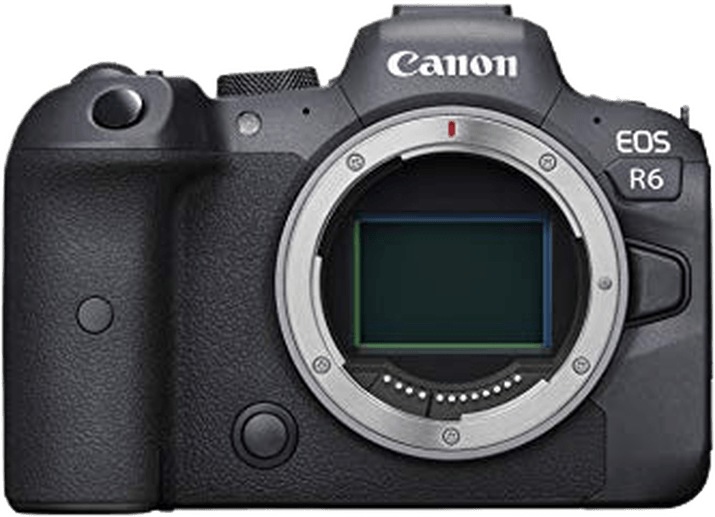
- Resolution
- 20.1 MP
- Sensor
- Full Frame
- Video
- 4K
- Weight
- 680 g
Highlights
- Up to 20 fps burst shooting
- In-body stabilisation reduces camera shake
- Flip screen eases awkward shooting angles
- Two card slots for flexible storage
- Weather sealing against dust and moisture
Trade-Offs
- Low megapixel count compared to closest competitors
- Interface is challenging to navigate
- EVF drains the battery
- Camera heats up shooting 4K / 60 fps
Canon EOS 1D X Mark III
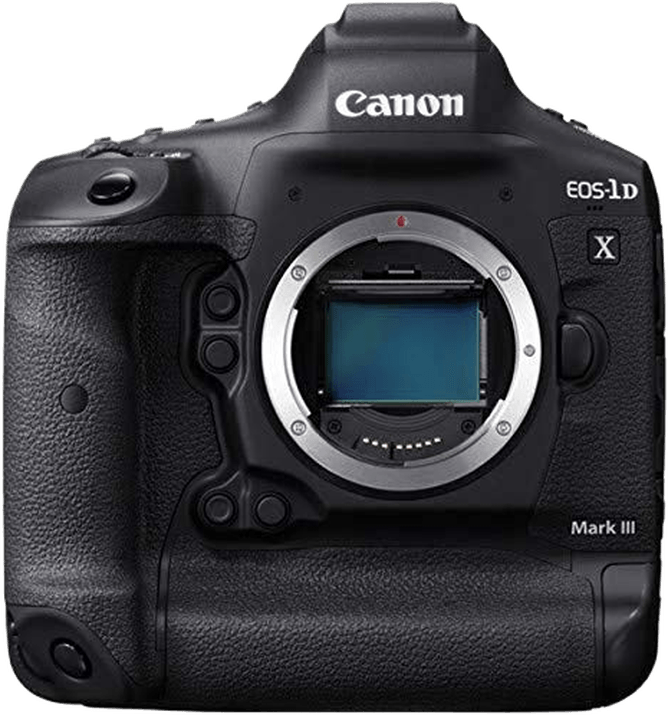
- Resolution
- 20.1 MP
- Sensor
- Full Frame
- Video
- 4K
- Weight
- 738 g
Highlights
- Excellent low-light capabilities
- Dual Pixel AF and AI detection
- Fantastic buffer for continuous shots
- High frame rate for video recording
- Great battery life
Trade-Offs
- Relatively expensive
- Lower megapixel count than closest competitors
- No in-body image stabilization
- A heavy camera body
Canon EOS 5D Mark IV
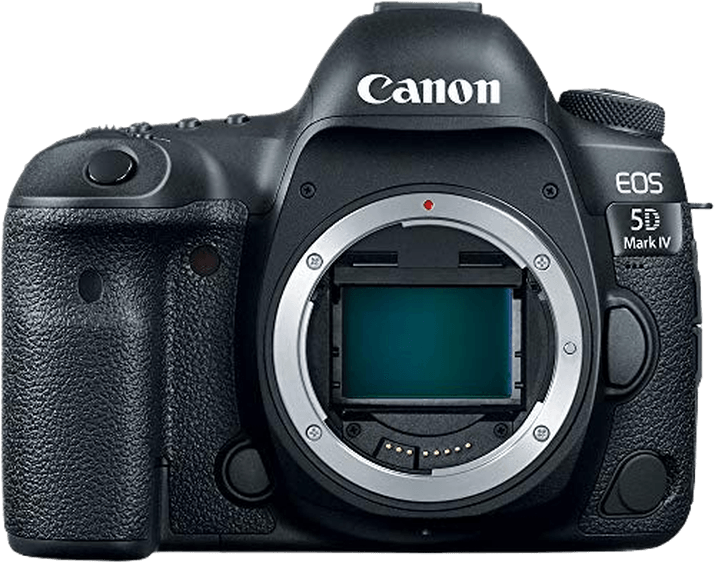
- Resolution
- 30.4 MP
- Sensor
- Full Frame
- Video
- 4K
- Weight
- 890 g
Highlights
- Quality sensor produces detailed and vibrant images even at high ISOs
- Dual Pixel AF with eye detection
- User-friendly touch-to-focus screen
- 900-shot battery life
- Cinema-quality (DCI) 4K video
Trade-Offs
- Unreliable, imprecise subject tracking
- Limited dynamic range
- No in-body stabilization
- No bluetooth
- 64x crop factor with 4K video
Canon EOS 90D
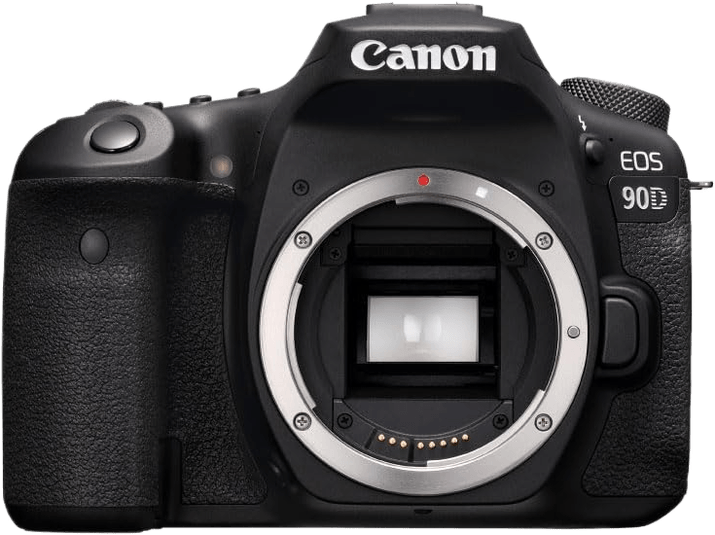
- Resolution
- 33 MP
- Sensor
- APS-C
- Video
- 4K
- Weight
- 701 g
Highlights
- Excellent 32.5 MP APS-C sensor
- Dual Pixel AF with eye detection
- Decent frame rate of 10 fps
- Good, 1,300-shot battery life
- Live View and 4K/30p Ultra HD video
Trade-Offs
- Unreliable autofocus when using the optical viewfinder
- 4K video has a soft focus
- No in-body image stabilization
- Limited video codecs and frame rates
Canon EOS 6D Mark II
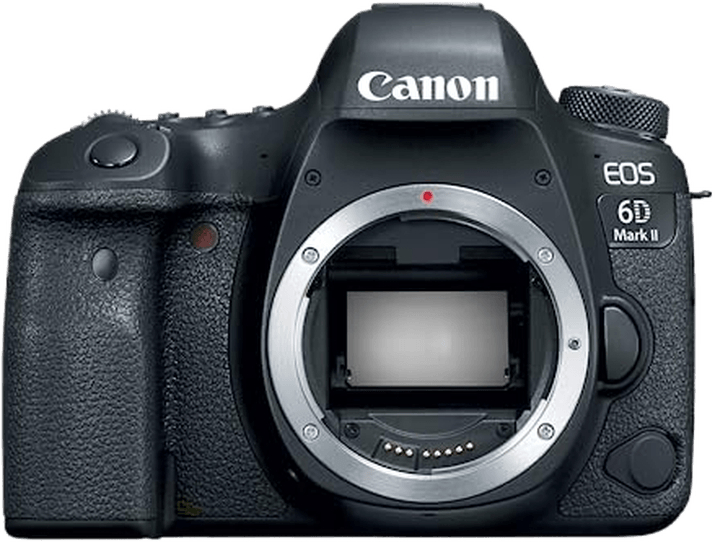
- Resolution
- 26.2 MP
- Sensor
- Full Frame
- Video
- Full HD
- Weight
- 453 g
Highlights
- Fantastic image quality
- Impressive 45-point AF system
- Built well and nice to handle
- Handy built-in Wi-Fi and GPS
Trade-Offs
- Low dynamic range
- Relatively limited video capabilities
- Only one memory card slot
- No USB charging
Canon EOS 5DS
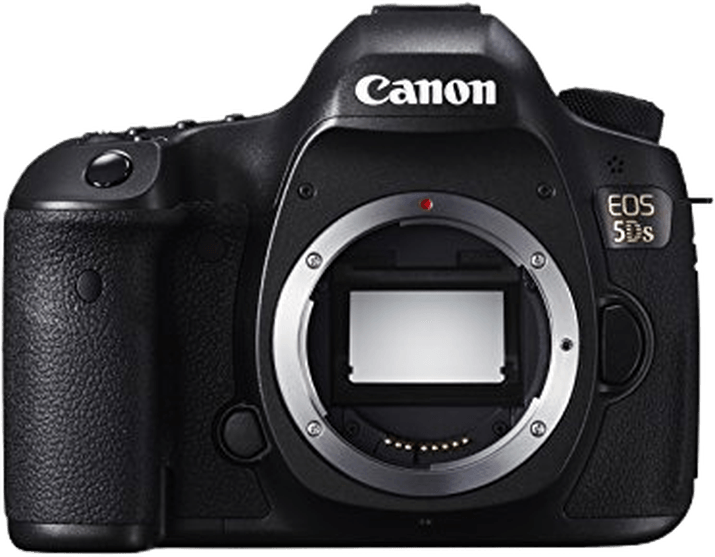
- Resolution
- 50.6 MP
- Sensor
- Full Frame
- Video
- Full HD
- Weight
- 930 g
Highlights
- High resolution
- Anti-flicker mode
- Time-lapse photography
- Fine Detail Picture Control
- LCD graphic overlays in viewfinder
Trade-Offs
- Low frame rate
- Few autofocus points
- No 4K video
- Limited battery life
- No in-built image stabilization
Canon EOS Rebel T8i / 850D
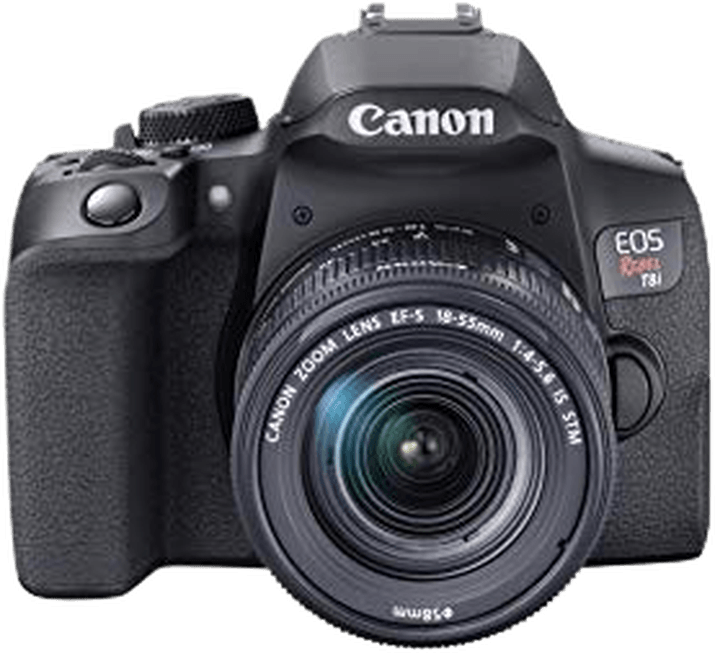
- Resolution
- 24 MP
- Sensor
- APS-C
- Video
- 4K
- Weight
- 515 g
Highlights
- Excellent image quality
- Face and eye-detection AF
- Great ISO range and low-light performance
- 4K/25p and Full HD/120p video
- Webcam functionality and remote shooting with smartphone
Trade-Offs
- Fiddly control dials
- Less reliable AF in video mode
- Small optical viewfinder display
- Cropped 4K video
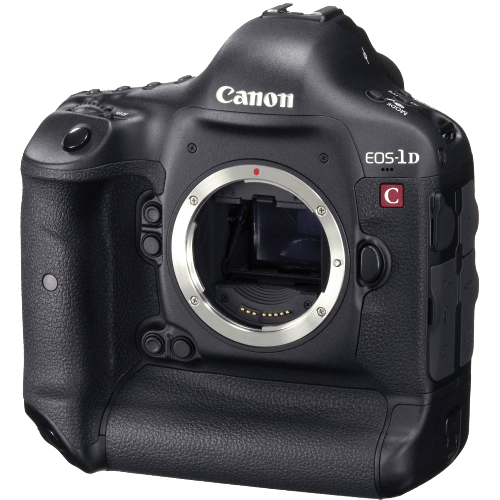
Canon 1D C
- Resolution
- 18 MP
- Sensor
- Full Frame
- Video
- 4K
- Weight
- 1545 g
Highlights
- A high frame rate
- A fast shutter speed
- Excellent 4K video
- An integrated grip
- Weather sealing
Trade-Offs
- A low sensor resolution
- No sensor-shift image stabilization
- A heavy camera body
- No fully articulating touch screen
- No wireless connection
However, the technology has advanced so much that the best Canon camera for sports photography has to be the best mirrorless camera. That means the R3—or the R5—if you can’t do without the larger sensor!
Best Sports Photography Camera Buying Guide
Shutter speed, frame rate, buffer size, and autofocus capability are vital in choosing the best sports camera. But why? Let’s understand a bit more about each to appreciate them. You’ll see why they’re at the top of the list when deciding on the best camera for sports photography.
The first and most obvious observation is that action on a sports field happens fast—very fast! Imagine a home run in baseball, a touchdown in American football, or a goal in soccer.
They all happen in a matter of seconds. And the crucial moment is often measured in thousandths of a second. That explains why shutter speed, frame rate, and buffer size are so important to sports cameras.

Shutter Speed
If your shutter speed is too slow, you might end up with a blurred shot. This would be no good for the back pages of a newspaper or an online news feed! That means you need a maximum shutter speed of at least 1/4000 s—perhaps more.
A related problem is “rolling shutter effect.” This can be a problem with electronic shutters.
It takes time to read a sensor line-by-line. And that can lead to distortion of fast-moving subjects. For example, a golf club might look twisted at the point of impact… which just looks weird!
Frame Rate and Buffer
If your frame rate is too low, you get fewer chances to capture the “decisive moment.” And you, of course, get fewer shots you can sell.
Fast-moving players and athletes can move a long way in a fraction of a second. That means you must capture as many positions as possible to show every aspect of the action.
Picture editors will make the final decision. But you need to give them the best choice of shots. That might be the quarterback throwing the pass, the wide receiver catching it, or the same player entering the endzone.
If your buffer size is too small, your camera will start slowing down. And it might stop taking pictures altogether!
That’s the worst possible outcome for a sports photographer! If you’re at a sports event to take pictures, you won’t get paid to wait for your buffer to clear.

Autofocus
Another important feature you’re looking for is a fast and efficient autofocus system. It needs to lock on quickly and offer accurate subject tracking. Picture editors are looking for tack-sharp images of the action. They’ll reject anything with too soft a focus.
It’s also worth pointing out that if you’re trying to sell to the national press, you won’t have the option of doing much retouching to the images. Sports photography is a kind of photojournalism. So sports photographers can’t just edit out a player who gets in the way!
Sensor Size
But what about sensor size? Don’t you need to have a high image resolution to get excellent image quality?
Well, it’s nice to be able to crop an image to isolate the main action. And you get more detail from a 50 MP camera than a 20 MP one. However, there’s a trade-off between sensor size on the one hand and dynamic range, buffer limit, and continuous shooting speed on the other.
The greater the number of pixels, the smaller each has to be. So that means they can’t gather as much light. Because a lot of sports photography happens at night or in poorly lit venues, that’s a problem.
The buffer size is a function of the read/write speed of the sensor, the processing engine, and the memory card. More pixels lead to bigger file sizes. So each image takes longer to register.
The frame rate is also affected for the same reason. The longer the camera records one image, the longer it has to wait before it can take the next one.

Mirrorless Camera Features for a Sports Camera
So how does all that affect your camera buying decision? Well, the good news is that mirrorless cameras solve most if not all those problems.
The best mirrorless models have large sensors, fast shutter speeds, high frame rates, big buffers, and eye detection. That means there’s not much of a trade-off left to make!
Mirrorless cameras also have the advantage over DSLRs in that their focus points cover most, if not all, of the frame. That means you’re far more likely able to follow fast-moving action and get the composition you want.
Finally, electronic shutters are often susceptible to rolling shutter effect. However, the much-improved readout speeds of the modern generation of mirrorless cameras make that much less of a problem.
Still undecided? Check out our Canon R7 vs R10 comparison or our new post on the best cameras for skateboarding next!

