
Laowa 8-15mm f/2.8 FF Zoom Fisheye
Laowa · 8–15 mm · f/2.8
Score Breakdown
Scores combine our editorial testing with published lab data.
General | |
|---|---|
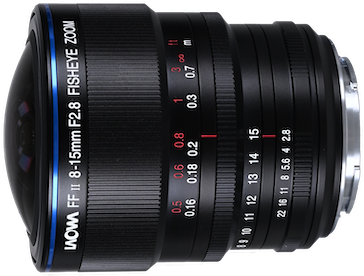
About This LensThis zoom fisheye gives a full-frame photographer direct control over how strongly the lens bends a scene. At 8mm the curvature is extreme; at 15mm it reads far gentler. That suits interiors, architecture, dramatic skies and any subject placed close to the camera. It comes in Nikon Z, Canon RF, Leica L and Sony E versions, each covering full frame. Choose the version made for your camera. Laowa launched the design in 2025, and it remains in production. The main trade-off is that everything is manual. You focus and zoom by hand, and there is no autofocus to fall back on. | |
| Brand | Laowa |
| Release Year | 2025 |
Lens Mount ⓘThe lens mount will tell you what type of lens range you can fit onto the camera body. Often the same camera company will have different lens ranges for different cameras. | Sony E |
System ⓘIndicates which camera system the lens is designed to attach to. | Sony E |
Maximum Format ⓘLargest sensor size compatible with the lens. |  Full Frame Full Frame |
Physical57/100 | |
About the BuildThe lens weighs 1 lb 6.9 oz (650 g). The Nikon Z version measures 3.72 in (94.5 mm) across and 3.01 in (76.4 mm) long; other mounts differ. The front takes no screw-in filter, so adjust exposure and effects at the camera or in editing. Its physical specification score is 57 out of 100. | |
| Lens Weight | 650 g |
Lens Diameter ⓘWidth of the lens at its widest point | 76.4 mm |
Lens Length ⓘHow long the lens is from front to back. | 94.5 mm |
Front Filter Compatible ⓘSome lenses are compatible with front filters, some are compatible with back filters and some are compatible with both. Front filters are usually more convenient to add and remove. | No |
Optics67/100 | |
About the OpticsAt 8mm, curved lines dominate: ceilings sweep overhead and walls bow outward around a foreground subject. Zoom to 15mm and the same room reads calmer, with gentler curvature that still keeps a wrapping view. Choosing between them becomes a framing decision rather than a fixed look. The f/2.8 maximum stays constant through the zoom, so brightness and exposure hold steady while you change focal length. That helps in dim interiors, and it keeps the aperture usable for night-sky frames across the range. It focuses as close as 0.5 ft (16 cm), which pairs well with the fisheye view. A nearby subject looms while the scene wraps around it, stretching perspective for effect. The lens also reaches 0.23x magnification, so small subjects can fill a large part of the frame. Manual focusing stays manageable at these lengths because depth of field runs deep, especially at 8mm. Set focus roughly and check the ring; most of the scene usually stays sharp. Nine aperture blades keep stopped-down highlights round and even. | |
Focal Range ⓘShortest to longest focal length of the lens (zoom range start - end ) | 8–15 mm |
Aperture Range ⓘLargest aperture at the lens's shortest focal length to longest focal length (aperture range start - end) | 2.8 |
| Focal Length Angle of View | 180°–175° |
Flange Focal Distance ⓘDistance from lens mount to sensor. | 18 mm |
Diaphragm Type ⓘStructure and design of the aperture |  Manual Manual |
Blades ⓘNumber of diaphragm blades in aperture | 9020 |
Zoom Lens ⓘZoom allows you to vary the focal length, change between long shots and close-ups |  Yes Yes |
Zoom Mechanism ⓘSystem enabling zoom function |  Manual Manual |
Zoom Ring ⓘIf zooming is adjusted using a zoom ring |  Yes Yes |
Zoom Type ⓘThe design or approach to zooming |  Rotary Rotary |
Closest Focusing Distance ⓘMinimum distance for a subject to be in focus. | 16 cm01500 |
Maximum Magnification ⓘLargest size a subject can be reproduced | 0.23x |
| Autofocus Mode | No |
| Manual Mode |  Yes Yes |
| Manual Focusing Ring |  Yes Yes |
Features | |
About the FeaturesThere is no image stabilisation in any version. Wide 8–15mm views tolerate slow handheld shutter speeds, but dim interiors and night scenes may still call for a steady hold or a tripod. For tripod work such as star scenes, the missing stabilisation matters little. The body carries no weather sealing, so shelter it from rain, spray and dust. There is no fluorine coating either, so the front element needs ordinary cleaning care. The rotary zoom ring works manually and has no lock. Nothing holds the ring in place, so re-check your focal setting after moving between shots. | |
Weather Sealing ⓘWeather sealing capabilities will give you more confidence when shooting in unfavourable conditions. | No |
Fluorine Coating ⓘCoating to repel water and oil from lens elements. | No |
| Built In Lens Hood | No |
Zoom Lock ⓘZoom lock allows the zoom ring to be locked at the desired focal length | No |
Teleconverter ⓘA teleconverter (extender) is an extra piece of equipment that fits between the lens and the camera body to enhance magnification | No |
| Image Stabilization | No |
Construction54/100 | |
About the ConstructionThe Nikon Z version includes four low-dispersion elements within its thirteen-element, nine-group build. Low-dispersion glass helps reduce chromatic aberration, where colours focus at different points and leave coloured fringes along high-contrast edges. Fringing tends to appear on subjects like branches against a bright sky. Other mount versions differ in their glass, so these details apply only to Nikon Z. Its construction specification score is 54 out of 100. | |
Elements ⓘLens elements refer to individual pieces of glass within the lens. | 13 |
| Groups | 9 |
Aspherical Elements ⓘThe number of aspherical lens elements which can help correct aberrations such as spherical aberration. | 2 |
Bi Aspherical Elements ⓘElements with two non-spherical surfaces | 0 |
Low Dispersion ⓘElements that reduce chromatic aberration | 4 |
Super Low Dispersion ⓘAdvanced elements further reducing chromatic aberration | 0 |
CA Reduction ⓘBuilt-in features to reduce chromatic aberration | 0 |
Internal Focusing ⓘInternal Focusing means that the lens does not change in size during focusing, and the front element does not rotate. | No |